





Table of Contents
To choose a printer for rigid board, you first need to identify the board you will print on, then compare two architectures: flatbed UV and single pass. The right choice then depends on the thicknesses actually accepted, the net throughput, and the full cost, from the listed prices down to the cost per saleable package.
Flatbed UV or Single Pass for Rigid Board?
Both technologies rely on inkjet printing, but they move different elements. On a flatbed UV table, the print head moves over a stationary plate. With single pass, the board moves under fixed print heads. Choosing the right printer therefore depends as much on how you load your parts as on your volumes.
How a Flatbed UV Printer Works
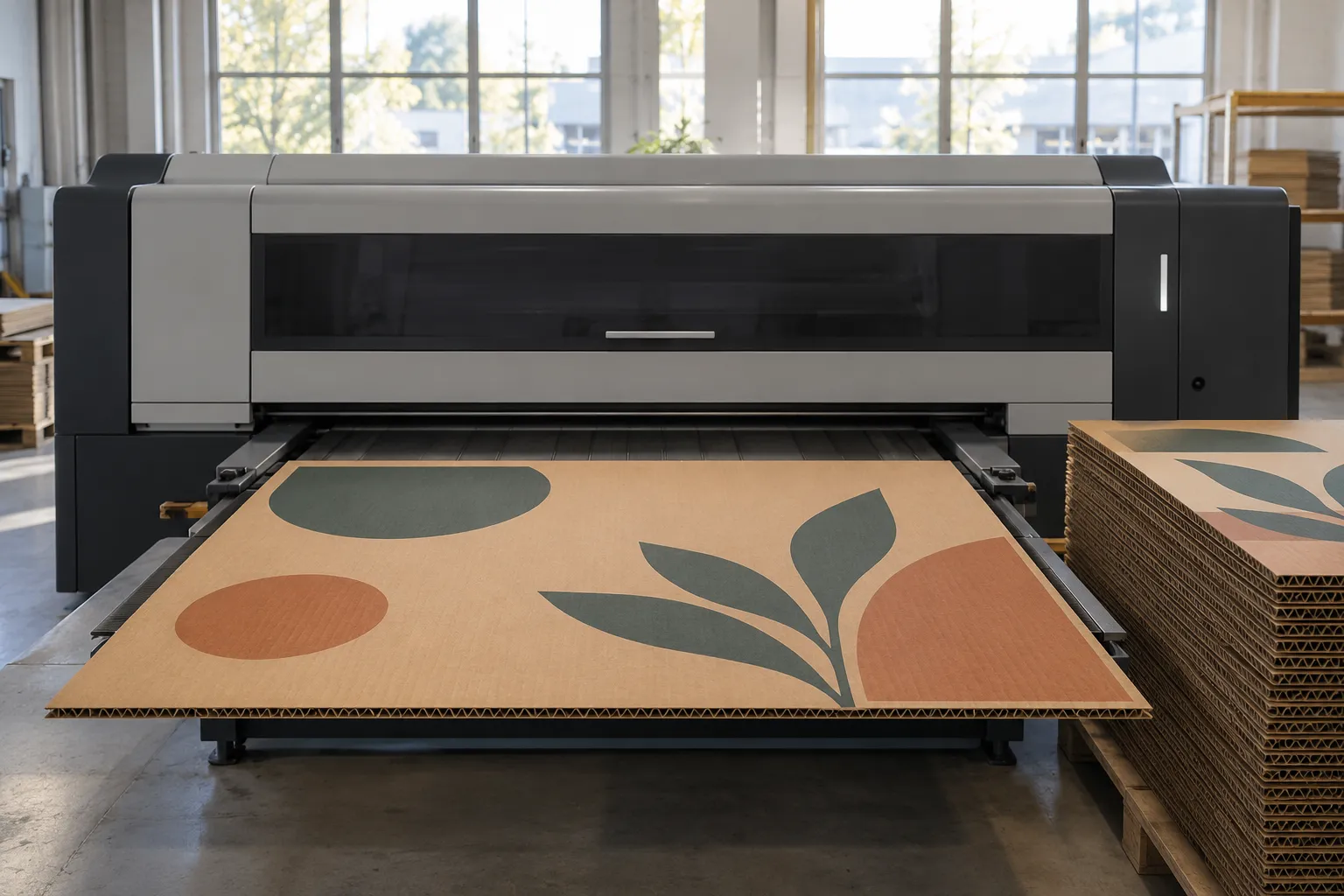
On a flatbed UV printer, the plate stays still on a table, often held in place by vacuum. A carriage deposits the ink over several back-and-forth passes, then an ultraviolet light source cures it, meaning it hardens instantly.
This architecture handles parts that a fast conveyor cannot handle well. It is therefore the preferred option when your production matches one of the following cases:
- Prototypes : validation d’un visuel ou d’une découpe avant le lancement d’une série.
- Séries courtes : petites quantités pour lesquelles la mise en route d’une ligne ne se justifie pas.
- Nombreuses références : changements fréquents de fichier sans outillage à remplacer.
- Plaques difficiles à convoyer : panneaux rigides qui passent mal dans un convoyeur rapide.
Once the ink is cured, its adhesion depends on the ink, the surface condition, any surface preparation, and the UV dose received. A surface that looks dry does not prove its final resistance, so check it after it has stabilized.
How a Single Pass Printer Works
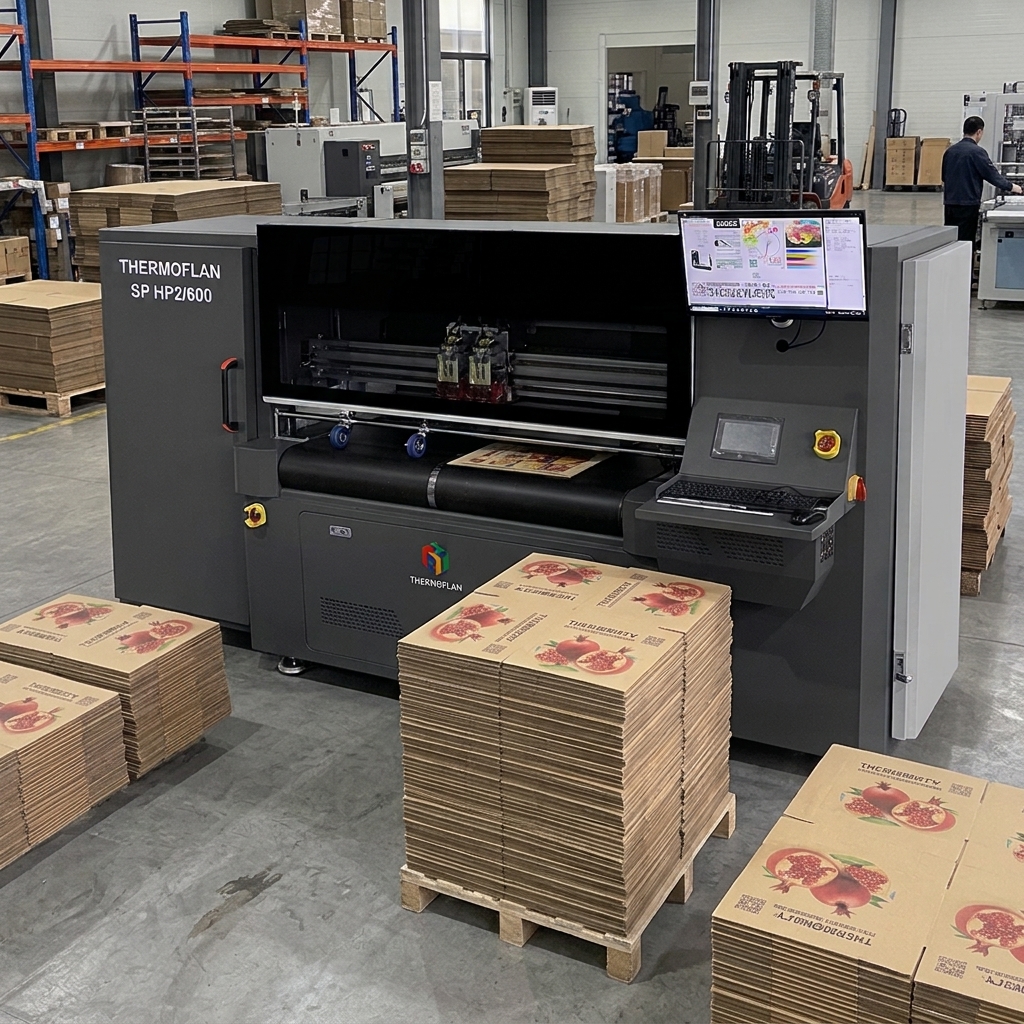
In single pass, the carton moves under a row of fixed heads and receives the entire image in one pass, without carriage back-and-forth. This architecture favors throughput, provided that feeding and conveying keep up. Thermoflan offers a range of single-pass inkjet printers that print directly onto cardboard and corrugated board, with models suited to different formats and production volumes.
In practice, the hold of the substrate determines quality on the conveyor. On the SP 300, 600, 900, 1200, 1500 and SP 1800, a perforated conveyor belt with suction holds the cartons in place, complemented by adjustable guides. An automatic carton loader is available as an option.
Inks and uses to distinguish
The term “single pass” describes an architecture, not an ink type: a press of this kind can use a UV or water-based process. The SP 300, 600 … and SP1800 thus use water-based inks. On cardboard, this process requires controlling absorption, drying and the risk of warping. Moreover, a UV printer does not become water-based simply by changing consumables.
Because digital printing is done without plates, it allows graphic customization and variable data. Continuous inkjet and laser, on the other hand, are mainly used for coding: dates, batch numbers or references. They do not replace a graphic inkjet printer covering the entire surface of a package.
Which cartons and which thicknesses are actually accepted?
A technical datasheet gives limits, but your carton sets the real constraints. Before comparing a printer’s specifications, precisely qualify the substrate, then check it against the stated capabilities. Then check the surface and how the image holds up after conversion.
Identify the board and its basis weight
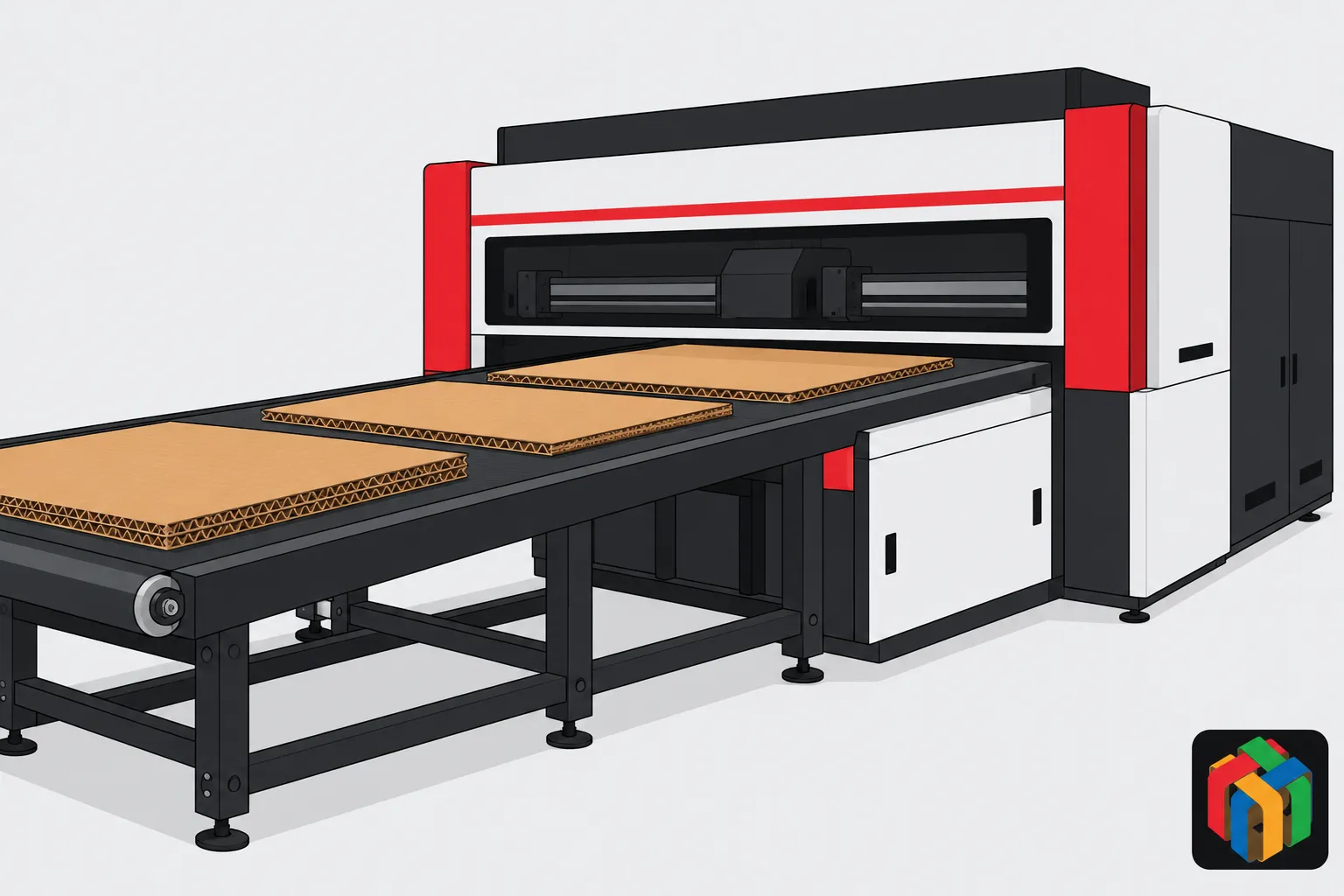
The term “rigid board” covers several packaging materials that do not impose the same printing constraints. Before consulting us, specify which of these substrates matches your production:
- Carton compact : étuis et boîtes pliantes.
- Carton ondulé : caisses, emballages de transport et présentoirs.
- Carton contrecollé : support revêtu d’un film ou d’un papier de couverture.
- Coffret déjà monté : volume formé, imprimé après assemblage.
For a folding carton or folding box, flat board typically falls around 250 to 500 g/m², depending on the design. This basis weight measures surface mass. It does not alone determine thickness or stiffness, and two boards of the same basis weight can behave differently.
To make your measurements reliable, rely on standards. Standard NF EN ISO 536, February 2020 edition, defines the determination of the grammage of paper and board. In addition, ISO 534:2011 describes the methods for measuring thickness, density and specific volume.
Compare the stated capacities with the actual parts
Thermoflan’s two reference models cover distinct needs. The SP 300 accepts up to 150 mm of thickness, for a printable width of 300 mm. By contrast, the single pass SP 1800 printer prints across a width of 1,800 mm, but limits thickness to 80 mm.
The difference lies in width rather than thickness. A declared maximum thickness remains a mechanical limit, not a guarantee of quality. Therefore, check the effective free height, the fixing, the tolerances and the flatness on your actual board, both flat and on the conveyor.
Caractéristique SP 300 SP 1800 Largeur imprimable maximale 300 mm 1 800 mm Largeur de support maximale 680 mm 2 500 mm Épaisseur de support maximale 150 mm 80 mmCheck the surface and its durability after conversion
On corrugated cardboard boxes, the thickness depends on the flute: about 0.6 mm for F flute, 4 mm for C and 5 mm for A. Five-layer structures can reach 8 mm. Warping, dust, or crushed flutes can then disrupt printing. Other substrates require specific checks:
- Carton compact non couché : absorption, étalement des gouttes et régularité des aplats.
- Carton compact couché : mouillage, adhérence, résistance aux rayures et tenue au pli.
- Contrecollé ou coffret formé : relief, déformation, maintien de la pièce et zones masquées.
Once the plate is printed, the packaging box still goes through several operations. The image must withstand creasing, die-cutting, gluing and stacking. So test your samples all the way to the finished box, not just flat.
What net throughput can you expect from each technology?
The productivity of a digital printing machine cannot be judged by its maximum speed. What matters is the number of compliant cartons produced in a given time. The factors that slow this throughput differ depending on whether you work with flatbed UV or single pass.
Measure compliant cartons rather than nominal speed
A speed expressed in m²/h, m/min or sheets per hour cannot be directly compared with other units. You need to know the format, the layout of the pieces, the number of passes and the yield. Moreover, the advertised maximum speed may correspond to a different mode than the commercial quality you are aiming for.
So calculate the net throughput: number of compliant plates divided by the total measured time, including stops and waste. A valid comparison keeps the same substrate, the same file, the same ink coverage, the same quality mode and the same counting rules.
What slows down flatbed UV
On a flatbed UV table, the number of passes, the resolution and any white or varnish layers lengthen printing time. Added to this is the time for loading, positioning and unloading the plates, whose weight increases in short runs and during changeovers between references.
To judge this trade-off between speed and quality, prepare a test file containing small text, codes, solid areas, gradients and brand colours. Evaluate their legibility and rendering on the final carton, then again after finishing.
What determines single pass throughput
For the SP 300 and SP 1500, Thermoflan specifies speeds of 5, 15 and 30 m/min. The announced resolutions are 1,200 × 300, 1,200 × 600 and 1,200 × 1,200 dpi. In practice, test the chosen mode at the required quality, as high resolution is only useful if the packaging justifies it. Actual throughput also depends on the line surrounding the printer:
- Alimentation : régularité de l’arrivée des cartons sous les têtes.
- Convoyage : maintien et stabilité du support pendant le passage.
- Empileur : capacité à évacuer les cartons au rythme de l’impression.
- Synchronisation : coordination des équipements amont et aval.
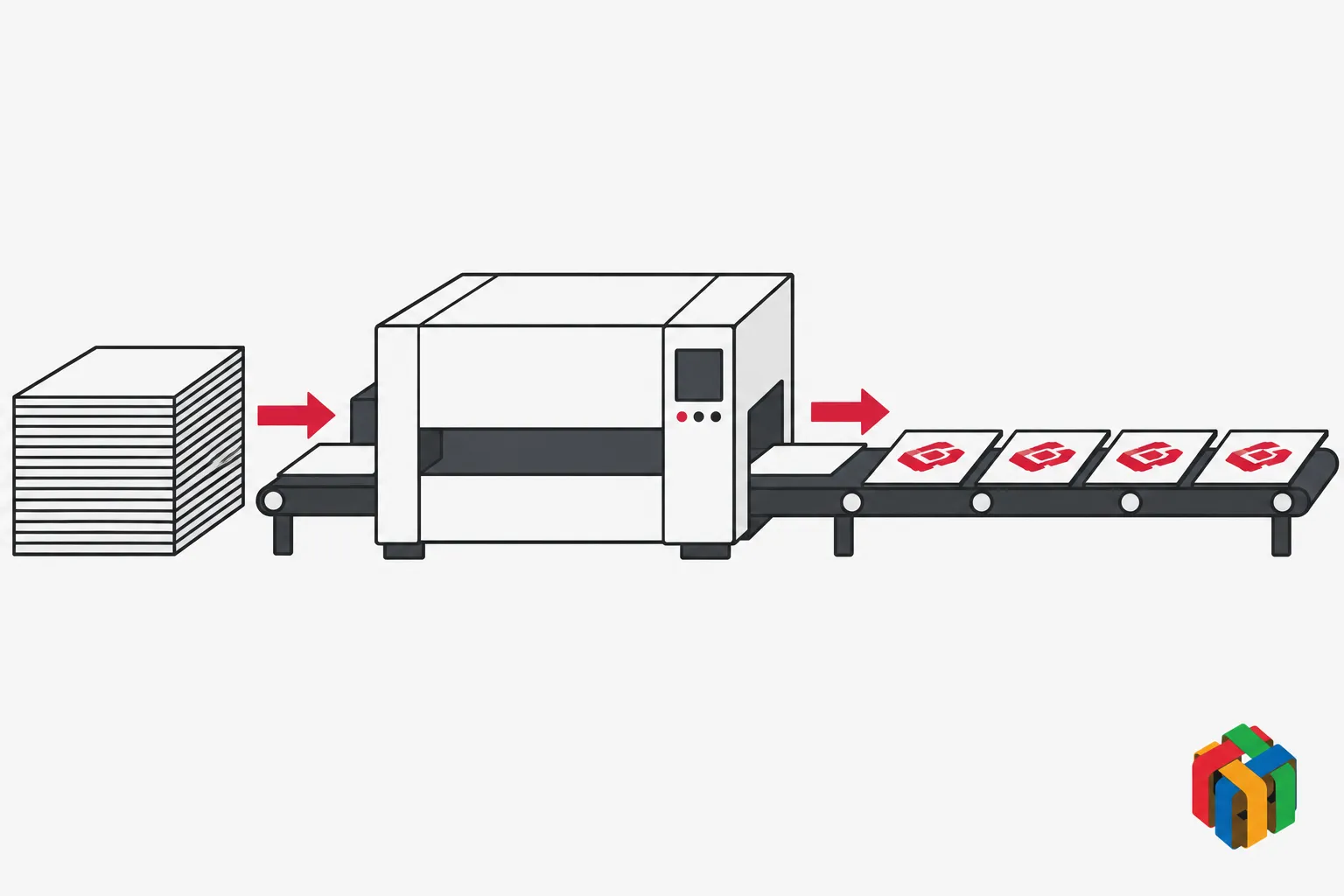
On the compact SP 300 single pass printer, as on the SP 1500, the automatic feeder mentioned above conveys cartons from a stack. During a representative trial, record separately the start-up, changeovers, feeding or stacking stoppages, cleaning, scrap and operator interventions.
What is the real cost and what is the break-even point?
The price of a printing machine is only the starting point of the calculation. To compare two pieces of equipment, bring the investment and operating costs back to the cost of a saleable package. Then factor in trials, maintenance and the risks associated with operation.
Advertised prices and full investment
Thermoflan advertises the SP 300 from €32,250 and the SP 1500 from €143,800. These entry prices do not constitute a quote for an installed configuration. The full cost covers acquisition, installation, industrial ink and other consumables, maintenance, energy, labour, scrap and downtime. The configuration to be priced depends on the following criteria:
- Largeur et format : dimensions des cartons à imprimer.
- Épaisseur des supports : de la feuille compacte au panneau ondulé.
- Couleurs et blanc : nombre de canaux et besoin d’une sous-couche.
- Automatisation et cadence nette : niveau d’alimentation et débit recherché.
An oversized configuration then weighs on depreciation: calculate your actual format before choosing.
Calculate the cost per saleable package
The unit cost must include setup, changeovers, consumption, waste and post-printing operations, up to the saleable package. A faster machine loses its advantage if its changeovers immobilize the line.
No production volume makes single pass universally more profitable than flatbed UV. Instead, build scenarios of 100, 1,000 and 10,000 packages using your own references, so you can compare your company’s actual costs.
In these scenarios, relate ink consumption to the area actually printed and to the file used. The theoretical sheet area skews the calculation as soon as coverage remains partial.
Factor in trials, maintenance and operational risks
Set your acceptance criteria before the trial on real cartons: colour, legibility, positioning, adhesion and resistance after conversion. Availability is then assessed over a defined period, based on breakdowns, cleanings, nozzle checks, intervention times and the availability of parts in France. Finally, articles R. 4412-6 and R. 4412-7 of the French Labour Code require a chemical risk assessment covering all activities, including servicing and maintenance.

Single pass printer for your rigid cartons
From the SP 300 to the SP 1800, compare Thermoflan single pass printers for direct printing on your cardboard packaging.
Frequently asked questions
Should you print directly onto a rigid box or use a decor paper?
Both approaches are possible. A decor paper can be printed separately, then laminated or applied onto the structure. To print an already formed box, check the available height, masked areas, how the object is held, and the risk of collision with the carriage.
What is the difference between pre-print and post-print for corrugated board?
Pre-printing prints the coating before it passes through the corrugator. Post-printing, by contrast, prints directly onto the corrugated board once it is already formed.
How do you get accurate colors on kraft board?
An opaque white can serve as a base for colors on brown or tinted board. Only UV printing can deposit a white undercoat. Then check its opacity, ink consumption, and curing. An identical CMYK value does not guarantee the same brand color on two machines or two boards: evaluate solids, gradients, neutral greys, and repeatability on the final substrate.