



Contents
- What is a single pass digital printer?
- How does printing work on a packaging line?
- Which packaging is single pass suitable for?
- How to choose and qualify a single pass printer?
- Frequently asked questions
A single pass digital printer prints a package in one pass under fixed inkjet heads, without any plate or printing cylinder. You will see how it works on a production line, which packaging it can handle, how it compares with flexography and offset, and which criteria to check when qualifying a machine on your own boxes.
What is a single pass digital printer?
A single pass printer applies its design while the substrate moves once under the heads. This principle distinguishes it from scanning machines. It also brings digital control to what forme-based processes lock into tooling.
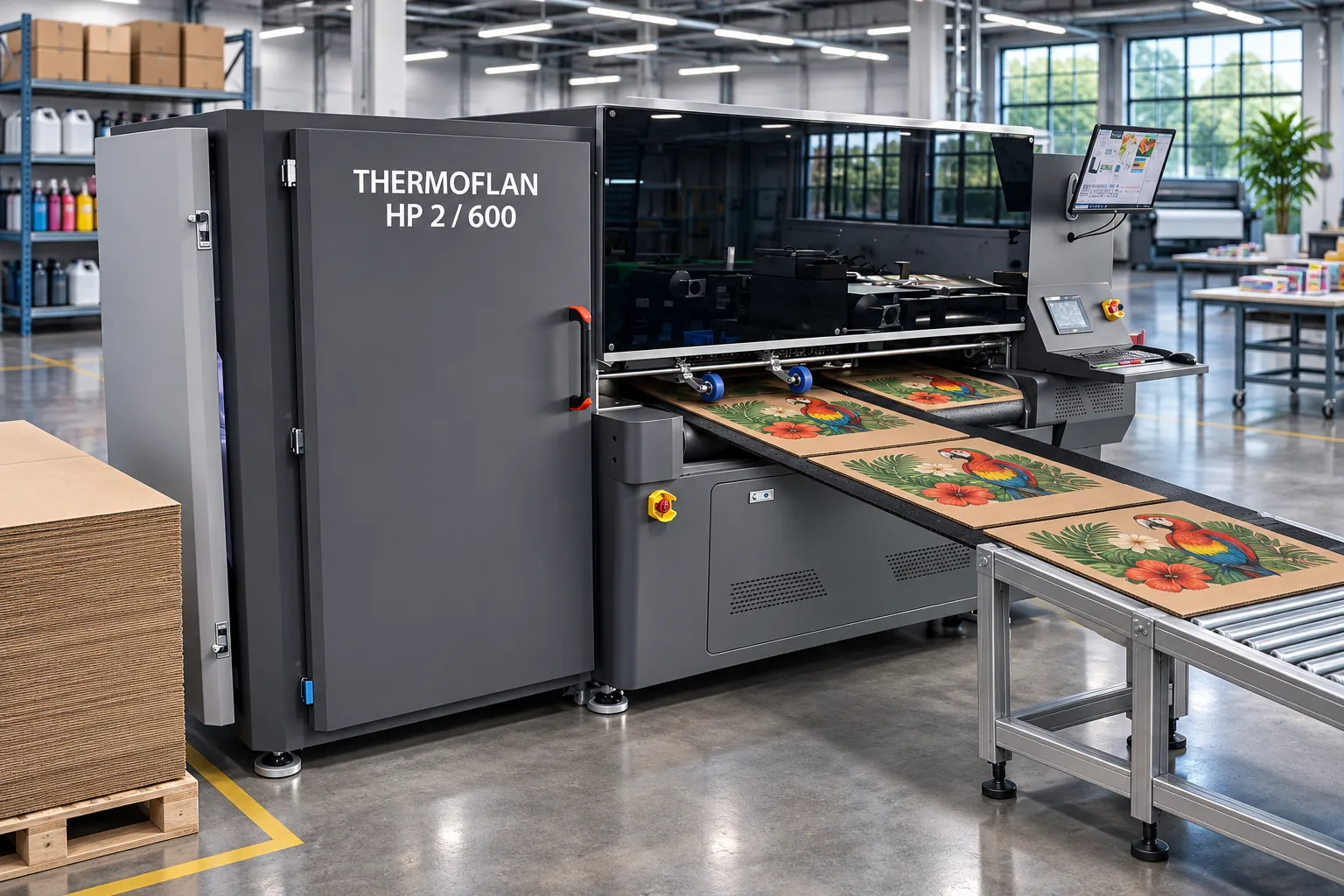
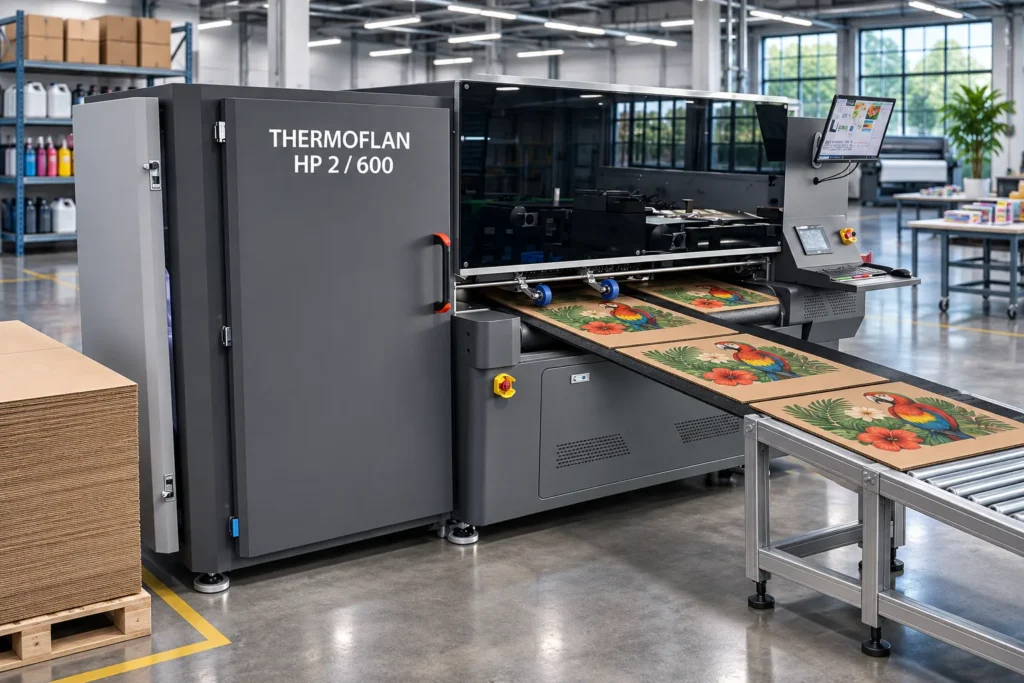
The single pass principle
The inkjet heads remain fixed and cover the entire printable width. Once the substrate is engaged, their nozzles spray ink droplets directly onto the material: no plate is pressed against the corrugated board. The term “onepass,” synonymous with single pass, refers only to this printing kinematics.
The difference from a scanning printer
On a scanning machine, the head moves from left to right above the substrate. In single pass, by contrast, the media (cardboard, envelope, bag, etc.) is carried by the conveyor belt to pass under stationary heads. Industrial inkjet heads can be thermal or piezoelectric, but neither of these technologies alone defines the single pass principle.
In addition, digital printing is controlled by a file, just like a regular printer. Conventional processes, on the other hand, require preparing a plate or cylinder before each design. Thermoflan groups these machines in its Single Pass printer range for packaging.
The possibilities of digital control
Single pass can produce a monochrome, multicolor or gradient design. Since no screen or plate needs to be made or set up again, the visual can change from one sheet to the next, which simplifies managing multiple product references. The file can also include variable data such as barcodes, QR codes and serial numbers.
How does printing work on a packaging line?
Passing under the heads is only one stage of the line. Upstream, the file must be prepared and the substrate must be presented correctly. Downstream, the packaging still needs to be packed.
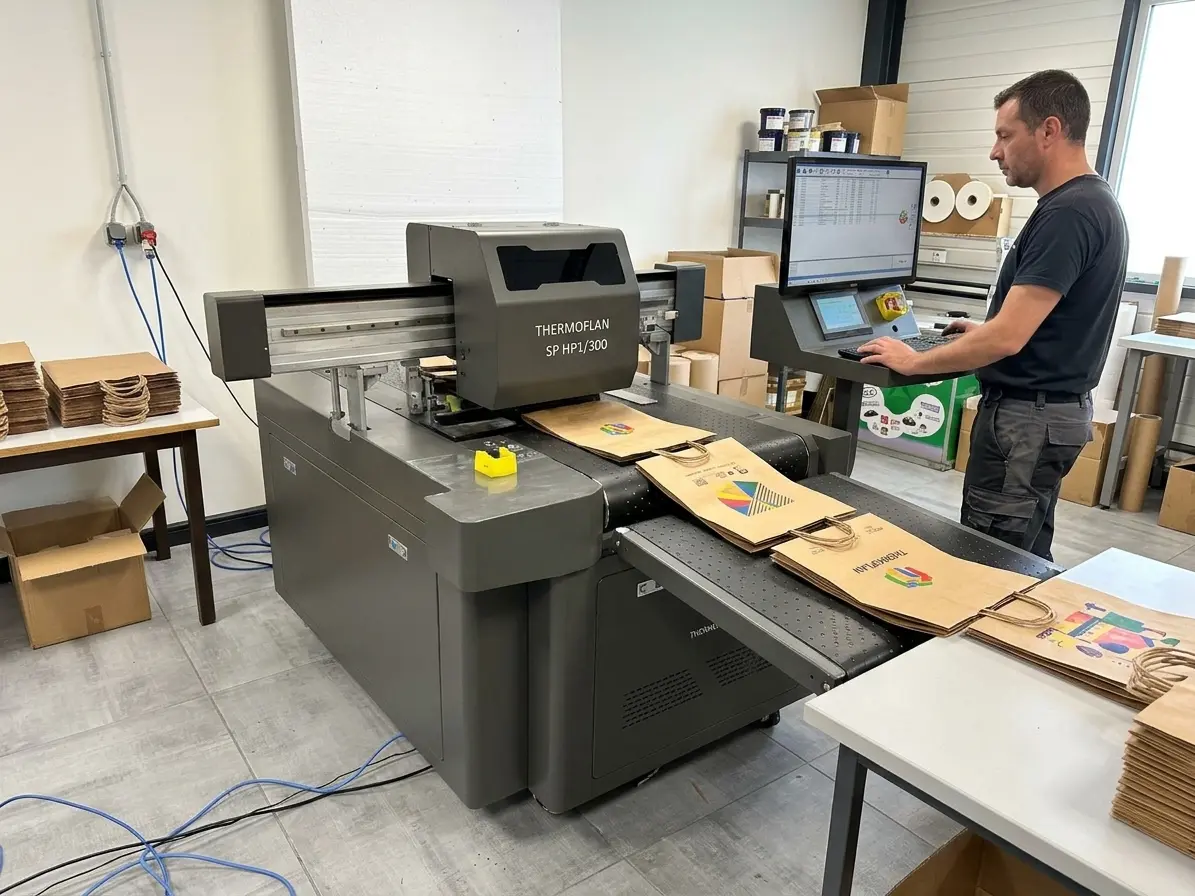
Preparing and feeding the substrate
It all starts with creating or importing the digital file that contains the texts and visuals. Once this file is ready, the substrate enters the line. On a sheet-fed line, feeding involves squaring and registration. On a roll-fed line, it requires checking tension, guiding and splicing.
Before passing under the heads, cleaning the substrate removes impurities that could disrupt printing. Flatness matters just as much. In practice, a warped board can change the distance between the cardboard and the heads: flatten it before starting the run.
Holding and depositing the drops
In the process described by Thermoflan, a perforated conveyor belt holds the substrates by suction. Adjustable mechanical guides then align them. As soon as the substrate is detected, printing starts, and synchronization between its advance and the deposit of droplets ensures print accuracy while limiting blur.
The software complements this mechanical setup. It can adjust image quality and color rendering according to the visual and the substrate.
Drying and converting
In the water-based ink process described by Thermoflan, the water contained in the ink evaporates during drying. However, single pass does not eliminate this step or finishing: cutting, creasing, folding and gluing still need to be done. According to FEFCO, these operations can be carried out inline or separately.
Their volume depends on where the press sits in the plant. In post-print, the design is applied to corrugated board that has already been manufactured. In pre-print, the liner paper is printed on a roll before going to the corrugator.
Which packaging is single pass suitable for?
Single pass covers a wide family of packaging made of cardboard, paper and wood. Its suitability also depends on the structure of your production runs and the processes you compare it with.
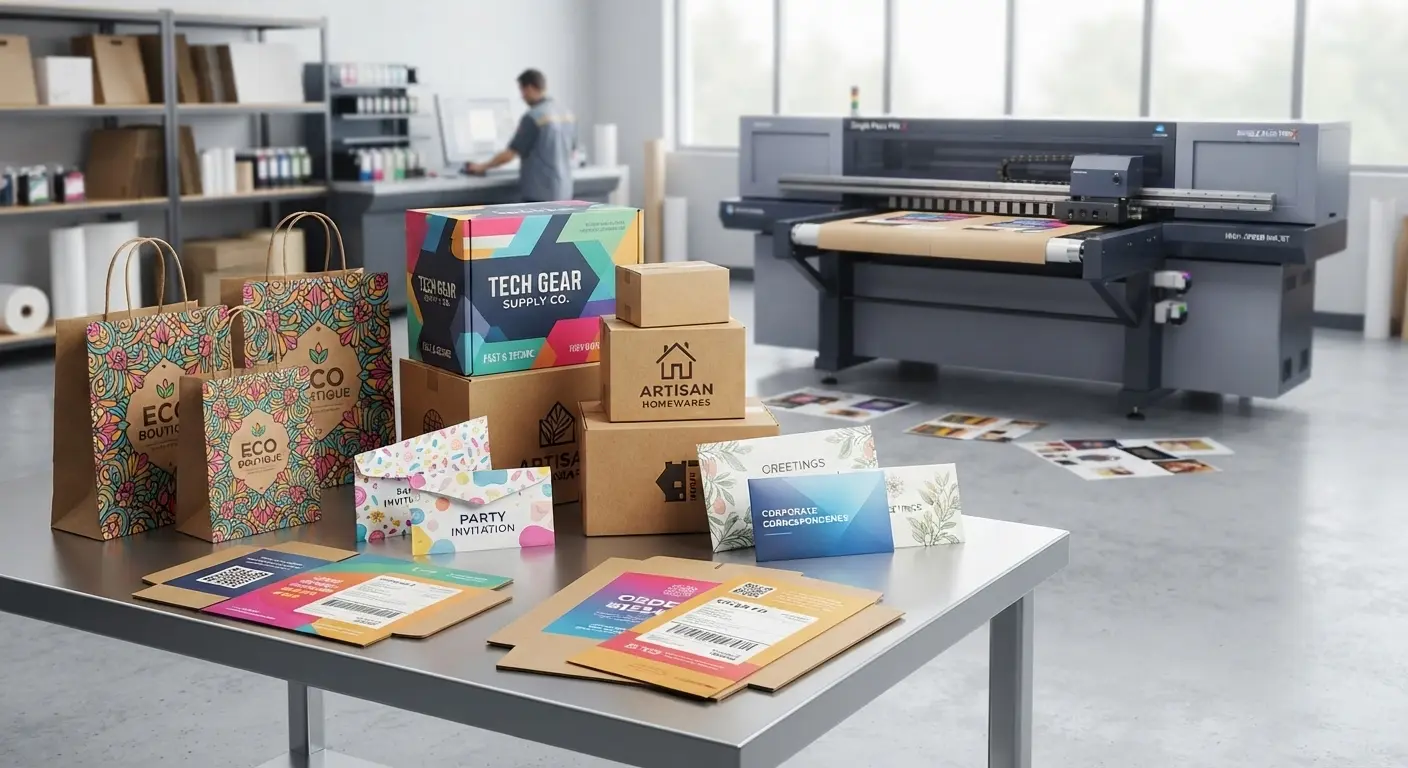
Supports and possible applications
If the substrate, ink and line are compatible, the single pass can print corrugated board, flat board, boxes and paper bags. Thermoflan mentions in particular shipping cartons, pizza boxes, kraft pouches, wooden crates and custom packaging for e-commerce.
Results change from one substrate to another. Coating, absorbency, background colour, dust, flatness and thickness all affect the rendering, ink adhesion and the permissible speed. A brown kraft and a white uncoated board must therefore be qualified separately.
Thermoflan series and equipment
Without a plate, prototypes, short runs and frequent design changes are easier to manage. A single production run can also chain several designs. Thermoflan offers its single pass printers for small, medium or large runs, with the SP 300, SP 600 MINI, SP 600, SP 900, SP 1200, SP 1500 and SP 1800 models.
Among them, the SP 600 prints corrugated board, kraft pouches and other flexible materials. Its optional automatic board loader can make it easier to integrate into a production line.
Positioning against flexography and offset
Flexography, or flexo, is a conventional printing process that uses a flexible raised plate mounted on a cylinder. For packaging, its requirements fall under ISO 12647‑6:2020, which replaced the 2012 edition in September 2020.
Offset also relies on a printing plate and can suit long, stable runs. A press presented for packaging advertises up to 22,000 sheets/hour. Its format, preparation and finishing, however, differ from those of a single pass line.
The difference lies in the runs and versions actually produced, more than in raw speed. Compare digital printing, flexography and offset on your job changeovers, ink, waste and finishing.
How do you choose and qualify a single pass printer?
Choosing a single pass machine means checking its stated data against your substrates, your output rates and the end use of the packaging. Three checks structure this qualification.
Format and quality on the actual substrate
Your specifications set the framework for trials: substrate and feed direction, usable dimensions, solid areas, spot colours, codes to be read, registration tolerances and die-cut layout. The Thermoflan SP 300 has a stated maximum print width of 300 mm. Its resolutions are 1,200 × 300, 1,200 × 600 and 1,200 × 1,200 dpi, though this does not replace a trial at the planned format and speed.
- Sharpness and joins: check the actual sharpness and the joins between heads on each board reference.
- Colour registration: check its stability at production speed.
- Code legibility: test the readability of printed codes on the final substrate.
- Faulty nozzles: observe the effect of a missing nozzle on the run.
On a fixed head, this last defect can run along the entire length of the sheet. Maintenance therefore includes checking, cleaning and calibrating the heads.
Realistically usable output rate
Published speeds are expressed in different units. One post-print configuration advertises up to 5,500 sheets/hour at 1,200 × 600 dpi. It accepts boards from 1 to 8 mm, and its data sheet also cites 1,200 × 1,200 dpi without linking that maximum to it. Others advertise 60 m/min on coated board and up to 120 m/min on uncoated board. Some show 90 linear metres/minute or up to 100 metres/minute. For pre-print on roll, one configuration advertises up to 305 m/min, before corrugation and converting.
For a digital press, only the rate of compliant packaging deliverable per shift matters. That rate depends on the format, sheet spacing and feeding, quality mode and drying. Job changeovers, waste and downstream converting capacity also limit it.
Validating the run and end use
A proof on the final substrate tests the design and, where planned, the die-cutting, creasing and folding-gluing. The operating study also covers inks, any primer or varnish, cleaning, energy and maintenance.
For food packaging, the mention “water-based ink” does not prove suitability for food contact. The DGCCRF requires assessment of the transfer through the printed outer surface and set-off in stacks or rolls. This assessment takes into account the board, the applied layers, the food, and the duration and temperature of use. For the non-food side, Regulation (EC) No 2023/2006 requires migration and set-off to be controlled. In France, the decree of 13 April 2022 prohibits the MOAH and MOSH concerned from 1 January 2023 and has tightened their limits since 1 January 2025.

Qualify a single pass printer for your packaging
Corrugated cartons, boxes, kraft bags: compare Thermoflan single pass printers, from the SP 300 to wide-format models, on your own media.
Frequently asked questions
Which ink should you choose for a packaging single pass printer?
The choice depends on the substrate, the drying method, the required resistance and the end use, since inkjet does not require a single formulation. Thermoflan offers models with water-based inks, which reduce the use of solvents, or with pigment inks. The latter are water-resistant and suit marking that must withstand moisture.
Is a white-coated carton required to print in single pass?
Not always. In aqueous single pass printing on brown board, a digital white can be used. However, a brown kraft liner, a coated white liner and a corrugated board with a thin facing do not necessarily give the same result or the same print adhesion.
Can the loading of cartons on a Thermoflan single pass printer be automated?
Yes, as an option. The SP 300 and SP 600 can take an automatic carton feeder, and the SP 600 MINI an automated system. On the latter, this system aligns the media and limits interruptions as well as the risk of human error.