


Contents
- Which source to choose for engraving steel and stainless steel?
- Which laser engraving machine for your production?
- How much does a steel engraving station cost?
- How can you validate metal engraving before buying?
- How can you secure and comply with the laser station?
- Frequently asked questions
Choosing a laser engraving machine for steel means matching a source, a power level and a station to your actual parts. This choice relies on the differences between fiber, MOPA, UV and CO₂, on power and field benchmarks, on a euro quote for a defined scope, on tests before purchase, and on the safety obligations of the station.
Which source to choose for engraving steel and stainless steel?
The choice of source depends first on the expected result on the part. Thermoflan recommends choosing the technology according to the metal, its surface finish and the result you want: surface contrast or relief. It is therefore necessary to distinguish marking, engraving and cutting before comparing wavelengths.
From laser marking to laser cutting
These three operations do not act on metal in the same way. Laser marking creates visible contrast, whereas engraving removes material. Cutting, on the other hand, separates the part in two.
- Surface marking: it changes the appearance of the metal to create contrast, without significant material removal.
- Black annealing on stainless steel: it colors the surface of the stainless steel without creating a cavity. It guarantees neither abrasion resistance nor corrosion resistance.
- Engraving: it removes metal and produces a measurable depth, sometimes perceptible to the touch.
- Laser cutting: the beam passes through the full thickness of the part to separate the metal.
This distinction protects you from a common purchasing mistake. An engraver capable of removing steel does not prove that it can cut sheet metal. Cutting requires industrial machines designed and sized for that operation.
Conventional fiber laser or MOPA?
A fiber laser typically emits between 1,064 and 1,070 nm. It is the first laser source to evaluate for marking or engraving bare steel and stainless steel directly. A MOPA fiber laser additionally allows wider adjustment of pulse duration and frequency. It is used to seek a contrasting black or certain color effects on stainless steel, with no guaranteed result. A MOPA fiber laser is not necessarily more powerful for all that.
As soon as you run a laser test on carbon steel, check the contrast, depth and oxidation obtained. On anodized aluminum, the laser beam instead modifies the surface layer, without necessarily engraving the underlying metal. This behavior explains why the same setting does not transfer from one metal to another.
UV, CO₂ and diode compared on metals
A UV marking laser typically works at 355 nm. It deserves a test for microtext or for parts that tolerate heating poorly, without being automatically more precise or faster than a fiber laser. By contrast, CO₂ generally works around 10.6 µm and is poorly suited to direct engraving of bare steel. A Thermark paste or spray allows a mark to be created after application and cleaning, but the metal is not engraved in depth.
A visible diode mainly acts on painted or anodized metal. On bare metals, notably reflective copper, brass or titanium, and stainless steel, compatibility must be verified on a sample. In practice, compare the sources in the range of CO₂, fiber and UV laser machines using your own parts, rather than relying on the promise of an “all-surface” machine.
Tip
Choose your source based on the steel and its surface
On bare steel and stainless steel, fiber or MOPA comes first. UV deserves a test, while CO₂ only marks with a marking paste or spray. Start with your actual parts.
Which laser engraving machine for your production?
Once fiber has been chosen, sizing covers three points: power, the working field and the organization of the station. Each one influences the achievable depth, the size of the parts processed and the actual throughput.
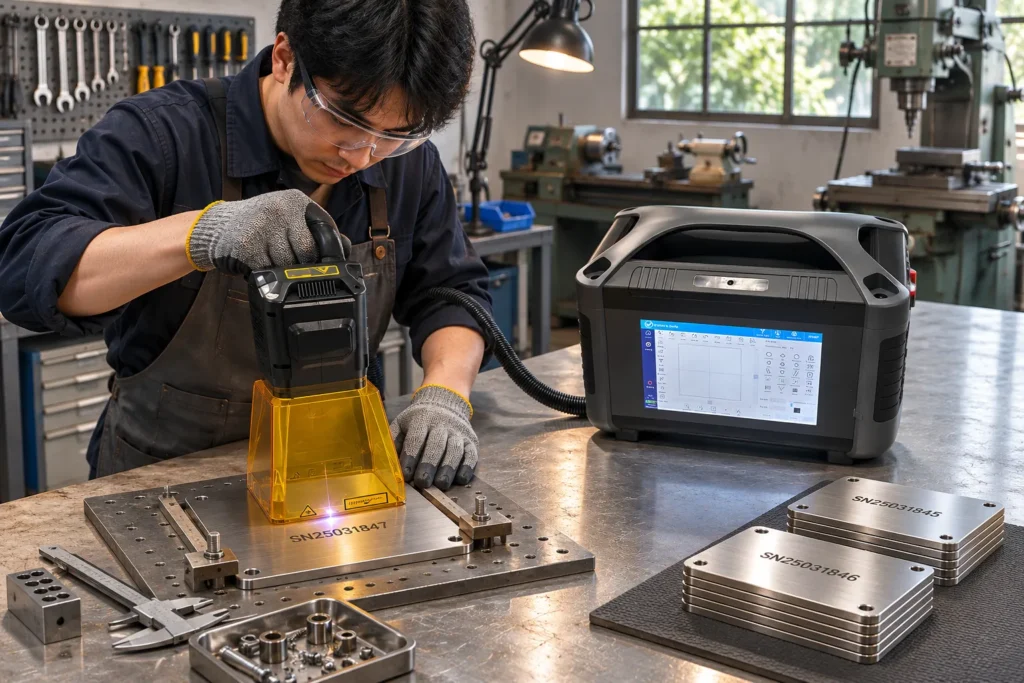
Power and throughput of a laser engraver
A 20 W fiber serves as a reference for text, logos and codes on the surface. At 30 W, industrial marking and surface engraving gain in capability, but throughput remains limited for deep engraving. A 50 W fiber suits deeper, repetitive engraving. A 60 W MOPA mainly offers more latitude in adjusting the pulses.
From 100 W onward, a laser engraving machine for metal handles material removal and intensive production more easily. The outcome, however, depends on the full set of parameters: depth also depends on the material, the optics, the focus, the speed and the number of passes, not just on wattage.
| Fiber power | Reference use | Limitation to be aware of |
| 20 W | Text, logos and codes on the surface | Slow deep engraving |
| 30 W | Industrial marking, surface engraving | Limited throughput for deep engraving |
| 50 W | Deeper and repetitive engraving | Depth to be measured on your steel |
| 60 W MOPA | Extended pulse adjustment | No guaranteed depth |
| 100 W and above | Material removal, intensive production | Integration to be studied according to the installation |
Field, optics and part geometry
The working field must cover the size of your parts and patterns. The Thermoflan fiber range spans 20 to 300 W, with fields from 70 × 70 mm to 1,200 × 600 mm. These extreme values do not correspond to a single model.
A larger field does not mean uniform quality. The precision of a laser marking machine must therefore be verified across the entire usable area, corners included. Likewise, the actual line width on metal may differ from the stated spot size.
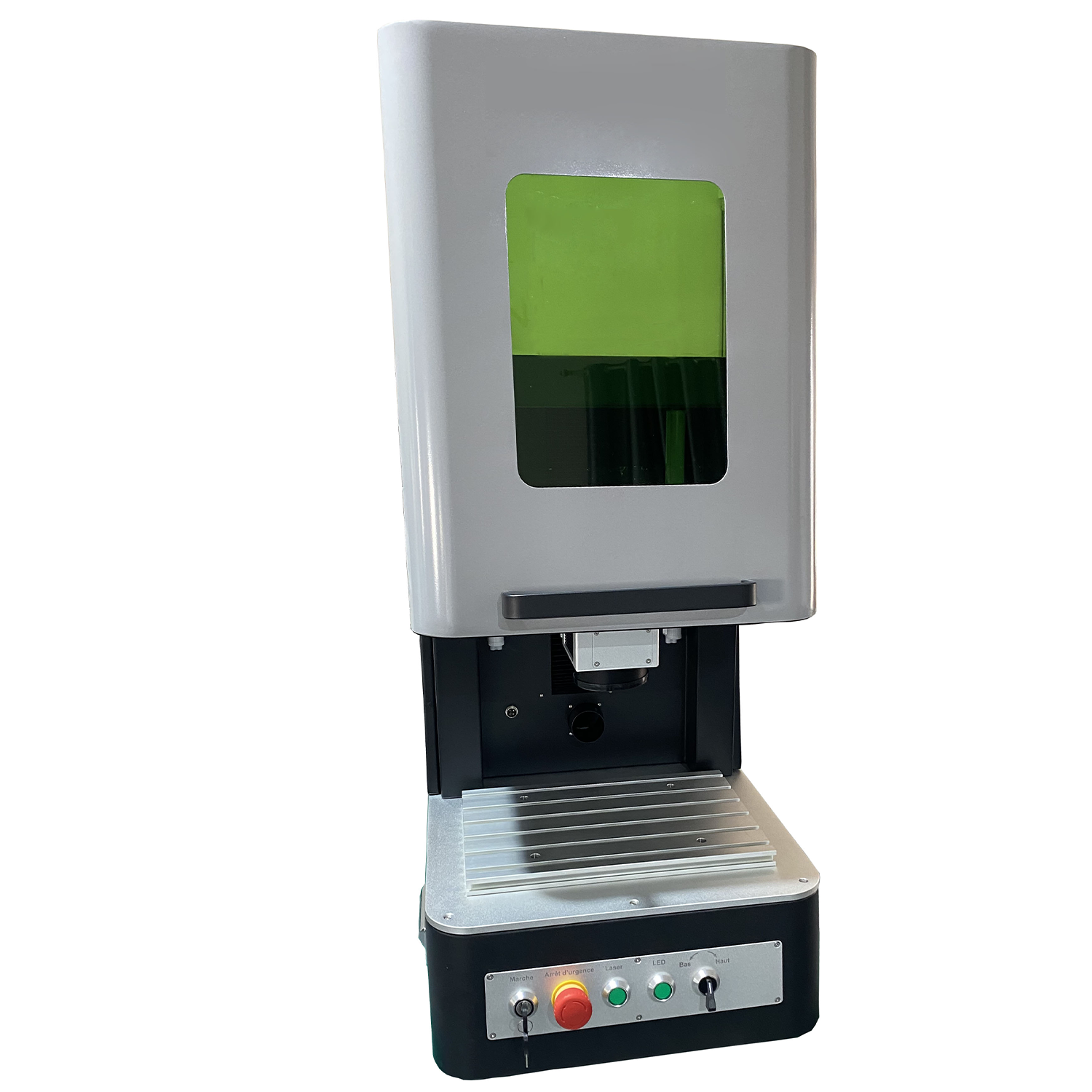
Tall, curved or cylindrical parts add height and positioning constraints. Check the working distance and depth of field on these parts. The Fiber Mark Standard fiber laser marking station features a motorized Z axis and can take an autofocus or a rotary tool.
Station, software and production cycle
The station format depends on how your parts are handled. The Thermoflan fiber laser engraving range includes a battery-powered portable laser engraver for large parts that are difficult to move. It also includes the Fiber Mark Basic, Standard and Pro stations, as well as a motorized X-Y table for large surfaces.
A professional laser engraving machine is then judged by its software. SVG and DXF are vector formats, whereas a PDF may contain only a flattened image. Test your actual files, variable data, QR codes and CSV import end to end, on the proposed laser marking system.
Throughput is ultimately measured over the full cycle. A scan speed announced up to 7,000 mm/s does not give the time per part, which includes loading, clamping, identification, focusing, firing, inspection and unloading. As for cooling the source, it depends on the design of the station.
How much does a steel engraving station cost?
The list price represents only part of the investment. To budget correctly, define the priced scope, add the equipment of the installed station, then reason in terms of cost per conforming part.
Displayed price and quote scope
Thermoflan lists the Fiber Mark Standard from €7,540. To compare the price of a laser engraving machine, request quotes in euros on an identical scope. The price of laser engraving on metal indeed depends on several priced items:
- Excl. VAT and incl. VAT amounts: these must be clearly distinguished on each quote to avoid comparing different bases.
- Optical configuration: the field, optics and head change the amount independently of power.
- Mechanics and automation: axes, automation and interfaces with production add to the priced configuration.
Power alone therefore does not determine the price. Two sources of the same power can lead to very different quotes depending on the equipment around them.
Equipment and charges for the complete station
In addition to the machine, the installed budget may include the enclosure, interlocks, fixturing and fume extraction. Filters, software, connections, installation and training complete this scope. Source cooling is a separate function from extraction: some compact fiber systems are air-cooled, while other installations require a liquid circuit.
Maintenance is then added to the budget each year. It covers in particular optics and filters. The Thermoflan fiber laser range requires almost no maintenance.
Cost per conforming part
Cost per conforming part divides all production expenses by the number of accepted parts. It includes the full cycle, scrap, consumables, energy, labor and service. For CO₂ marking on steel with Thermark (pigmentation), application, drying, cleaning and the consumable add to this calculation.
Between a fixed station and a portable device, handling and positioning of parts weigh on this cost. A multi-part fixture or a rotary axis can also improve throughput without increasing the nominal power.
How to validate metal engraving before purchase?
Thermoflan recommends confirming performance through testing, as each alloy and each surface finish reacts differently to the laser. Useful validation relies on criteria set in advance, comparable tests, and acceptance under workshop conditions.
Defining criteria for your parts
Before testing, specify the steel grade, finish, geometry, mark dimensions and, if necessary, the required depth. This data is then used to set separate acceptance thresholds.
- Contrast and legibility: a deep engraving does not guarantee that a code can be read.
- In-service durability: a dedicated threshold, separate from the visual appearance obtained as the part comes off the station.
- Cycle time: a target measured on the actual part, not on a flat sample.
Tests must also include unfavourable production variants. Prepare parts from other batches, with different roughness, coating, residual oil, curvature or height.
Comparing reproducible tests
Compare conventional fibre, MOPA and, if fineness or heating requires it, UV. Parts must be prepared and clamped in the same way so that any observed difference comes from the source itself.
Each test must be repeatable. Record the source, lens, focus, power, pulse parameters, speed, fill spacing and number of passes.
Measure the resulting mark for depth, width, raised features and floor uniformity. Removed volume changes firing time: a depth of 0.20 mm removes much more metal over a large solid area than over a small number.
Accepting the machine under real conditions
Once the recipe is selected, check the durability of the marking after the planned degreasing, painting, passivation, cleaning or abrasion. Then read the codes with the workshop’s reader and lighting, and measure the accepted-parts rate and the full cycle. Finally, verify repeatability between operators, after repositioning and when changing batches, keeping recipes locked and retaining reference parts, images and measurements.
How to secure and comply with the laser station?
A steel engraving station exposes operators to radiation and emissions from the part. Thermoflan recommends a risk analysis of the station before production, covering in particular radiation, fumes, filtration and cooling.
Radiation, enclosure and compliance
Standard NF EN 60825-1 defines the hazard classes of laser equipment. According to INRS, an open industrial laser may fall into class 4, whereas a properly enclosed machine may be class 1 in normal operation. Classes 3B and 4 pose eye hazards, and class 4 adds skin and fire risks.
- Beam containment: laser protection must address reflections from metal surfaces; suitable goggles do not replace the enclosure.
- Safety devices: guards, interlocks and emergency stop must be checked on the installed system as a whole.
- Documents: the CE marking, declaration of conformity and French-language manual must match the configuration delivered.
- Regulation (EU) 2023/1230: it generally becomes applicable on 14 January 2027.
This new regulation does not automatically invalidate machines already placed on the market under the previous rules.
Fume extraction and maintenance
Engraving can emit fumes and particles from the metal, coatings or oils. In premises with specific pollution, Article R. 4222-12 of the Labour Code has governed ventilation since 1 May 2008: these emissions must, where possible, be eliminated or captured as close to their source as possible.
This extraction must be verified under real operating conditions. With the enclosure closed, check the flow rate, make-up air and filter condition. The mere mention of ‘HEPA’ does not demonstrate treatment of gaseous contaminants.
Ventilation is then subject to periodic checks. The order of 8 October 1987, applicable since 1 April 1988, requires a check at least once a year. If air is recirculated, additional checks must be carried out at least every six months.
Risk assessment and workshop controls
Articles R. 4452-1 et seq. of the Labour Code govern risks linked to artificial optical radiation. Under articles R. 4452-7 et seq., in force since 5 July 2010, the employer calculates exposure where the technical data does not rule out the risk, and measures it if necessary. A significant change in health and safety conditions also requires updating the risk assessment and the single risk document, with no regulated fee in euros.
The electrical installation is subject to separate checks. According to the order of 26 December 2011, in force since 30 December 2011, it is verified initially when created or when its structure is modified, and then every year. Under certain conditions, this interval may be extended to two years.
Fiber, UV and CO₂ Lasers for Steel
From traceability marking to deep engraving on steel and stainless steel, compare Thermoflan lasers and prepare your tests with our experts.

Frequently Asked Questions
What should you check before buying a used or refurbished laser engraving machine?
Check the condition of the source, the test results on your parts, the availability of spare parts, the enclosure and the software. Also require transfer documents and plan an on-site acceptance inspection. INRS covers these purchases in its sheet dedicated to used machines.
What does routine maintenance of a fiber engraving laser involve?
According to Thermoflan, routine maintenance of its fiber lasers mainly involves periodically cleaning the output lens with a soft optical cloth and a suitable solvent. The process uses no ink or marking chemical that needs regular replenishing.
Can you laser engrave mirror-polished stainless steel?
A mirror-polished finish increases the difficulties caused by beam reflections. The surface finish, brushed or polished, should therefore be specified in the requirements and in the safety analysis. A successful engraving on brushed stainless steel does not automatically transfer to a polished part: validate it with a test on the actual finish.