







Contents
- Which laser to choose based on surface and finish?
- Laser engraving settings on aluminum
- Which machine for a plate or a part?
- What budget should be planned for the machine?
- What should be validated before production starts?
- Frequently asked questions
Choosing an engraving machine for aluminum depends first on the surface to be treated: bare, anodized, painted, or coated aluminum. This guide compares the fiber, CO₂, and UV lasers sold by Thermoflan. It also covers settings, plate and part formats, installed budget, and the tests to run before production begins.
Which laser to choose based on surface and finish?
Bare, anodized, and coated aluminum do not react to the beam in the same way. A clear mark on black anodizing therefore does not prove that the machine can mark bare metal. Before comparing sources, identify the alloy grade, the finish, and the color of the parts to be marked.
Fiber and MOPA for bare metal
A 1,064 nm pulsed fiber laser marks bare aluminum and anodized aluminum directly. It is therefore the most versatile choice for a workshop that handles both surfaces. On bare metal, this infrared laser can produce dark gray, a light finish, a texture, or an engraving, depending on the alloy, the finish, and the settings. Thermoflan presents its range of fiber laser engraving machines as an industrial metal marking solution.
MOPA fiber is still a fiber laser, but its pulses can be adjusted more finely. This setting can help control contrast and heating on various anodized finishes, without making it systematically preferable. In practice, a machine intended for aluminum engraving should be judged on bare parts.
CO₂ for colored aluminum and coatings
The CO₂ laser emits at a wavelength generally close to 10.6 µm. It can modify or remove anodizing, a colored aluminum layer, or a coating, but it does not directly engrave bare aluminum under usual conditions. Thermoflan’s CMark Basic marks anodized aluminum. In the range of CO₂ laser machines, flatbed models suit plates, while galvanometric stations favor throughput over a defined area.
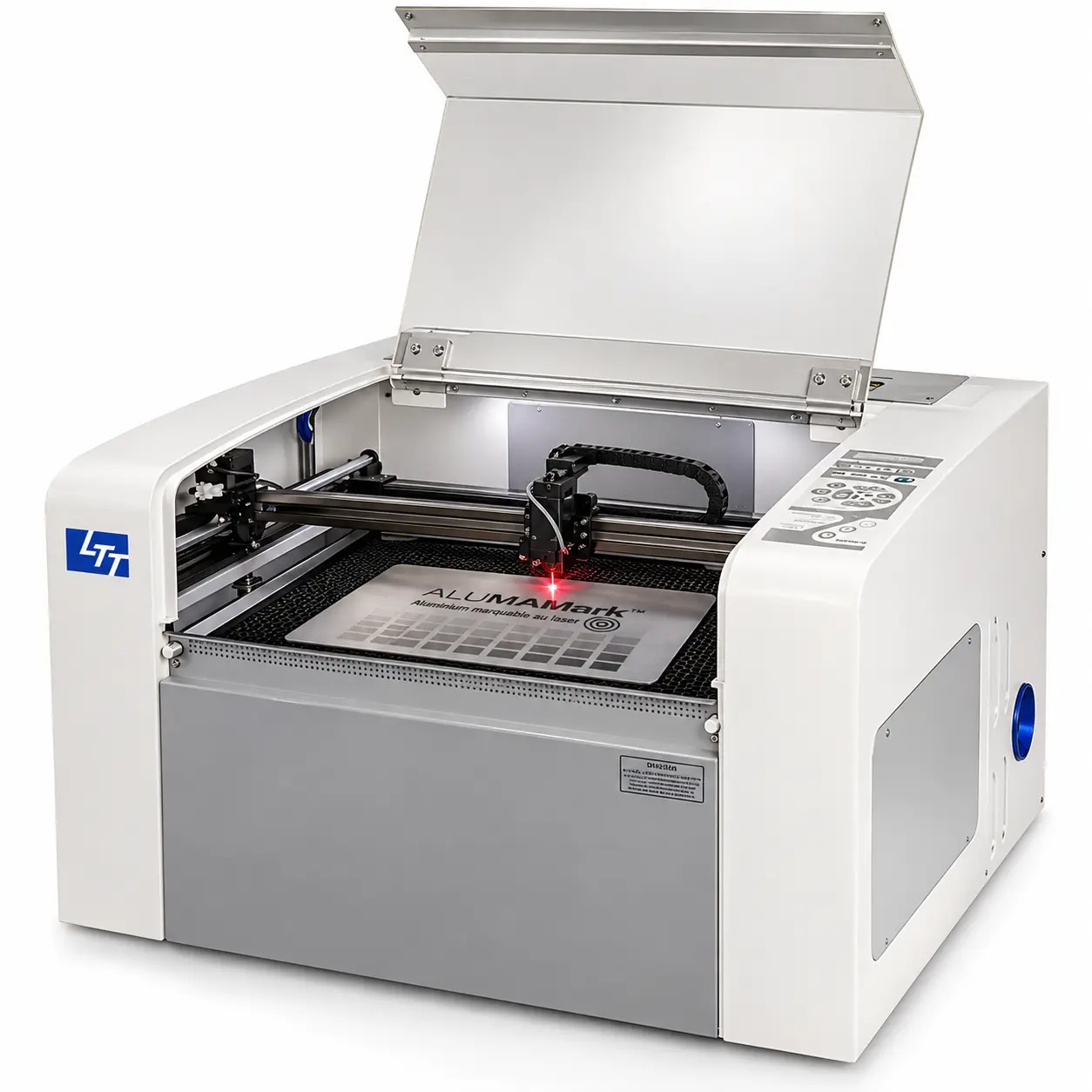
For signage and industrial identification, Thermoflan also offers AlumaMark. This aluminum designed for CO₂ laser marking reacts thermally to form a high-contrast black on a metallic or colored background, without ink or mechanical engraving. The material is particularly suited to indoor use. For outdoor use, it requires a varnish or a protective film.
UV and diode for special cases
The UV laser deserves a comparative test against a well-tuned fiber laser when the part is heat-sensitive, the detail is very fine, or the code is small. However, the term “cold marking” does not guarantee results on every anodized finish.
Conversely, a blue diode can act on certain anodizings or coatings. It does not directly engrave bare aluminum under usual conditions, so it remains a simple point of comparison for a workshop that handles bare metal.
Tip
Choose your laser based on the aluminum surface
Fiber or MOPA lasers handle bare aluminum, CO₂ handles colored aluminum and coatings, and UV handles special cases. First identify the actual surface of your parts: bare, anodized, painted, or coated.
Laser engraving settings on aluminum
Once the source is chosen, the result depends on the settings and the actual condition of the part. The same equipment can produce a surface mark, a recess, or an alteration of the anodizing.
Distinguishing contrast from depth
Laser marking mainly changes the appearance of the surface, whereas laser engraving removes material. To specify the result, distinguish four levels: a visible mark, a tactile line, a measurable recess, and a cut.
This distinction matters as soon as black anodizing is involved. As mentioned above, a light mark may then result solely from modification of the oxide layer.
When a recess is required, laser engraving on aluminium is qualified by a depth measurement on the actual part. A photograph or contrast alone is not sufficient to validate the engraving process.
Adjusting parameters without damaging the part
Each setting acts on a specific criterion: power affects depth and processing time, scan speed affects exposure, pulse frequency affects appearance, and focus affects line precision. However, increasing power does not necessarily guarantee better contrast.
On a thin part, these parameters also determine heating. The laser beam can then warp or discolour the aluminium, and shorter pulses can limit thermal diffusion. The black obtained by annealing on stainless steel cannot be reproduced identically on aluminium, because the marking mechanism differs.
Surface preparation is just as important as the settings. Dust, oil and debris can make laser engraving on aluminium uneven. Therefore, clean the parts before each test. A polished surface also requires particular attention to reflections back into the optics.
Preserving the durability of a marked anodising
Anodising forms a protective layer of aluminium oxide. Its thickness classes include AA3, AA5, AA10, AA15, AA20 and AA25. Certain dyes require class AA20 or higher. QUALANOD notably requires specifying the class, alloy, colour and sealing method.
These data determine durability after marking. A controlled surface modification can preserve protection, whereas local removal exposes the metal. Corrosion resistance also depends on the alloy, the anodised thickness and the operating environment.
The order of operations also affects the result. Marking performed before or after anodising, colouring and sealing does not necessarily produce the same finish: the difference lies in the sequence, which should be defined with the surface treatment provider.
Which machine for a plate or a part?
After the source and settings, the format of the parts guides the choice of architecture. A flat plate, a machined part and a bulky component do not require the same field, the same holding system or the same axes. Thermoflan recommends considering dimensions, loading and positioning when choosing the machine.
Defining the usable field for plates
For a metal signage plate, the usable area is not limited to the table dimensions. An aluminium plate intended for laser engraving is assessed against four criteria:
- The inscription: dimensions of the text, logo or code to be marked.
- The footprint: size of the plate to be loaded into the machine.
- The height: space available under the marking head.
- The holding: device that immobilises the plate during marking.
A large table does not guarantee a large design in a single pass either: the optical field, the lens and any repositioning must be checked separately. When engraving a perforated metal plate, check that focus and contrast remain uniform up to the edges, without encroaching on the holes and fixings.
Holding and orienting machined parts
On a machined part, the choice of laser engraver depends on clamping, positioning repeatability, surface relief and the beam’s access to the area to be marked. A rotary axis may be necessary for a cylindrical part. In addition, a 3D laser head available on fibre or UV lasers can facilitate marking parts of varying heights.
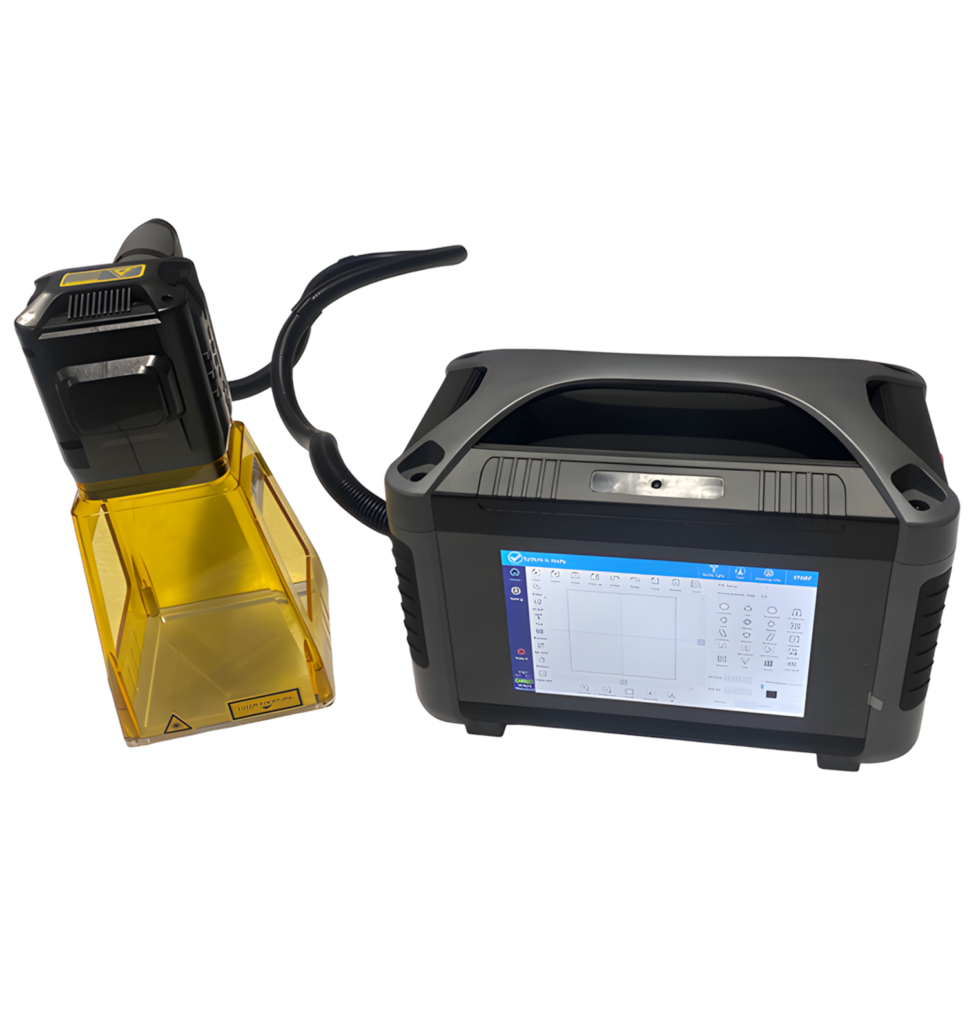
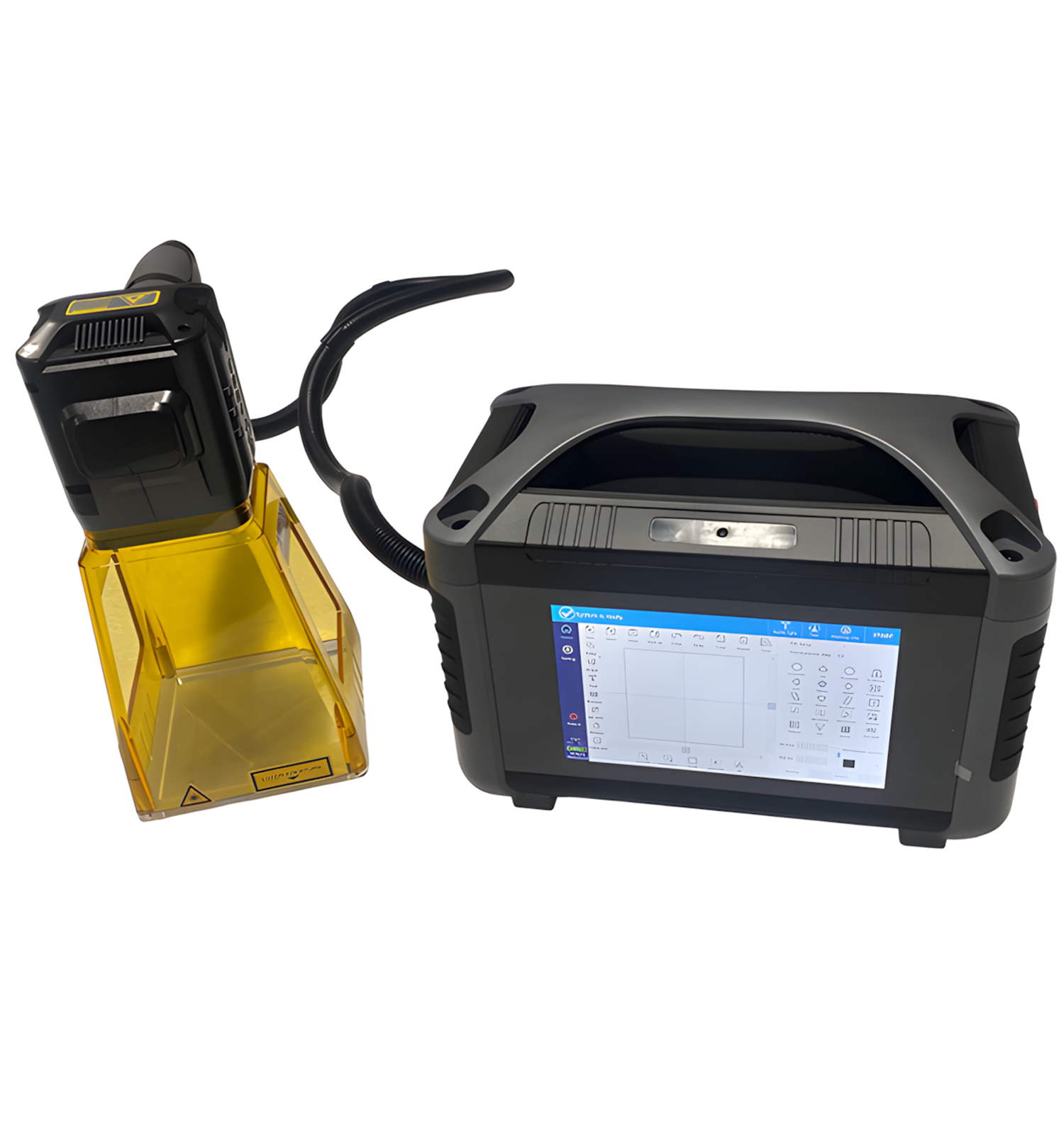
Some parts cannot fit inside a closed enclosure. For large or difficult-to-move metal parts, Thermoflan offers the Fiber Mark Tool, a battery-powered portable fibre laser. An open frame also makes it easier to access parts that exceed the dimensions of a closed enclosure.
Choosing the axes and software
Thermoflan’s Fiber Pro Max XY combines a fibre source with a motorised table on the X and Y axes. Its software segments the design according to the optical field of the lens. The galvanometer head then marks each zone, and the table moves the part to the next one, without manual repositioning.
Conversely, the Fiber Mark Standard is intended for regular identification of components. It is the preferred choice when production involves fine, high-resolution markings, particularly on aluminium.
For traceability, check that the software handles variable identifiers and 2D codes. The readability of a Data Matrix or QR code also depends on the actual reader and lighting, as metal reflects light.
What budget should be planned for the machine?
The configuration chosen for plates or parts accounts for a large share of the investment. However, the budget should be considered in terms of installed cost and then operating cost, not just the listed price of the source.
Calculating the installed configuration cost
The price of a metal laser engraving machine varies with the technology, usable power, pulse settings, source stability, optics and marking field. Options also weigh in: galvanometer scanner, Z axis, autofocus, rotary axis, clamping and automation all affect both purchase cost and productivity.
Beyond the equipment, the installed budget for laser machines includes the safety enclosure, filtered extraction, integration, software, testing and training. Ask that each of these items be itemised in the quote.
Assessing operating costs
Once the machine is installed, the operating cost depends on the power consumption of the whole system, the optics, filters, maintenance, spare parts and software licences. Fibre lasers require neither ink nor chemicals and little routine upkeep. However, the announced service life of their source does not represent that of the entire machine.
Operator time and production downtime also contribute to the real cost. With a CO₂ laser, surface preparation intended for marking bare metal adds consumables, drying and cleaning for each part.
Compare offers on the same production
A fibre laser chosen for its ability to process bare metal may be oversized if production consists almost entirely of small markings on coloured anodised aluminium. Likewise, the scanning speed stated in mm/s does not represent throughput: loading, positioning, focusing, closing, extraction, reading and unloading are all part of the cycle.
A useful comparison therefore relies on a detailed configuration and a cycle time measured on the planned parts. Ask for both rather than a ranking based solely on wattage or maximum beam speed.
What to validate before going into production?
The cycle time requested from suppliers is only meaningful if it is measured under conditions close to production. Validation covers three areas: the result on real parts, the safety of the workstation and the compliance of the delivered cell.
Test the real result and throughput
Tests should cover the planned bare aluminium grade, the anodised finish of the batch concerned and the most demanding geometry. According to ADAL, the composition and microstructure of the alloy influence the appearance of the anodising. The protocol then covers production content and calls for precise measurements:
- Test content: smallest text, the most densely filled logo, variable number and code to be read.
- Cycle records: preparation time, cycle time, contrast after cleaning, code readability and scrap.
- Usage checks: depth, residues, abrasion resistance and local corrosion, according to a protocol defined before testing.
The ISO/IEC 29158:2025 standard provides a reference for verifying symbols marked directly on parts. Finally, repeat acceptance testing with the planned enclosure, extraction and automation, as a result obtained with an open head does not validate the installed cell.
Contain the beam and capture emissions
Fibre laser infrared radiation is invisible, and reflective aluminium increases the risk. The laser class must therefore be verified for the complete machine, not based on the source or the cover alone. Check the enclosure, interlocked doors, beam shutdown on opening, the emergency stop and maintenance access. Suitable laser safety eyewear does not replace this containment.
Once the beam is contained, the question of fumes remains. INRS recommends capturing emissions as close to their source as possible. The pollutants to be treated depend on the alloy, the anodising, any coatings and any consumables used.
Verify the compliance of the cell
For a professional machine in France, obtain the instructions in French, the EC declaration of conformity and the CE marking for the complete machine, not just for the laser source.
After commissioning, Article R.4322-1 of the French Labour Code, in force since 1 May 2008, covers the maintenance of compliance of work equipment in use. ISO 11553-1:2020 sets safety requirements for laser machines, but on its own it does not certify the compliance of the delivered cell.
Fibre, CO₂ and UV lasers for aluminium
Bare, anodised or coated aluminium, sheets or machined parts: compare Thermoflan lasers according to your surfaces and formats. Ask our experts for advice.

Frequently asked questions
Can a compact infrared module replace a professional fiber marker?
Some low-power 1,064 nm infrared modules can process small parts or produce light markings. However, their capabilities are not equal to those of a professional fiber marker. To compare them, check the actual optical power, the working area, the throughput, as well as the contrast or depth achieved on the intended aluminum.
Does anodizing certification guarantee the durability of laser marking?
No. Anodizing certification alone does not certify the durability of a marking applied afterwards. For a part exposed to abrasion, chemicals or weather, legibility and durability after marking must be validated by testing, and cannot be inferred from visual contrast alone.
How can the traceability of identifiers marked on aluminum be ensured?
A machine connected to a production system can automatically assign serial numbers and keep digital records. Additionally, check that the identifier remains legible after operations that could alter it, not just immediately after the laser shot.