





Table of Contents
- What machine to cut plexiglass?
- What precision to expect from laser cutting?
- What budget to plan for a laser cutter?
- What to check before buying in France?
- Frequently Asked Questions
Choosing a CO₂ laser cutting machine for plexiglass depends on three essential criteria: the type of laser source, the power required based on the thickness of the plexiglass to be cut, and the overall budget for the laser cutting setup. This article compares CO₂ lasers, diode lasers, and CNC saws and milling machines. It also details the edge quality to expect, prices in euros, and the checks to carry out in France before buying.
What machine to cut plexiglass?
Plexiglass belongs to the PMMA family, also known as acrylic glass. Not all laser sources process it in the same way. The difference lies in the wavelength, then in the power and the bed format: these three criteria should be compared separately.
Transparent acrylic, diode, fiber and CO₂ source
For cutting plexiglass, a CO₂ laser machine is particularly suited to transparent sheets. Conversely, the beam of a blue diode laser generally passes through transparent acrylic without being able to cut it. A diode can, however, be used to cut certain types of opaque and dark acrylic. As for the fiber laser, it can act on the reflective layer of mirror acrylic, but it is not a versatile solution for cutting PMMA.
Thermoflan offers flatbed CO₂ laser machines suited to cutting plexiglass sheets. Within this range, the glass CO₂ laser tube is an economical solution for routine cutting and engraving work. The RF (radio frequency) tube, meanwhile, offers a finer and more stable beam, particularly useful for producing precise contours and cuts requiring great finesse.
The choice of laser source therefore plays an essential role in the quality and precision of laser cutting and engraving of plexiglass, as well as in the results obtained when engraving plexiglass.
What power for which thickness?
The power of the CO₂ laser tube is an essential criterion for determining the thickness of plexiglass that can be cut. For laser cutting acrylic, a 40 to 60 W source generally cuts sheets 5 to 6 mm thick. With 80 W, laser cutting can reach 8 to 10 mm in a single pass. CO₂ laser tubes of 150 to 200 W cut plexiglass and PMMA sheets 15 to 20 mm thick. For laser cutting thick plexiglass, from 20 mm of PMMA, CO₂ laser machine configurations may require a power between 200 and 650 W. Some laser cutting machines even advertise a cutting capacity of up to 30 mm of plexiglass.
These laser cutting capacities for plexiglass are indicative only. The maximum cuttable thickness, cutting speed and finish quality depend on the laser machine used, the power and speed settings, and the characteristics of the acrylic sheet. At greater thicknesses, focal point adjustment, compressed air assist and fume extraction require particular attention. The indicative rule of 10 W per millimeter of acrylic thickness is a useful starting point for choosing the power of a CO₂ laser machine, but it does not allow the cutting time to be calculated precisely. With comparable material and cutting parameters, a higher CO₂ laser power generally allows thicker plexiglass sheets to be cut or the cutting speed to be increased.
| CO₂ power | Indicative acrylic thickness | Note |
| 40 to 60 W | Up to 5 to 6 mm | Indicative value |
| 80 W | 8 to 10 mm | In one pass |
| 150 to 200 W | 15 to 20 mm | Speed and finish not guaranteed |
| 200 to 650 W | From 20 mm | Focus, air and extraction to monitor |
Working area and plate passage
The working area of a CO₂ laser cutting machine is chosen according to the format of the plexiglass sheets and the dimensions of the parts to be cut, independently of the laser tube power. The working formats offered in Thermoflan’s CO₂ range range from 450 × 300 mm to 1,600 × 1,000 mm, to meet different cutting and laser engraving needs.
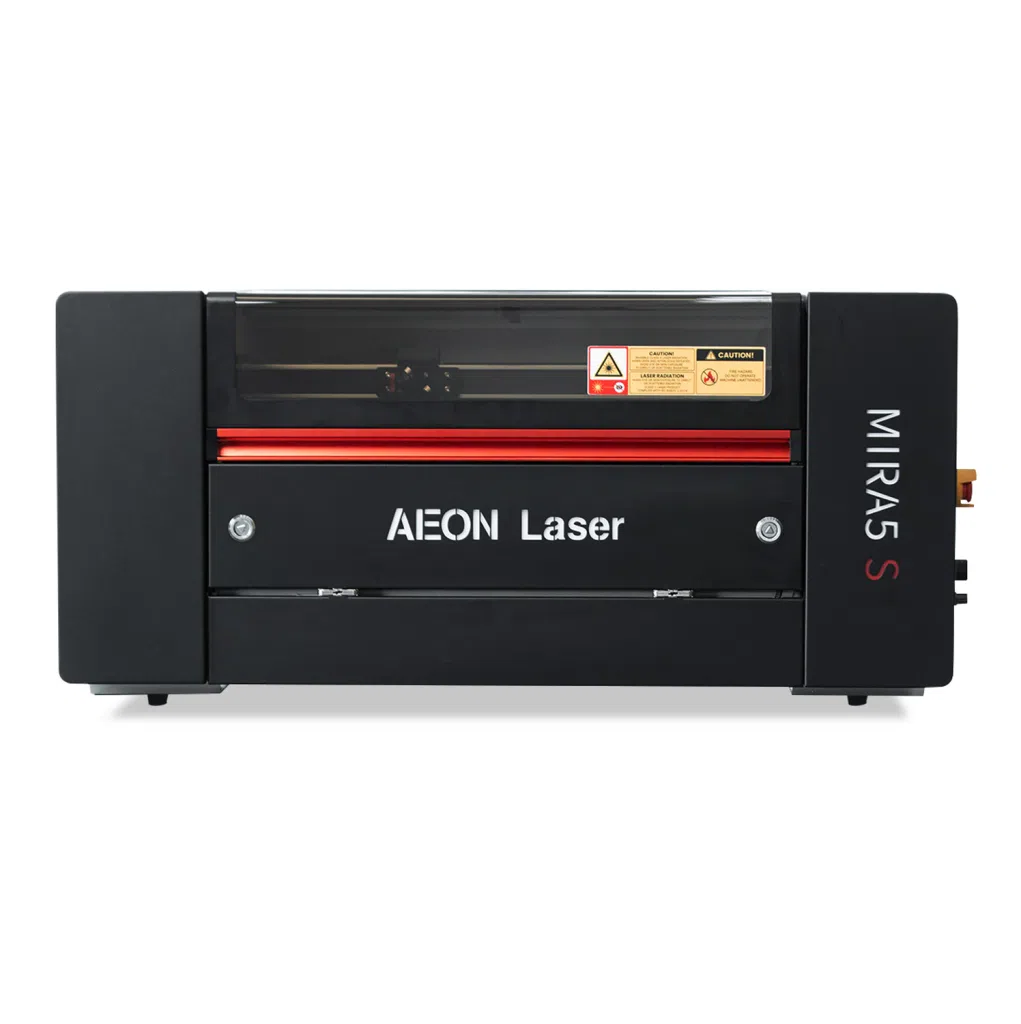
The Redline Mira 7 S, for example, has a working area of 700 × 500 mm and pass-through doors at the front and rear of the machine. These openings make it possible to work on parts longer than the cutting bed while keeping the same passage width.
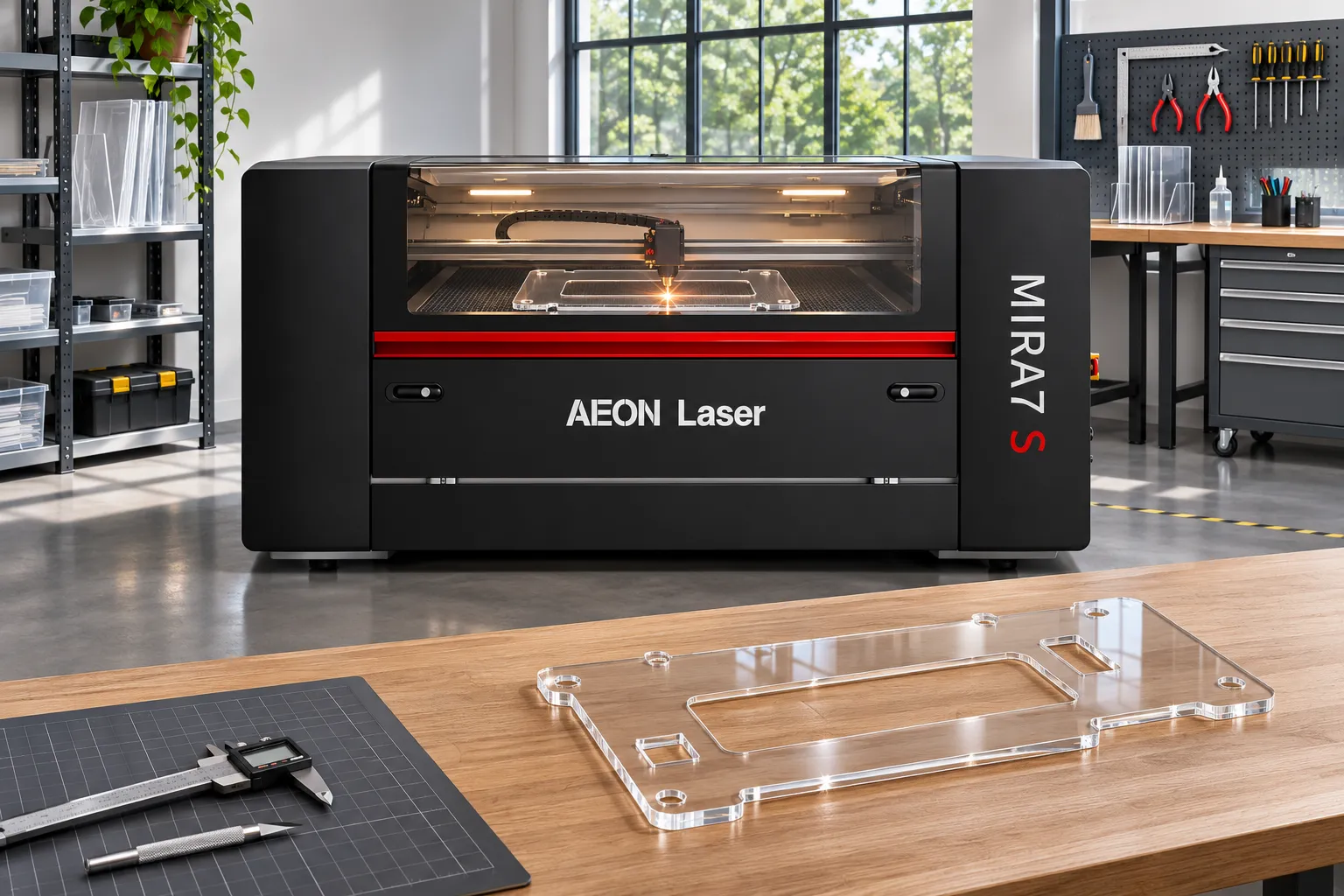
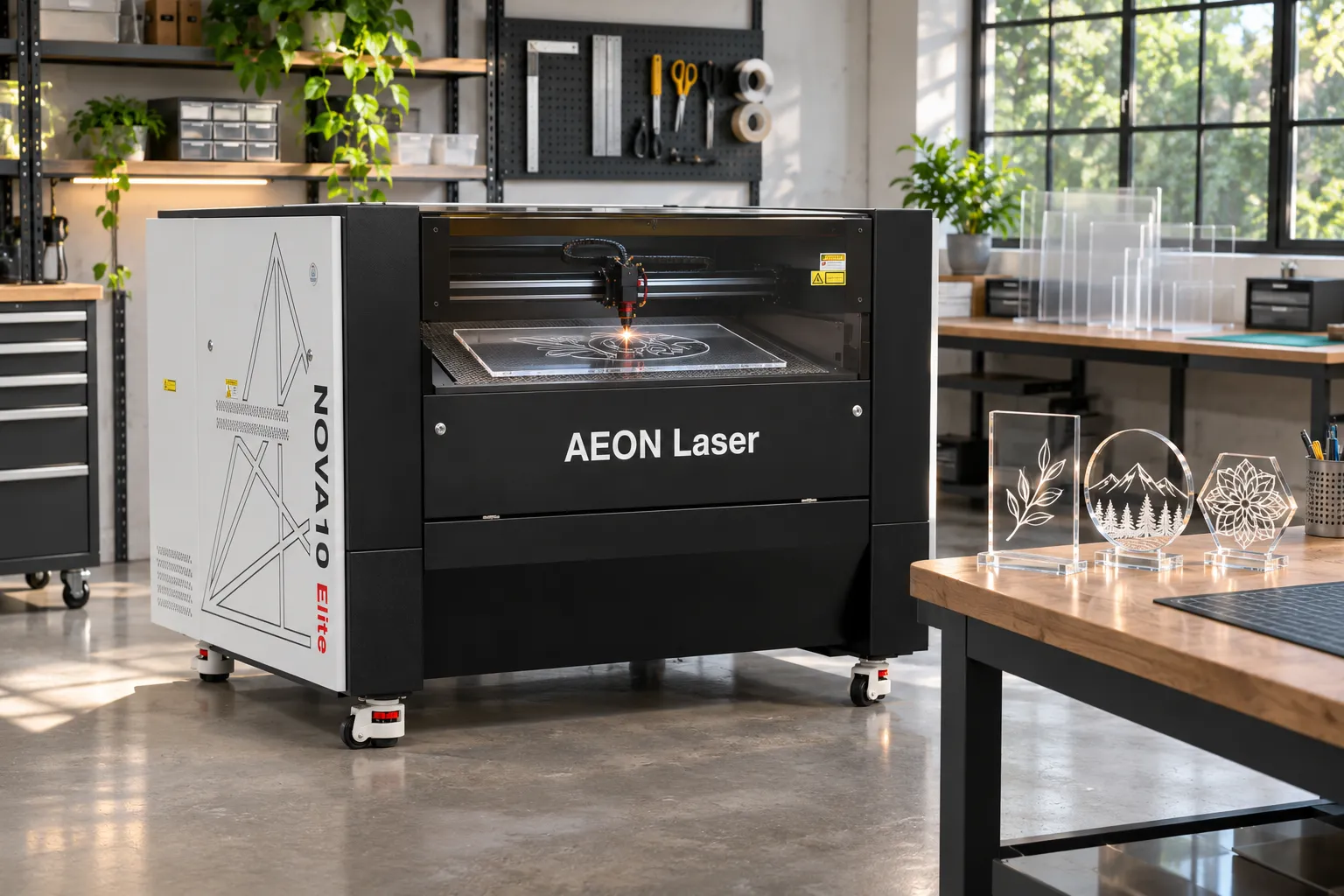
Other CO₂ laser machines meet specific needs: the Mira 5, compact, is suited to prototypes and small runs; the Nova Elite 14 allows work on large cutting areas; while the I4000 features a large work table equipped with four pass-through doors.
In practice, before choosing a laser machine to cut acrylic sheet, it is important to measure the dimensions of the longest and widest sheets to be processed. These measurements help determine whether a large work area is needed or whether a machine with pass-through doors meets production requirements.
Tip
Choose the laser source based on your acrylic sheet
Not all laser sources process PMMA in the same way. First identify the type of sheet (transparent, coloured, mirror) and its thickness, then check that the chosen source and power are suitable.
What level of precision can be expected from laser cutting?
Once the machine is sized, the result is judged on the part itself. Laser cutting leaves an edge whose appearance, kerf width and finish vary depending on the sheet and the settings. The type of PMMA, cast or extruded, and coated sheets such as mirror acrylic also affect the result.
Edge of an acrylic sheet
The heat of a CO₂ laser can leave a glossy edge without sanding on an acrylic sheet. A slight burr may nevertheless appear on the upper and lower faces. The kerf, i.e. the width of material removed, also increases with thickness:
- 3 mm sheet: kerf of about 0.26 to 0.44 mm depending on cutting conditions.
- 10 mm sheet: kerf of about 0.64 to 0.82 mm depending on cutting conditions.
- Feed rate too slow: the edge may become matt.
- Feed rate too fast: grooves may form on the edge.
Beyond speed, focus, air assist and extraction also influence the finish. Adjust them on an offcut of the same reference before judging an edge.
Cast and extruded PMMA, engraving and durability
Cast PMMA, sold under the GS reference, generally gives a white, high-contrast frosted laser engraving. Conversely, extruded XT produces a less contrasting engraving. On a transparent sheet, engraving on the back can be tested in addition to engraving on the front face.
These two families also differ in sheet consistency. Material documentation indicates thickness tolerances of about ±15% for cast and ±5% for extruded. These are sheet tolerances, not cutting tolerances.
Once the part is cut, stresses close to the laser edge can cause cracking after bonding. Annealing, to be validated depending on the part, is then recommended: 80 °C for GS and 70 to 80 °C for XT. In both cases, it lasts at least 2 h.
The case of mirror acrylic
Mirror acrylic is a PMMA sheet fitted with a reflective coating. It is thus distinguished from clear acrylic sheet without coating, but also from a glass mirror. For laser cutting of mirror acrylic, the described process consists of engraving on the back of the sheet, followed by CO₂ laser cutting. It is important to monitor the heating of the material and the condition of the reflective coating after each test cut.
As with clear acrylic sheets, a glossy edge guarantees neither dimensional compliance nor the straightness of the cut part. The pigmentation of the PMMA and the thickness of the sheet can also influence the final appearance after laser cutting.
What budget should be planned for a laser cutter?
The purchase price of a CO₂ laser cutting machine depends mainly on the laser source and its power, but it represents only part of the overall cost of the cutting station. The figures below give orders of magnitude in euros for the French market. They also make it possible to compare the cost of laser cutting with other solutions, such as a saw or a CNC router.
Listed prices and comparable configurations
On the French market, the price of a 40 W diode laser is around €1,799 for engraving on PMMA only. A 40 W CO₂ laser starts at around €5,800, while an 80 W CO₂ laser machine costs about €8,000. These laser configurations are not, however, directly comparable quotes, as they rely on different technologies and equipment.
At Thermoflan, the Redline Mira 7 S CO₂ laser machine starts at €7,750 excl. VAT.
The Redline Mira 7 S laser cutting machine is available with several power configurations: a 60 W, 80 W or 90 W Premium glass CO₂ laser tube, or a 30 W or 60 W RF laser tube. These different sources and powers are detailed on the Redline Mira 7 S laser page. To compare laser cutting machine prices correctly, it is therefore important to always specify the type of laser source and the tube power.
Total workstation cost
A comparable budget includes the machine, the table, the focusing and the sheet handling. It also covers extraction or filtration, compressed air, software, installation and training. Ask suppliers for a detailed quote based on this same scope.
Operation then adds maintenance, energy, consumables, material losses, operator time and any finishing. An RF tube generally lasts longer than a glass tube, but replacing a glass tube usually costs less. In practice, economic throughput is measured in accepted parts per hour, after loading, inspection, cleaning and scrap, not from the machine datasheet speed alone.
Saw, CNC router and finishing cost
CO₂ laser cutting is contactless and produces no chips, including for contours and internal cutouts. By contrast, a CNC router requires clamping the sheet and removing chips. It does, however, allow drilling and pockets at controlled depth, and its budget shifts to the cutter, clamping, extraction and edge finishing.
A saw fitted with a blade suited to PMMA is mainly suitable for repeated straight cuts. Its edge may need reworking when optical appearance matters, a finishing step that then adds to the cost per part.
What to check before buying in France?
A price and a datasheet are not enough to validate a machine. A purchase is secured by a trial on your own sheets, by sizing the extraction, and by checking the compliance documents required in France.
Trial on the planned sheets
The purchase test piece uses the exact references of the GS or XT sheets, with their colours, films and thicknesses. Its layout includes a straight line, an angle, a small hole, an internal contour and a laser engraving area. Before the trial, set the acceptance criteria:
- Dimensions and edges: dimensional tolerances and acceptable appearance of both faces.
- Engraving and defects: expected contrast, acceptable marks and burrs.
- Production: cycle time and acceptable scrap rate.
The trial is run on the proposed machine, at the maximum planned thickness, with the intended extraction and accessories. Keep the parameters and photographs, then repeat the cut to verify that precision remains constant.
Extraction, emissions and fire
According to measurements published by INRS in December 2014, laser cutting of PMMA releases 200 to 300 mg/m³ of methyl methacrylate at 30 cm from the point of impact. The same measurements found 0.5 mg/m³ of formaldehyde, though these do not represent individual exposure over 8 hours. For comparison, INRS gives a French occupational exposure limit (VLEP) of 205 mg/m³ over 8 hours and 410 mg/m³ short-term for methyl methacrylate.
Where emissions cannot be eliminated, articles R. 4222-12 and R. 4222-13 of the Labour Code require their capture as close to the source as possible. A cutting job must also not be left unattended. Check the extraction and safety devices before starting, then clean the bed, nozzles, optics and air passages according to the manual: this cleaning limits the build-up of flammable residues.
Compliance and acceptance of the workstation
Before purchase, check the manual, the CE marking, the declaration of conformity and the interlocks. Also verify the laser class in the configuration actually used, and the extraction requirements. A Class 1 rating alone tells you nothing about fumes or fire risk.
Workstation risks are listed in the single risk assessment document provided for by article R. 4121-1 of the Labour Code. If the documentation does not rule out the optical hazard, article R. 4452-7 provides for calculation and measurement of exposure where necessary. Acceptance ultimately covers the complete workstation, its safety devices, its extraction and training. The standards NF EN 60825-1 and NF EN ISO 11553-1 serve as references for reviewing the file. The ISO 11553-1:2020 edition replaced the 2005 edition in April 2020.
CO₂ Lasers for Cutting Plexiglass
Working area, power based on thickness, test cuts on your sheets: Thermoflan experts will help you size your laser cutting station.

Frequently Asked Questions
What is the best tool for cutting plexiglass?
A CO₂ laser cuts PMMA without mechanical force or chip production, and it can handle contours, internal cutouts and engraving. By contrast, a milled edge can be matte or satin depending on the machine, the cutter and the speed, and is then flame-polished. An abrasive disc heats the edge and makes the finish hard to control.
Which sheets and films should be checked before laser processing?
You must know the composition of the sheet and its protective film before any laser processing. PVC in particular is not recommended for this process.
What positioning accuracy does the Redline Mira 7 S offer?
The positioning accuracy specified for the Redline Mira 7 S is less than or equal to 0.1 mm. On the part, a glossy edge alone does not prove that dimensions or straightness are compliant: check them separately.