




Contents
- How does industrial pad printing work?
- How to get reliable industrial marking?
- Which solution should you choose to mark your parts?
- Frequently asked questions
Industrial pad printing makes it possible to mark parts with raised, curved or textured surfaces. Its reliability depends on the setting of the plates, pads and inks. You then need to choose between a manual, semi-automatic or automatic machine, or a service provider, depending on cycle rate, cost and workstation safety.
How does industrial pad printing work?
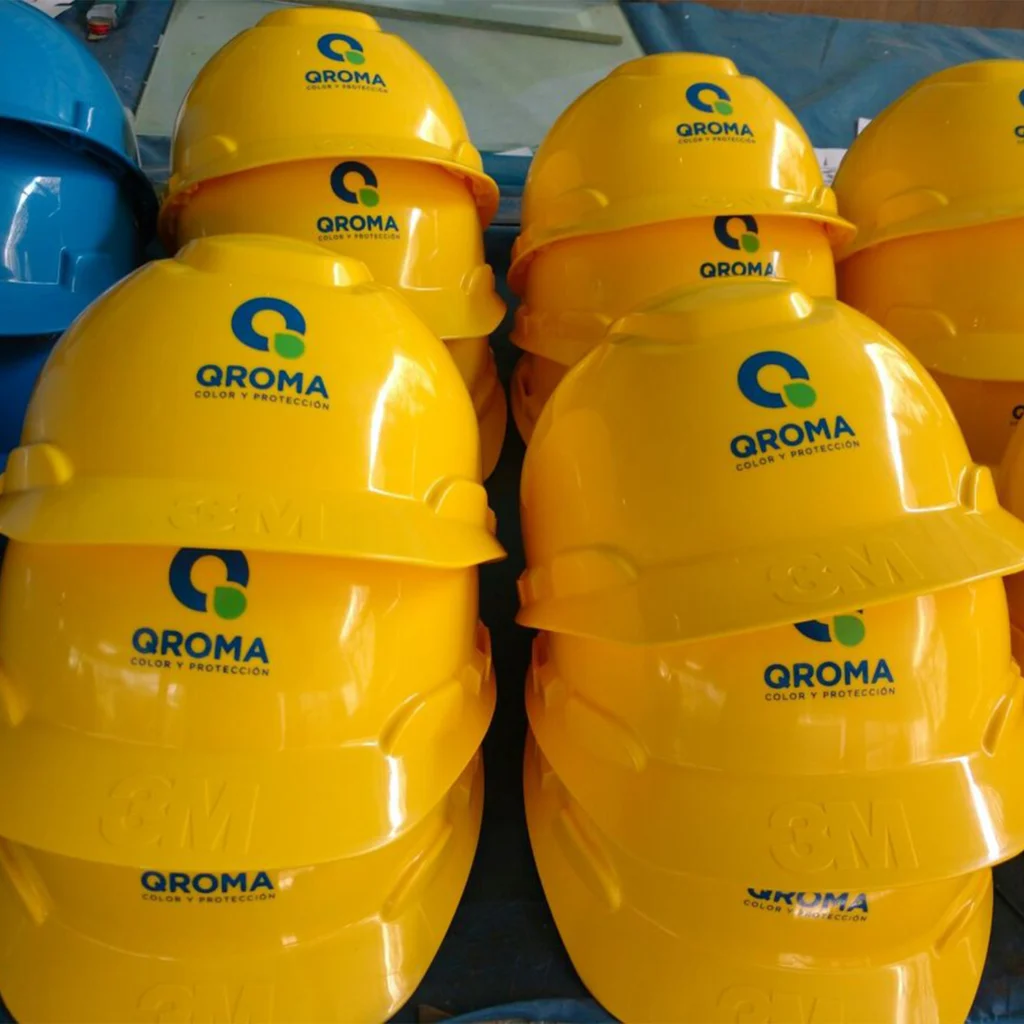
Pad printing is an indirect printing process: the ink never passes directly from the original medium to the part. This feature explains its use in many industrial sectors, wherever the design must be placed on an area that flat printing processes cannot reach.
The indirect transfer of ink
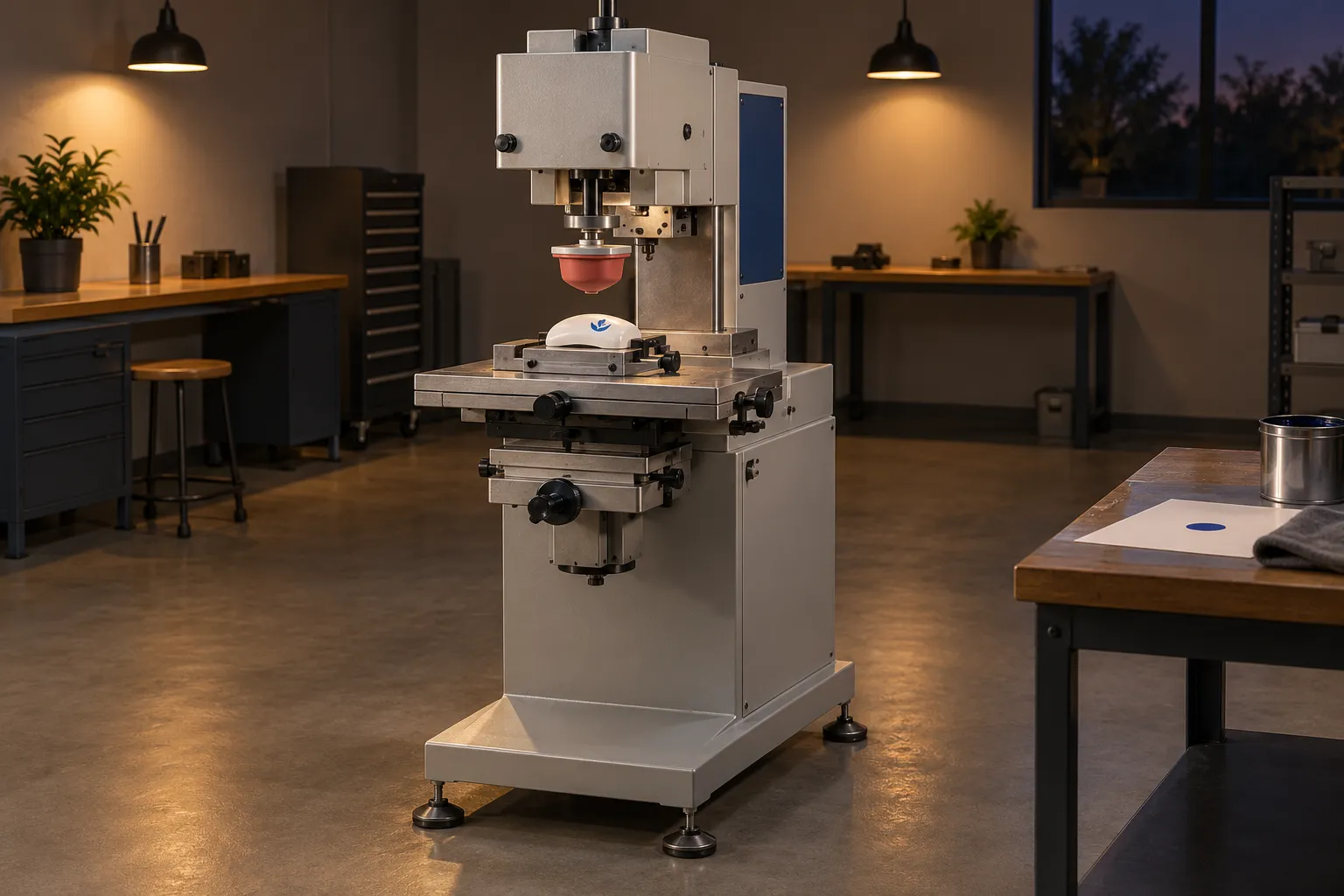
By definition, pad printing involves a silicone pad between the engraved plate and the part. The principle of pad printing relies on successive steps, from filling the engraving to deposition:
- Inking the plate: the ink cup fills the recesses of the engraving, then removes the excess ink from the plate surface.
- Closed-system doctoring: a cup fills the design and scrapes off excess ink with each pass.
- Pickup: the pad briefly touches the inked plate and picks up the design.
- Deposit: the pad deforms against the part held in position, deposits the ink and withdraws.
Once the deposit is made, the marking dries or cures depending on the ink chemistry. In practice, keep the part held stable throughout the compression: an unstable position can shift or misorient the design.
Suitable parts and designs
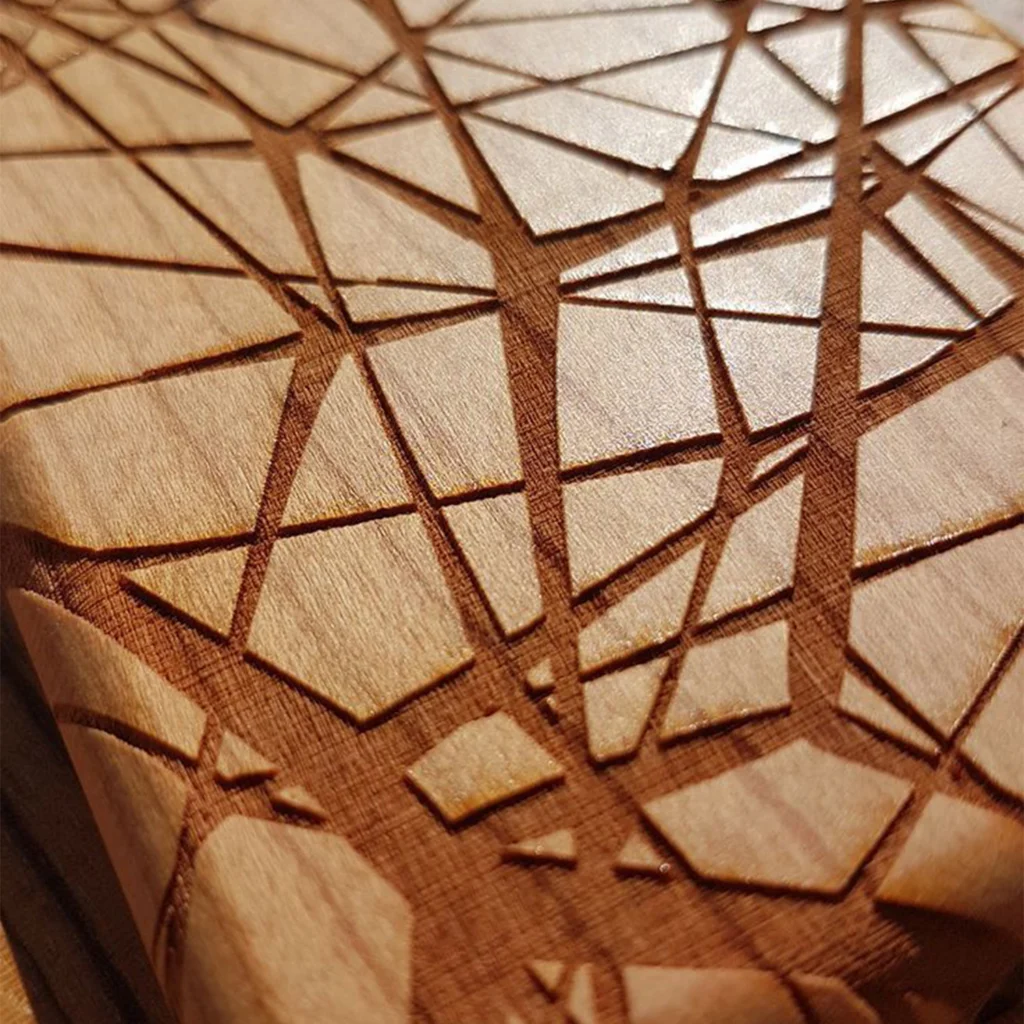
The pad’s flexibility allows it to reach flat, curved, concave, convex or textured surfaces. Conversely, a pronounced relief or a deep area may prevent a satisfactory transfer. Possible substrates include plastics such as ABS, PP, PE, PVC and polycarbonate, metals, glass, ceramics and wood, provided the ink is validated on the actual part.
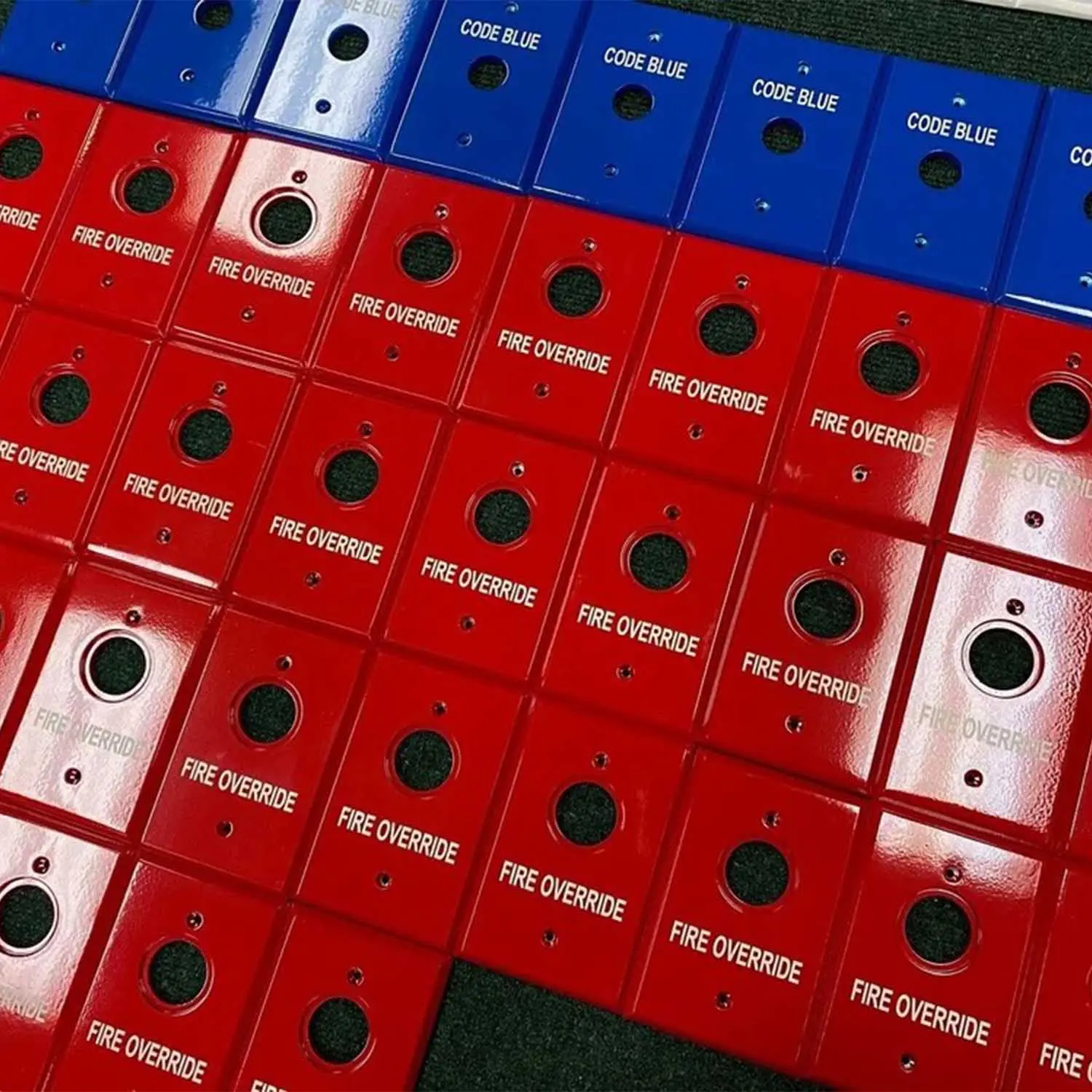
In the electronics industry, this printing technique marks a logo, text, scale markings or a pictogram on housings, buttons, keyboard keys and components. The medical field also uses it on certain components, where precise marking on a small shape is required.
The difference from screen printing and other processes
The difference lies in the path of the ink. In screen printing, the ink passes directly through a stencil screen, which makes it better suited to flat surfaces, whereas the flexible pad serves localized designs on three-dimensional shapes. Choosing a manual or automatic pad printing machine therefore depends first on the geometry of the part.
For a large solid area or a thick deposit, screen printing may be more suitable. A print covering almost the entire circumference of a cylinder often calls for cylindrical screen printing. For complex photographic gradients, UV or digital printing is generally better suited, and variable data points toward inkjet or laser, depending on the material and readability requirements.
Why choose industrial pad printing
- Marking of raised, curved or textured parts
- Manual, semi-automatic or automatic machines depending on cycle rate
- Compatible with a wide variety of industrial materials
- Ideal for small and medium runs in customization

How to get reliable industrial marking?
The quality of a marking depends on consumables chosen as a coherent set: plate, ink cup, pad and ink. Their setting, followed by inspection of the parts, then ensures repeatability from one run to the next.
Choosing plates, ink cups and pads
Each color requires its own plate. The artwork is first prepared by separating the colors. The plate can then be engraved directly by laser, or produced by exposing a film onto a photopolymer plate.
The photopolymer plate may suit short runs or when reordering must be quick. The steel plate, by contrast, meets needs for longer service life and higher repeatability. No universal economic threshold separates the two: compare their price and service life for your application.
Compared with an open ink cup, a closed inkwell contains the ink better, but its diameter limits the size of the marking. The condition of the doctor blade ring and the flatness of the plate determine consistent wiping. On the pad side, shape, hardness and profile are chosen according to the design and access to the area, since excessive compression can distort the image and accelerate cracking of the pad.
Matching the ink to the substrate
Solvent-based, two-component and UV-curable inks do not require the same transfer and drying conditions. The Printcolor inks presented by Thermoflan include two-component and UV systems, among others. On a plastic such as PP or PE, whose surface energy is low, any pretreatment (cleaning, plasma, corona or primer) must be validated with the ink and the part.
Once the ink is chosen, a touch-dry test does not prove final durability. In practice, test adhesion, abrasion resistance or chemical resistance only after the curing time suited to the substrate and intended use.
Setting up and controlling production
Setup changes one parameter at a time to isolate the effect of each setting. The settings involved:
- Inking: ink load and quality of the wiping on the plate.
- Contact and stroke: depth of pad pressure on the plate and on the part.
- Speed: how quickly the pick-up and deposit movements are made.
- Transfer time: delay between ink pick-up and ink deposit.
The validated recipe then records these settings and the consumables. Inspection checks for smudges, ink shortfalls, colour deviations and position defects. Batches, plate version, pad, results and scrap are recorded, and the first parts are rechecked after each change of run.
Which solution should you choose for marking your parts?
Choosing equipment depends on the degree of automation, actual throughput and total cost. In some cases, a service provider is an alternative to an in-house installation, with different safety obligations.
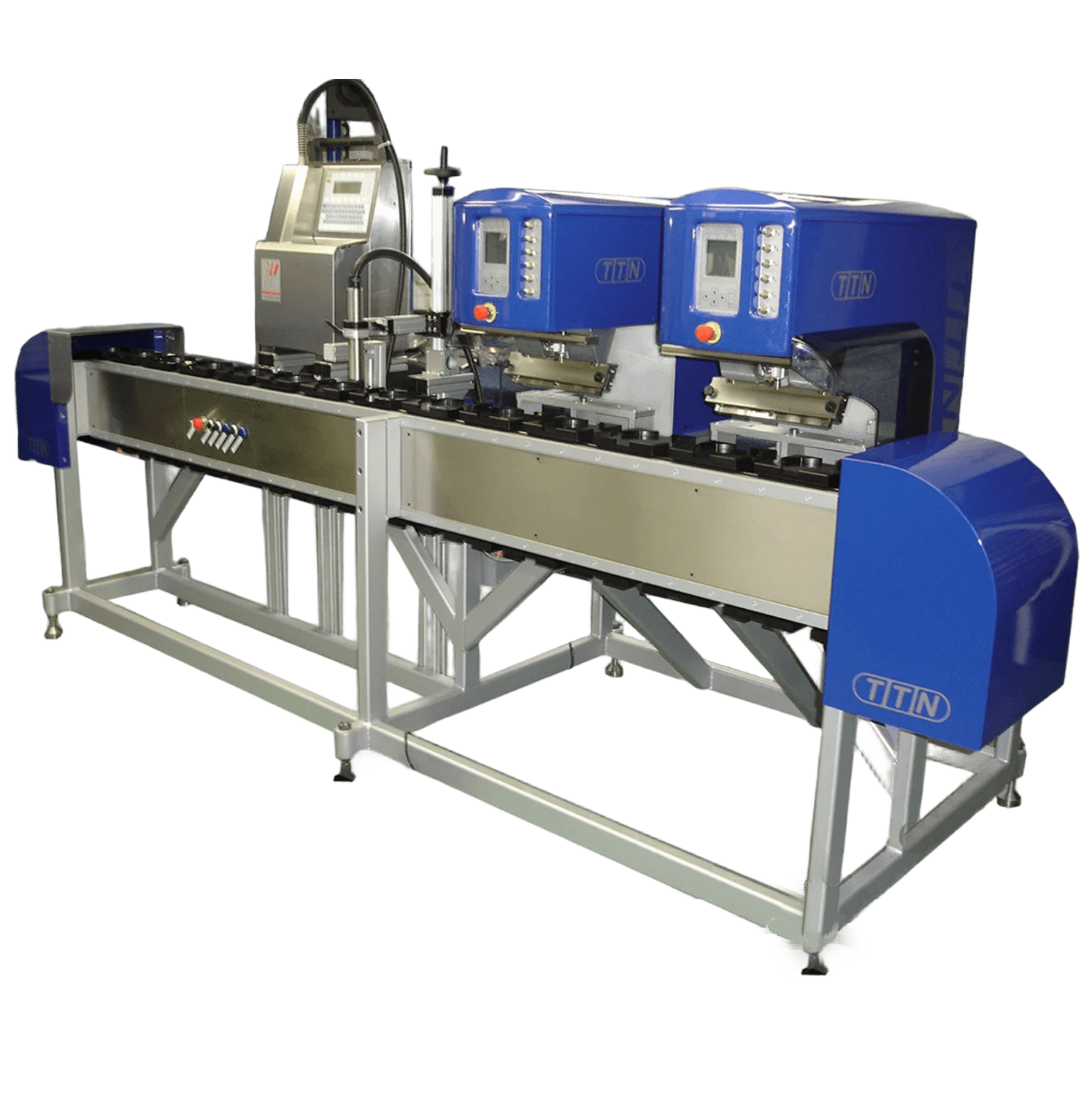
Manual, Universal and Pro machines
Thermoflan offers three ranges, which differ in how tasks are shared between the operator and the pad printing machine:
- Manual: the operator positions the part and starts the cycle; ergonomics, repeatability and series changeover time remain key factors.
- Universal: the cycle is automated and the operator positions the parts; some models are suited to elongated parts.
- Pro: marking in one to six colours and control of conveyors, indexers or surface treatment systems.
- Prototypes: the manual machine, in one or two colours, covers trials and small runs.
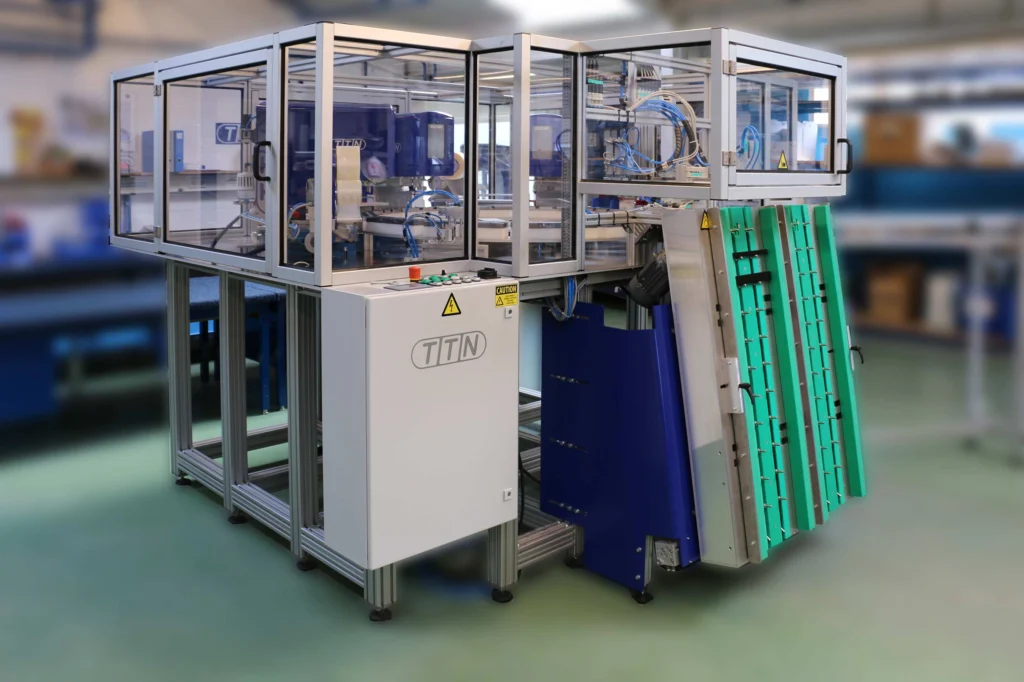
For large runs, the Pro range includes TTN automatic machines. The TTN Série 100 automatic pad printing machines are offered from €5,800. The TTN Série 350 automatic pad printing machines start at €17,800. These list prices do not necessarily include accessories and integration.
| Thermoflan range | Colours | Operator’s role | Entry price |
| Manual | 1 or 2 | Positions the part and starts the cycle | Not disclosed |
| Universal | 1 or 2 | Positions the part | Not disclosed |
| Pro TTN Série 100 | 1 to 6 (Pro range) | Depends on the automation chosen | From €5,800 |
| Pro TTN Série 350 | 1 to 6 (Pro range) | Depends on the automation chosen | From €17,800 |
Actual throughput and total cost
For one part per cycle, theoretical throughput is obtained by dividing 3,600 by the cycle duration in seconds. A manual single-colour machine delivers at most 600 cycles per hour, without guaranteeing 600 conforming parts.
An automatic configuration can reach 5,000 parts per hour or more. This figure depends on the automation, the number of colours and the complexity of the marking. Actual capacity also accounts for loading, stoppages, changeovers, drying, inspections and scrap.
The total cost of in-house production adds up equipment, tooling, labour, consumables, inspection, scrap and maintenance. For a batch of N parts, the simplified average cost is written F/N + V, where F is the fixed cost of the batch and V the variable cost per part.
Subcontracting and workstation safety
A service provider is justified when volumes, order frequency or technical constraints do not warrant an in-house installation. The plate remains a fixed cost: in Thermoflan’s example, a €15 plate adds €1.50 per part over 10 items. Over 100 items, this falls to €0.15 per part, before other costs. For a comparable quote, specify material, geometry, design, colours, quantities, tolerances and durability requirements.
Internally, Article R. 4121-1 of the French Labour Code requires the risk assessment to be recorded in the single risk assessment document (DUERP). Even with a CE-marked machine, this assessment covers solvents, pinching, repetitive movements, ventilation and any integration of a conveyor or robot.
Find your industrial pad printing machine
Manual, Universal or Pro: ThermoFlan helps you choose the pad printing machine that suits your parts and your production rate.
Frequently asked questions
How do you print multi-colour markings by pad printing?
The number of colours depends on the number of ink cups installed: two ink cups allow two colours. Successive re-printing can exceed this number, provided the parts are repositioned very precisely. Each colour requires its own plate and transfer, and registration, drying and cycle time must be taken into account. Air assistance limits the movement or mixing of inks already deposited.
What should you check in case of smearing, incomplete printing or poor adhesion?
For smearing, check the excess ink, the condition of the doctor blade ring and the contact setting. Incomplete printing points to inking, transfer time and pad profile. Poor adhesion calls for reviewing ink compatibility, any pretreatment and the curing delay. Unstable registration requires checking the tooling, mechanical play and fixings.
What obligations apply to ventilation of a pad printing station?
Articles R. 4222-20 to R. 4222-22 of the Labour Code require regular maintenance and inspection of ventilation systems. Article R. 4222-21 also provides for operating instructions and measures in case of breakdown. INRS, in its document ED 6049, describes prevention through ventilation and capture of emissions, particularly during preparation and cleaning.