



Contents
- Which laser engraving to choose for each metal?
- How to compare precision and throughput before buying?
- How much does a laser engraving machine cost?
- What safety checks should be made before commissioning?
- Frequently asked questions
Choosing a laser engraving machine for metal starts with the result you expect on your parts. The choice then depends on the source, fiber or UV, according to the metal; on precision and throughput measured through trials; on the investment, new or used; and finally on the safety of the workstation before it is commissioned.
Which laser engraving to choose for each metal?
The choice of laser technology depends on the metal, its surface finish and the intended result: surface contrast or relief. The same laser engraving may therefore succeed on brushed stainless steel and fail on polished aluminum.
Why choose a fiber or UV laser?
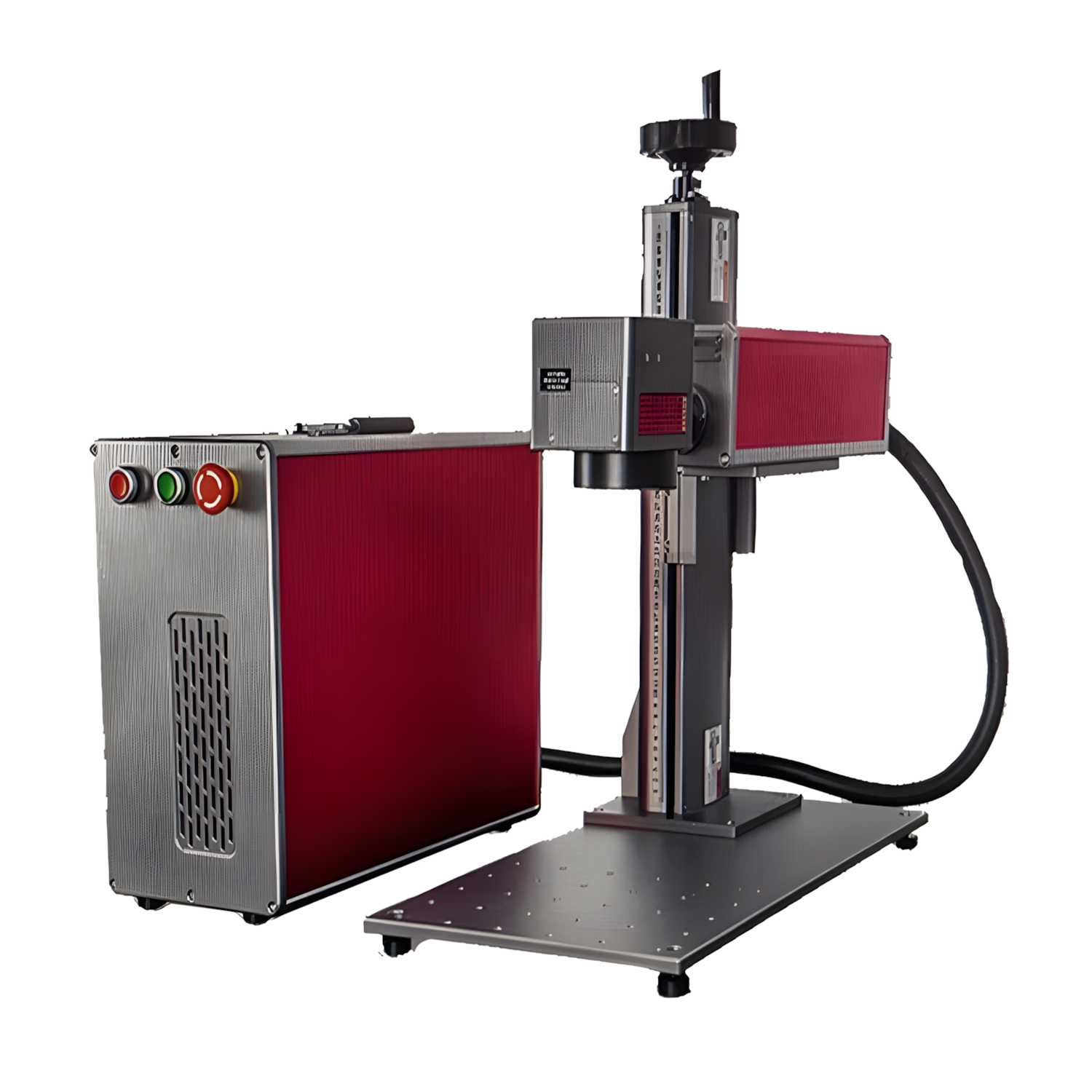
For laser engraving on metal, the fiber laser generally remains the first technology to evaluate. Its laser source amplifies radiation within an optical fiber, often around 1,064 nm, in a range of about 1,030 to 1,064 nm depending on the source. In a typical fiber laser system, galvanometer mirrors then deflect the beam toward the workpiece.
By contrast, a UV marking laser typically operates at 355 nm. It deserves a trial when your parts carry microtext or do not tolerate heat well, without necessarily being more precise or faster than fiber. As a complement, a MOPA fiber laser lets you adjust pulse duration to seek certain contrasts or color effects on stainless steel, though results are not guaranteed.
Which fiber laser marking to choose for each metal?
Carbon steel and stainless steel are well suited to fiber laser marking tests. On stainless steel, distinguish between black annealing, which colors the surface, and material removal. Corrosion resistance is then verified according to the grade, the finish, and the intended use of the part. For simple black markings on steel plates, a standard fiber laser correctly adjusted may be sufficient.
On aluminum and copper, reflectivity is a bigger factor, as summarized in the table below. CO₂ lasers generally operate at around 10.6 µm, and bare metals reflect this radiation to a large extent. Some coated or anodized metals can still be marked by acting on their layer, and your test must then separate the effect on the coating from the effect on the underlying metal.
| Metal | Technology to test | Checkpoint |
| Carbon steel | Fiber | Contrast, depth, oxidation |
| Stainless steel | Fiber, MOPA fiber | Black annealing or material removal, corrosion resistance |
| Bare aluminum | Fiber | Finish and reflectivity |
| Anodized aluminum | Fiber, CO₂ on the layer | Contrast from local removal of the anodized layer |
| Copper | Fiber, UV for certain fine markings | Absorption and heating |
| Bare metal under CO₂ (10.6 µm) | Not suitable | High reflection of the radiation |
Are fiber laser engraving and laser cutting comparable?
Surface marking creates contrast without significant material removal. Deep laser engraving, on the other hand, removes metal to form a relief, so the black annealing on stainless steel is not a cavity. The difference lies in the volume removed: 0.20 mm on a small number and 0.20 mm over a large solid surface do not represent the same amount of metal.
To qualify a deep fiber laser engraving, measure the depth, the engraved area, the total time, the evenness of the bottom, and any cleaning operations. The ability to engrave does not mean the ability to laser-cut sheet metal, which requires dedicated industrial machines. For deep material removal, UV throughput should be measured and compared with that of a pulsed fiber laser on the intended part.
Tip
Choose your laser based on the metal and the desired result
Choosing between fiber and UV depends on the metal, its surface condition, and the expected result: surface contrast or relief. Identify these before comparing machines.
How do you compare precision and throughput before buying?
Once the technology is preselected, two laser marking machines should be told apart by measured results, not catalog values. Precision depends on the optics and the working area used, while throughput is judged over the full part cycle.
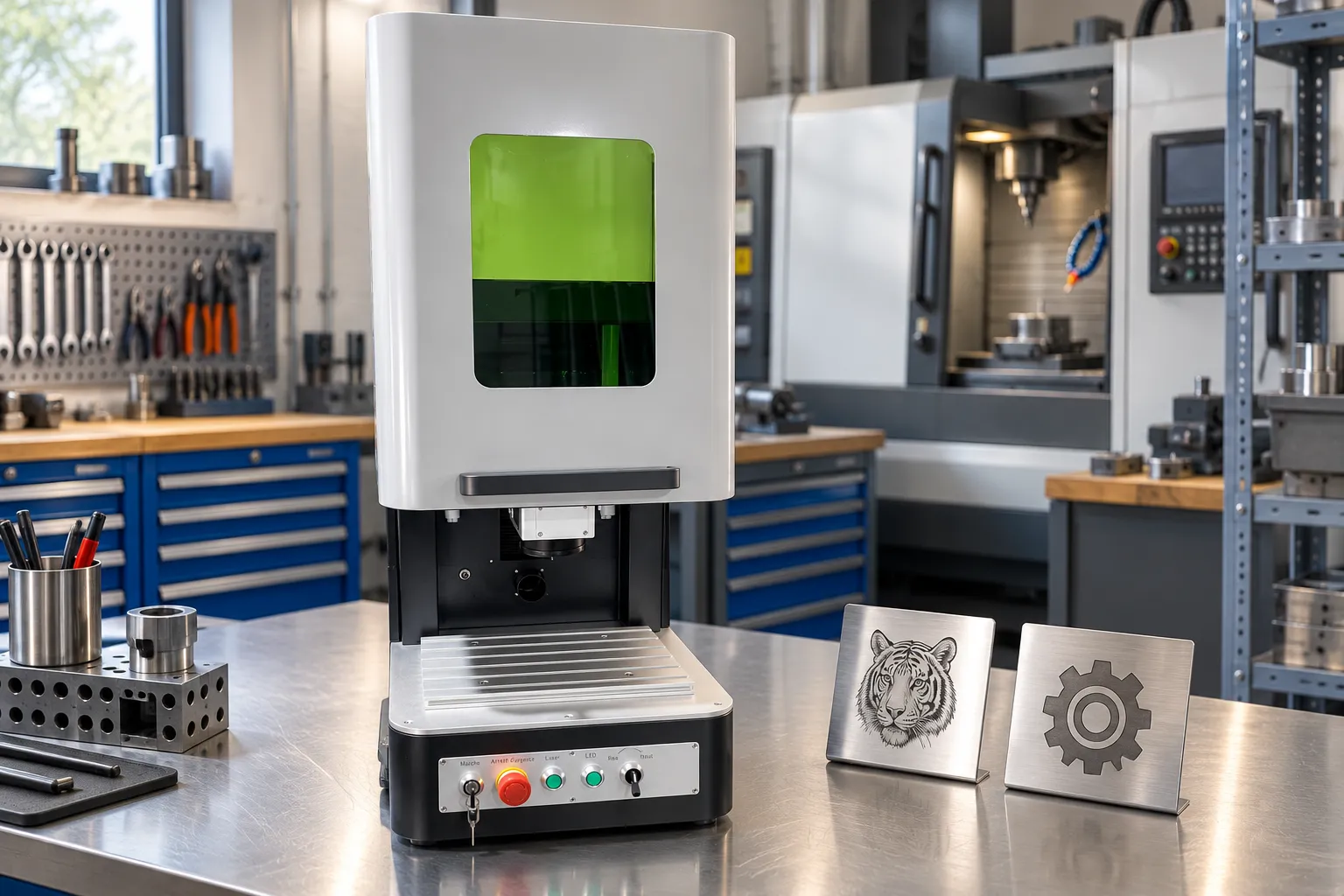
Which marking area stays precise?
Nominal laser power predicts neither contrast, fineness, depth, nor speed. Likewise, a spot size or resolution stated in micrometers does not guarantee a line of that width on metal. For pulsed sources, compare these quantities instead:
- Average power: energy delivered continuously by the laser beam over the duration of the marking.
- Energy per pulse: amount of energy delivered by each shot onto the material.
- Pulse duration and frequency: time of each shot and number of shots per second.
- Peak power: maximum level reached during a pulse.
The marking area depends on the optics and scanning: enlarging the field does not guarantee identical quality in the corners. In practice, check the working distance between the laser head and the part, the depth of field, and the focus on tall, curved, or inclined parts. Precision also covers positioning repeatability, dimensional deviation, and consistency between parts.
What cycle time can a laser marking machine achieve?
A scanning speed announced at up to 7,000 mm/s is not a cycle time. The full cycle chains together loading, clamping, identification, focusing, firing, inspection, and unloading. For illustration, 500 parts at an 8-second cycle represent 66.7 theoretical minutes. At 20 seconds, the same batch takes 166.7 minutes, before stoppages and handling.
This gap is often closed outside the source itself. In repetitive production, a multi-part fixture, a rotary axis for cylindrical parts, a camera, or an enclosed station can reduce the cycle time more than an increase in nominal laser power.
How do you decide between two machines through trials?
A comparative test starts with representative parts, prepared and clamped in the same way on each laser marking system. Define their characteristics beforehand:
- Material: grade, finish, and geometry of the actual part.
- Target result: contrast, depth if applicable, and marking size.
- Durability requirements: conditions the marking must withstand after processing and in use.
A matrix then varies power, speed, frequency, line spacing and number of passes. A grid of 10 speeds and 10 powers gives 100 combinations. With 5 × 5 mm cells, it occupies 2,500 mm², or 25 cm², excluding margins. Finally, link the settings and lens to the measured depths, the full cycle time and the conforming parts rate, and check the readability of a code with the reader planned for production.
What does a laser engraving machine cost?
The advertised price of a laser engraving machine covers only part of the expense. Installation and cost per part complete the calculation, as does the choice between a fixed station and a portable solution.
What is the investment and the cost per part?
In France, a professional fiber metal laser engraver with deep engraving starts at €4,200, though these figures are only orders of magnitude. Depending on the installation, metal engraving equipment also includes the enclosure, extraction, optional cooling, tooling, software and maintenance. The cost per part then includes the full cycle, scrap, consumables, energy and labor.
When should you choose a portable laser engraver?
Thermoflan offers the Fiber Mark Tool, a portable fiber laser engraving machine. This mobile laser marks parts directly on site, particularly when they are too bulky to move to a fixed station, and can be very useful for markings
Comparing a portable fiber marking laser with a fixed station requires factoring part handling and station organization into the cycle time. Firing time alone is not enough to decide.
What safety checks should be carried out before commissioning?
New or used, a laser engraving machine only goes into production after a risk analysis of the workstation. This covers radiation, fumes and cooling, and relies on standards, the Labour Code and compliance documents.
What risks must be controlled at the workstation?
According to INRS, a class 4 laser can present a hazard to the eyes and skin, including through diffuse reflection, as well as a fire risk. An enclosure only brings the whole system down to laser class 1 if its classification and protections have been established. The assessment covers these points:
- Radiation: direct and reflected beam, access during adjustment and maintenance.
- Fumes and particles: emissions from the metal or coatings being engraved.
- Extraction: filtration suited to the materials processed and the duration of the cycles.
- Cooling: method chosen for the source, air or liquid.
Regarding extraction, the mention “HEPA” alone does not demonstrate treatment of gaseous contaminants. Therefore, require the supplier to state the nature of the pollutants actually treated by the filtration.
Cooling the source and extracting fumes remain two distinct functions. Some equipment is air-cooled; a liquid circuit, however, requires compliance with the requirements on the fluid, flow rate, temperature and maintenance.
Which rules govern operator protection?
The standard NF EN ISO 11553-1 / ISO 11553-1:2020, published in April 2020, addresses the safety of laser processing machines without replacing the risk analysis of the installation. In addition, ISO 13849-1:2023, published in April 2023, serves as a reference for the safety-related parts of control systems.
In France, laser protection measures depend on the actual exposure at the workstation, as provided for by the articles of the Labour Code on risks related to artificial optical radiation (R. 4452-1 et seq.). Suitable goggles do not replace a properly designed enclosure. According to Article R. 4323-1, the employer also informs workers of the conditions of use and maintenance, the instructions, and the foreseeable abnormal situations.
Thermoflan ensures that our machines meet its standards.
Which documents should you check?
On a laser machine, check the declaration of conformity, the CE marking, the French-language manual, and the safety of the entire installed system, including accessories. The Machinery Directive 2006/42/EC and Regulation (EU) 2023/1230 apply according to their application timelines and the date the product is placed on the market or put into service.
Fiber and UV lasers for metal marking
Have you defined your metal, the expected result, and your production rate constraints? Compare Thermoflan’s fiber and UV lasers and ask its experts for advice.

Frequently asked questions
Is it possible to laser engrave steel?
Yes, carbon steel lends itself well to fiber laser trials, provided you check the contrast, depth, and oxidation achieved. Deep engraving may require successive passes. A highly contrasted marking does not necessarily withstand abrasion, cleaning, or later treatment.
Can a diode laser replace a fiber laser for engraving metal?
Some diodes produce a thermal effect on certain bare metals, but this does not necessarily demonstrate a deep engraving capability equivalent to that of a pulsed fiber laser. The term “infrared” refers to a spectral range: an infrared diode source is not necessarily a fiber laser.
Can brass, titanium, or precious metals be laser engraved?
Brass can be marked with a fiber laser after tests that account for its composition, color, and surface finish. Titanium accepts various markings, though colored effects and oxidation must be verified. Gold, silver, and their alloys can be marked in certain configurations, with representative tests required due to their reflectivity and value.