







Table of contents
- How do the two technologies produce their beam?
- Fibre or CO₂ laser depending on materials
- Speed, precision and cutting thicknesses
- What is the real cost of each technology?
- How to validate your choice before investing?
- Frequently asked questions
The difference between a fibre laser and a CO₂ laser lies mainly in the laser source and its wavelength. These characteristics determine the materials compatible with each technology and their marking or engraving capabilities.
How do the two technologies produce their beam?
Each laser technology generates its radiation according to a different principle and delivers it to the workpiece through a specific optical system. These two characteristics explain the main differences observed in the workshop, both in terms of the materials processed and the maintenance of the optics..
Two sources and two wavelengths
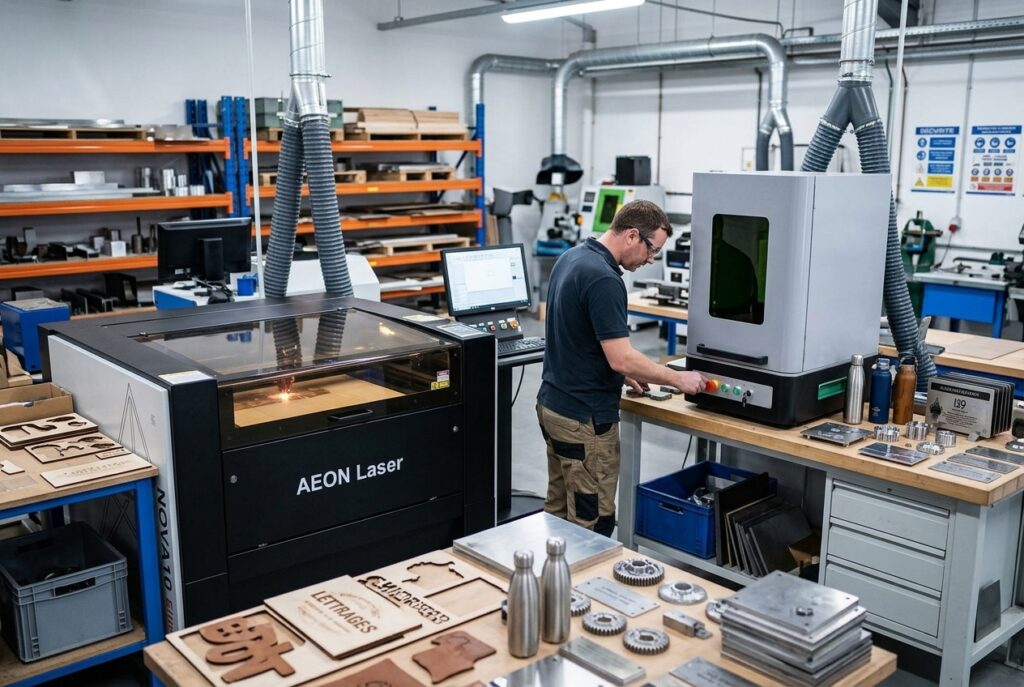
A fibre laser amplifies radiation within a doped optical fibre, most often doped with ytterbium, which is powered by diodes. By contrast, a CO₂ laser produces its laser beam by electrically exciting a gas mixture containing carbon dioxide.
The wavelength is about 1.06 µm for fibre. It is about 10.6 µm for CO₂, in the far infrared. These values determine how the material absorbs the beam, but on their own they do not guarantee any cutting performance.
Beam delivery via optical fibre
In a fibre architecture, an optical fibre cable carries the beam to the processing head. This cable carries the laser light: do not confuse it with the electrical cables or the machine’s control cables.
A classic CO₂ architecture works differently: mirrors guide the infrared beam, then a lens focuses it onto the workpiece. This principle is found on the range of professional CO₂ laser machines.
The transport method alone is therefore not enough to classify laser sources. For example, a disk laser whose beam passes only through a fibre remains a disk laser, not a fibre laser.
Continuous and pulsed sources
In practice, sheet metal cutting generally requires a high-power continuous source. Pulsed sources are mainly used for marking, engraving and certain fine work. The average power of a pulsed source does not, on its own, tell you about the duration, energy and peak power of its pulses.
Whatever the source, cutting remains a thermal process with no mechanical contact. The focused beam melts or vaporises the material at the targeted spot. An assist gas then removes this material while the head follows the programmed contour.
Tip
Choose between fibre and CO₂ depending on the material
Fibre laser is generally preferred for metals, CO₂ for most non-metals. For coatings and plastics, a case-by-case check is required, through a test on your parts.
Fibre or CO₂ laser depending on materials
Choosing starts with the material, since each wavelength is absorbed differently. Metals generally point toward fibre, and most non-metals toward CO₂. Coatings and plastics, however, require case-by-case checks.
Bare, reflective or coated metals
For industrial sheet metal cutting, fibre is generally the preferred solution, provided the machine’s power and configuration are suited. The following cases require special attention:
- Steel, stainless steel, aluminium: these three metals are the usual domain of industrial fibre cutting.
- Copper and brass: they can be cut on fibre machines designed for reflective metals. Check the protection of the head and source, as well as the piercing conditions.
- Steel cut with CO₂: an industrial CO₂ laser can cut steel and stainless steel. However, the capabilities of a small CO₂ engraver say nothing about those of an industrial installation.
On painted or anodised metal, it is the coating that reacts to the beam. As shown in the last part of this section, this case is not handled the same way as bare metal.
Wood, PMMA, glass and plastics
CO₂ lasers are particularly well suited to cutting and engraving organic materials: wood, paper, cardboard, textiles and leather, as well as PMMA. A standard fiber infrared laser is generally not the usual choice for cutting wood or PMMA.
Among non-metallic materials, each plastic requires checking the polymer, its color, its additives and the machine manual. Never consider PVC compatible by default: laser processing it can release hazardous gases and cause corrosion.
| Material | Fiber laser | CO₂ laser |
| Steel, stainless steel and aluminum sheet | Generally preferred for industrial cutting | Possible on an industrial installation |
| Copper, brass | Machine designed for reflective metals | More demanding |
| Wood, PMMA, cardboard, leather, textile | Not the usual choice for cutting | Particularly suitable |
| Glass | Not a direct replacement for CO₂ | Surface engraving depending on the machine |
| Plastics | Marking of certain polymers | Engraving or cutting of certain polymers |
| PVC | Never presumed compatible: hazardous gases and corrosion |
Glass calls for the same caution. Depending on the machine, a CO₂ laser can engrave the surface of glass, but that does not prove it can cut it cleanly.
Cutting, engraving and marking
These three operations are not the same. Laser cutting goes through the part. Engraving removes material without going through it. Laser marking may be limited to changing the appearance of the surface. For part references, serial numbers and Data Matrix codes on metal, fiber laser engraving is the usual solution. For this purpose, Thermoflan offers a range of fiber laser engraving machines designed for component identification.
A standard CO₂ engraver acts mainly on a painted or anodized layer rather than on bare metal. Thermoflan offers flatbed CO₂ machines for engraving and cutting plates, and galvanometer stations for rapid marking within a defined work area.
Speed, precision and cutting thicknesses
The stated performance applies only to a given material, thickness and machine. You must therefore read each figure together with the configuration it refers to.
Throughput on thin metals and other materials
On thin metal sheets and tubes, fiber laser cutting is generally faster than CO₂. A comparison between machines on 1 mm metals shows a speed 5 to 6 times higher. This ratio only applies to the machines compared.
The trend reverses on other materials: on wood and thick acrylic, CO₂ laser cutting can be faster than fiber. The same comparison describes a polished edge on 10 mm acrylic cut with CO₂.
Once the speed is known, the actual throughput still needs to be assessed. Contours, drilling, loading, preparation and sorting also determine how many conforming parts are produced per hour.
Machine precision and part quality
Fiber generally forms a smaller focal spot and a narrower kerf than CO₂. This can favor fine details on metal. Positioning accuracy measures the gap between the commanded position and the position reached. Repeatability measures the machine’s ability to return to the same position.
Neither of these values alone gives the tolerance of the part. The difference depends on the axes, rigidity, calibration, material holding and settings. Check dimensions, kerf width, edge quality, burrs and repeatability.
Maximum thickness and productive thickness
For low-to-medium thickness steel tubes, one comparison places fiber’s favorable applications at up to about 10 to 20 mm, depending on power. Beyond 20 to 25 mm, on some very thick tubes, a high-power industrial CO₂ laser can sometimes give a straighter edge. Whatever the laser cutting machine, the stated maximum thickness guarantees neither a steady throughput at that thickness nor a consistent edge quality.
What is the real cost of each technology?
The cost of a machine depends neither only on its source nor on its stated power. Investment, operating costs and maintenance must be compared on identical production.
Investment and cost per part
The price of a CO₂ laser machine does not depend solely on its source. Several other items affect the investment:
- Structure and motion: format, table, axes and head.
- Peripherals: automation, extraction and cooling.
- Laser tube type: at Thermoflan, a glass tube costs less to purchase than an RF tube. The RF tube stands out for its stability and its precision in fine engraving.
glass-tube CO₂ laser cutting tables correspond to this more economical starting choice. To compare costs, use the same parts and the same requirements. The cost per conforming part includes cycle time, consumables, auxiliaries, rework and scrap.
Electricity, gas and efficiency
Fiber lasers generally convert electricity into laser light more efficiently. A comparison on tube cutting gives an efficiency of 25 to 40% for fiber. It gives 8 to 10% for CO₂, without measuring the consumption of the entire installation.
To judge the real efficiency, record the kWh of the source, cooling, extraction and compressed air, both in production and on standby. Assist gas is added with both technologies: nitrogen is commonly used to obtain a stainless steel edge with little oxidation, and oxygen can be used for carbon steel.
Maintenance and service life
On a conventional CO2 laser, maintenance mainly concerns the mirror-based optical path. If these mirrors become dirty or misaligned, the beam deteriorates. Fibre transmission reduces this optical maintenance. It does not eliminate maintenance of the protective window, nozzles, cooling, table and extraction.
One comparison gives 20,000 to 25,000 hours for the CO2 laser tubes it describes. It gives about 100,000 hours for the diodes of the fibre sources studied. These service lives apply to these components, not to the complete machine.
How to validate the choice before investing?
The compatibility table gives a first indication. Only a test on your own parts and a complete technical file can then confirm the choice.
Tests on actual parts
A comparative test starts with the same batch of parts representative of your production. This batch is defined by the following criteria:
- Material: grades and surface finishes.
- Geometry: thicknesses and cutting lengths.
- Holes: number of holes per part.
On each machine considered, record the cycle time, scrap, edge condition, gas consumed, kWh on the meter and setup time. For laser cutting, add tolerances, burrs, oxidation and piercing time. The nominal power or maximum thickness in the catalogue is not enough to decide.
Configuration and data to request
A fibre station intended for laser marking does not replace a fibre sheet-metal cutting machine: the power, head, table and process differ. In your technical consultation, request the following separately:
- Cycle time: measured on your own files and actual materials.
- Total power consumption: that of the entire installation, not just the source.
- Gas and consumables: type and quantities.
- Maintenance plan and safety documentation: provided for the proposed configuration.
Compared item by item, these answers show whether the proposed laser cutting machine suits your production.
Safety and compliance in France
Under articles R. 4452-7 to R. 4452-12 of the French Labour Code, the employer assesses the risks linked to artificial optical radiation and records the results in the DUERP (single occupational risk assessment document). If this risk assessment for optical radiation reveals a risk of exceeding exposure limit values, the employer determines the necessary measures.
Prevention relies on beam enclosure, interlocking, training and fume extraction. Standards NF EN ISO 11553-1 and NF EN 60825-1 serve as references for laser safety and classification. In premises with specific pollution, article R. 4222-10 of the Labour Code requires capturing pollutants as close as possible to their emission when they cannot be eliminated.
The order of 8 October 1987 requires at least an annual check of the flow rates and condition of the extraction installation. On delivery, check the EC declaration of conformity, the manual, the laser class and the safety instructions corresponding to the configuration supplied.
Fibre and CO₂ lasers: validate your choice
Metals, wood, PMMA or plastics: Thermoflan offers fibre and CO₂ lasers. Ask for advice to confirm your choice on your own parts.

Frequently asked questions
What is the lifespan of a CO₂ laser?
No single lifespan applies to all CO₂ lasers. It depends on the aging of the source, thermal conditions, cooling, usage and maintenance. RF tubes generally last longer than glass tubes. A lifespan stated for the tube applies neither to the optics nor to the complete machine.
Which laser is the most efficient in production?
No technology wins by principle. A higher rated power does not improve productivity if setup, gas consumption, downtime or scrap increase. Track conforming parts per hour, kWh, gas, setup and maintenance times, availability, and cost per conforming part.
Can a single laser machine process both metals and non-metals?
A workshop that processes both metals and non-metals may need two complementary sources rather than one supposedly universal machine. Aluminum, copper and brass are harder to process with CO₂ than with a suitable fiber machine. Their reflections can also damage optical components.