


Table of contents
- What laser engraving machine for glass?
- What glasses and objects can be engraved?
- How do you compare models and manufacturers?
- What protections and obligations apply to the workstation?
- Frequently asked questions
Choosing a laser engraving machine for glass depends first on how each source interacts with the material. This article compares CO₂ laser and UV laser: interaction with glass, rendering, precision and throughput. It then covers compatible glasses and objects, the method for comparing models, and the safety obligations that apply to the workstation in France.
What laser engraving machine for glass?
CO₂ and UV are the two technologies Thermoflan offers for engraving and marking glass. They do not produce the same marking and therefore do not target the same designs. Conversely, other common sources in workshops do not mark bare glass.
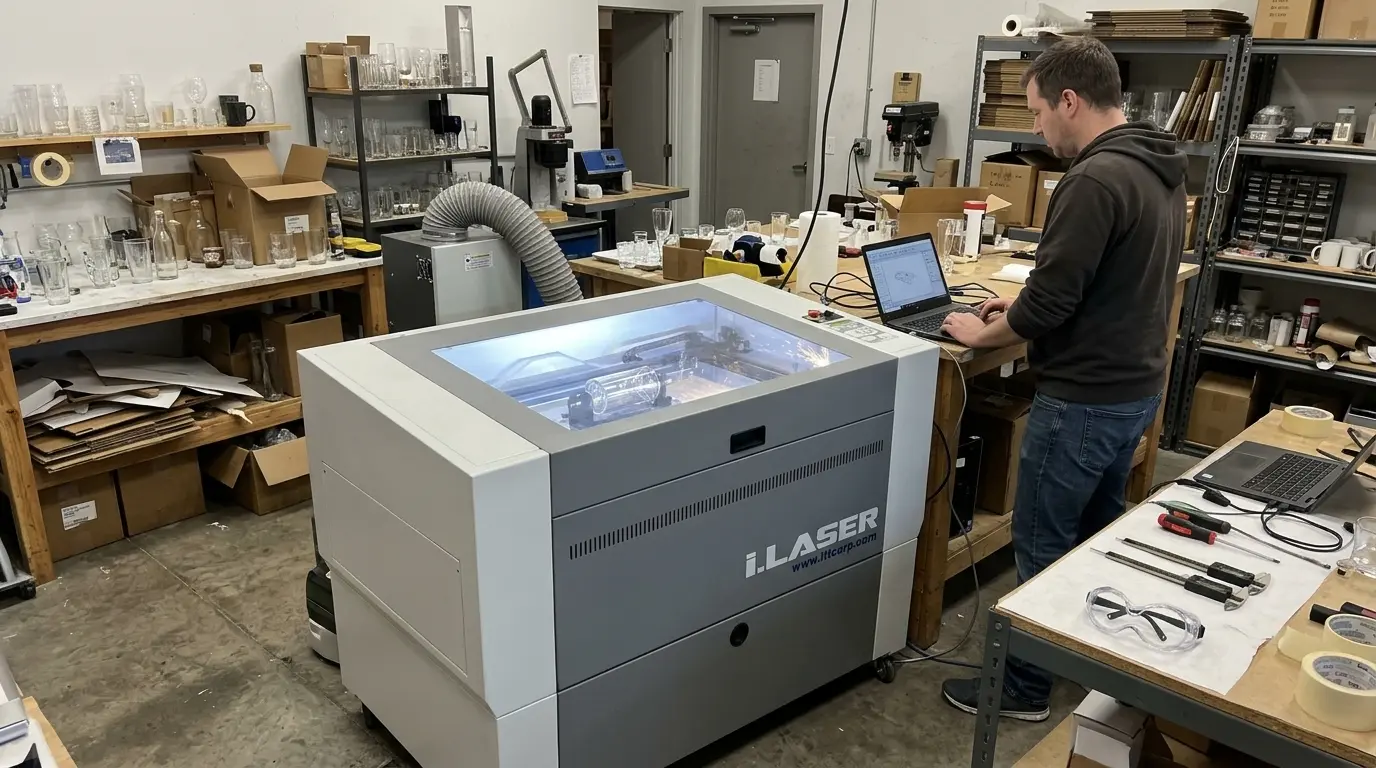
CO₂ and UV, two distinct interactions
To engrave glass, the CO₂ laser beam, at 10,600 nm, is absorbed right at the surface. Local heating creates shallow micro-fracturing: the microcracks scatter light and give a white, frosted appearance, close to sandblasting. According to the trade journal Verre, these microcracks reach a depth of a few micrometers.
The UV laser, at 355 nm, works differently: its effect depends on the glass’s absorption at this wavelength. Ablation may include a photochemical component that limits heating, without prior coating. This so-called “cold” marking nevertheless produces some heat and can leave defects.
| Criterion | CO₂ laser | UV laser |
| Wavelength | 10,600 nm | 355 nm |
| Interaction with glass | Surface absorption, micro-fracturing | Depends on glass absorption, possible photochemical component |
| Rendering | White, frosted, close to sandblasting | Fine marking, to be validated on the part |
| Prior coating | Not required | Not required |
| Thermoflan positioning | Raw engraving | High-finish marking |
Rendering, precision and marking depth
As the table summarizes, Thermoflan associates CO₂ with raw engraving and UV with high-finish marking. The difference lies in the size of the focused spot and in the heat-affected zone, which can limit the precision of CO₂.
In CO₂ systems studied by the journal Verre in December 2009, the spot struggled to go below 80 µm, or even 50 µm in an extreme case. Characters under 1 mm were then problematic, as were 16 × 16 DataMatrix codes under 5 mm per side. These figures are not certified limits of current machines. Also measure the depth of a UV marking on the intended part, whatever glass engraving solutions you are considering: the technology name alone does not tell you that.
Throughput and limits of other sources
Thermoflan announces a marking speed of up to 7,000 mm/s for its UV Basic and UV Pro stations. This beam travel speed does not give the number of compliant parts per hour, because a fine design may require several passes. In addition, two other sources struggle with bare glass. A blue diode laser of about 450 nm passes through transparent glass without marking it, regardless of its power: it requires an absorbent dark layer. The 1,064 nm fiber laser, which Thermoflan mainly intends for metals and some opaque plastics, is not a solution for direct glass engraving.
Advice
Choose your laser based on the finish you expect on glass
CO₂ produces a frosted engraving through micro-fracturing of the surface, while UV gives a finer marking. Run a test on your own parts before choosing.
What glasses and objects can be engraved?
The compatibility of a part depends on its composition, manufacturing and shape. The word “glass” alone is therefore not enough to qualify a purchase test. Once the material is identified, the remaining steps are choosing the holding method and preparing the design.
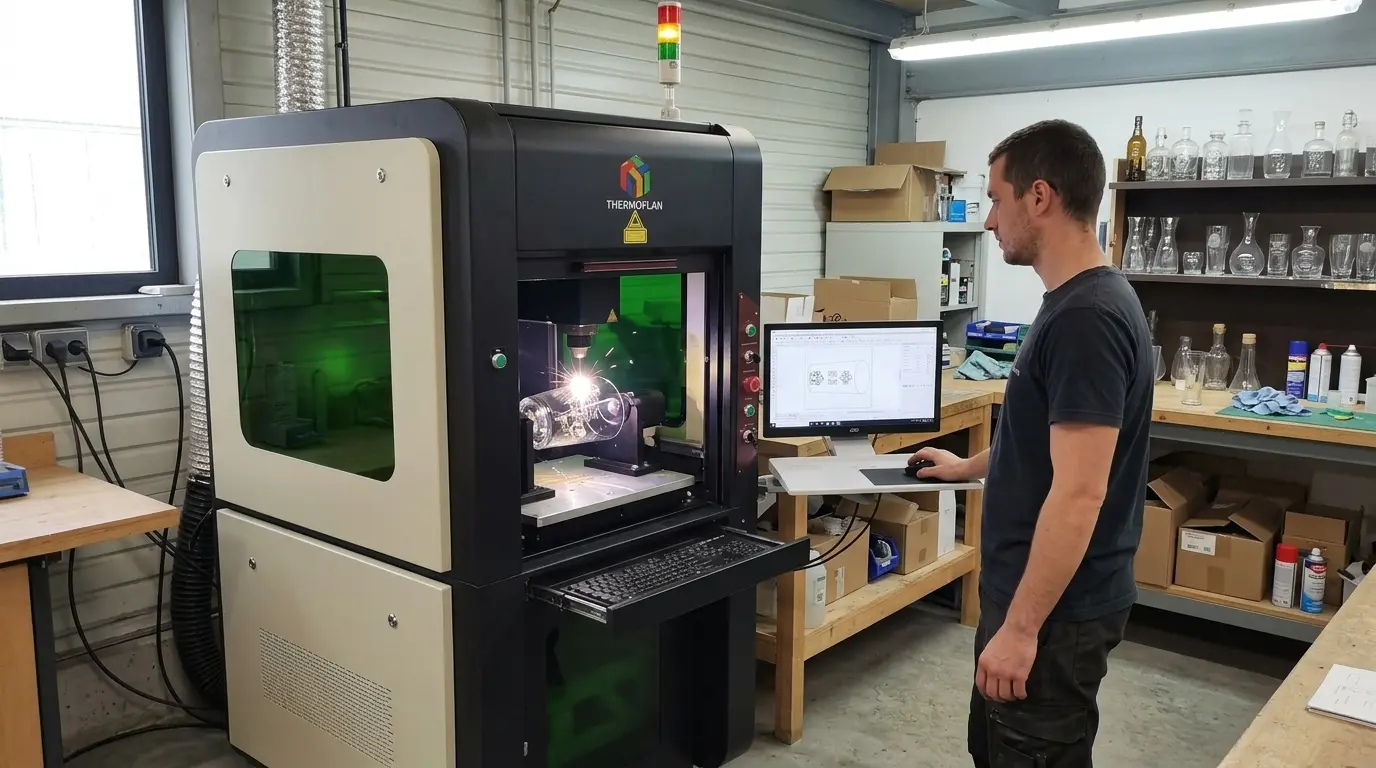
Composition and fragility of parts
Your test plan should distinguish the types of glass involved. The Fédération des industries du verre (French Glass Industries Federation) notably separates hollow glass, flat glass, technical glass and silica glass. Depending on their composition (soda-lime, borosilicate or crystalline), glasses do not have the same properties.
- Molded glass: often more homogeneous, it is generally easier to engrave.
- Hand-blown glass and crystal: their internal stresses can make cracks unpredictable under the effect of the beam.
- Tempered or laminated glass: its compatibility cannot be assumed and must be verified by a test.
Colored or artistic glass requires additional verification. Some contain cadmium or other heavy metals. Check their composition before any engraving.
Bottles and cylindrical parts on a rotary axis
Laser engraving on glass concerns in particular bottles, wine glasses, tankards, jars, dishes and plates. Each of these glass objects requires holding and focusing adapted to its shape.
On a CO2 laser machine, a tray holds flat parts. As soon as the part is round, a rotary cylinder attachment turns it under the beam. Focus adjustment then follows the curvature, including on certain conical shapes.
A UV head can also take a rotary attachment. In practice, the field, working distance, curvature and part positioning are validated together. In particular, wedge a handled glass so that the handle cannot pivot within the field.
Another solution is to use a laser fitted with a 3D head, which allows the laser to be focused differently depending on the height of the part. This is optimal and very fast.
Preparing a design with a consistent rendering
Personalizing text, logos, drawings or photographs starts with a digital file prepared in software. Before engraving, clean and stabilize the part so that fingerprints, misregistration or focus errors do not disturb the design.
Once the file is submitted, the settings influence the condition of the glass surface. Excessive power or resolution, such as overlapping dots, can make the engraving rough. For some designs, one manufacturer cites about 70% grey with halftoning, and 500 dpi for a photograph: these are test starting points, not universal settings.
On CO₂, a damp paper towel can additionally reduce roughness and lighten the marking. It must be laid evenly, without folds or bubbles. After engraving, a damp soft cloth removes residue, then the durability of the design is checked against the expected washing and rubbing.
How to compare models and manufacturers?
The stated power is not enough to tell two machines apart. The comparison rests on a precise specification, tests on your own parts and a measured cycle time. The choice of model comes afterward.
Defining the specification
The specification first describes the parts: known or presumed composition, thickness, heat treatment, coating and tint. It also specifies curvature, diameter, mass, tolerances and variations between suppliers. The expected result completes this description.
- Tint and uniformity: color of the laser marking and evenness of solid areas.
- Sharpness and fineness: minimum line width and minimum character height.
- Contrast and depth: desired depth or simple surface modification.
To compare engravers, ask the manufacturer for the exact reference and the current French data sheet. The request also covers the usable field, depth of focus, and mass and diameter limits. Axes, tooling and line or reading interfaces complete the list.
Validating tests and cycle time
The tests use the final designs: fine text, filled logo, halftone photograph or code. They are carried out at the center and at the edge of the field, as well as in unfavorable positions for cylindrical parts.
For a code, readability is checked with the reader, lighting and orientation planned for production. Also check its durability after cleaning, especially if the glass absorbs little UV.
The full cycle time includes loading, positioning, focusing, engraving, unloading, cleaning and inspection. On a representative batch, count compliant parts, scrap and rework rather than relying on beam speed alone. Validated samples then serve as references at machine acceptance.
Choosing a laser marking machine
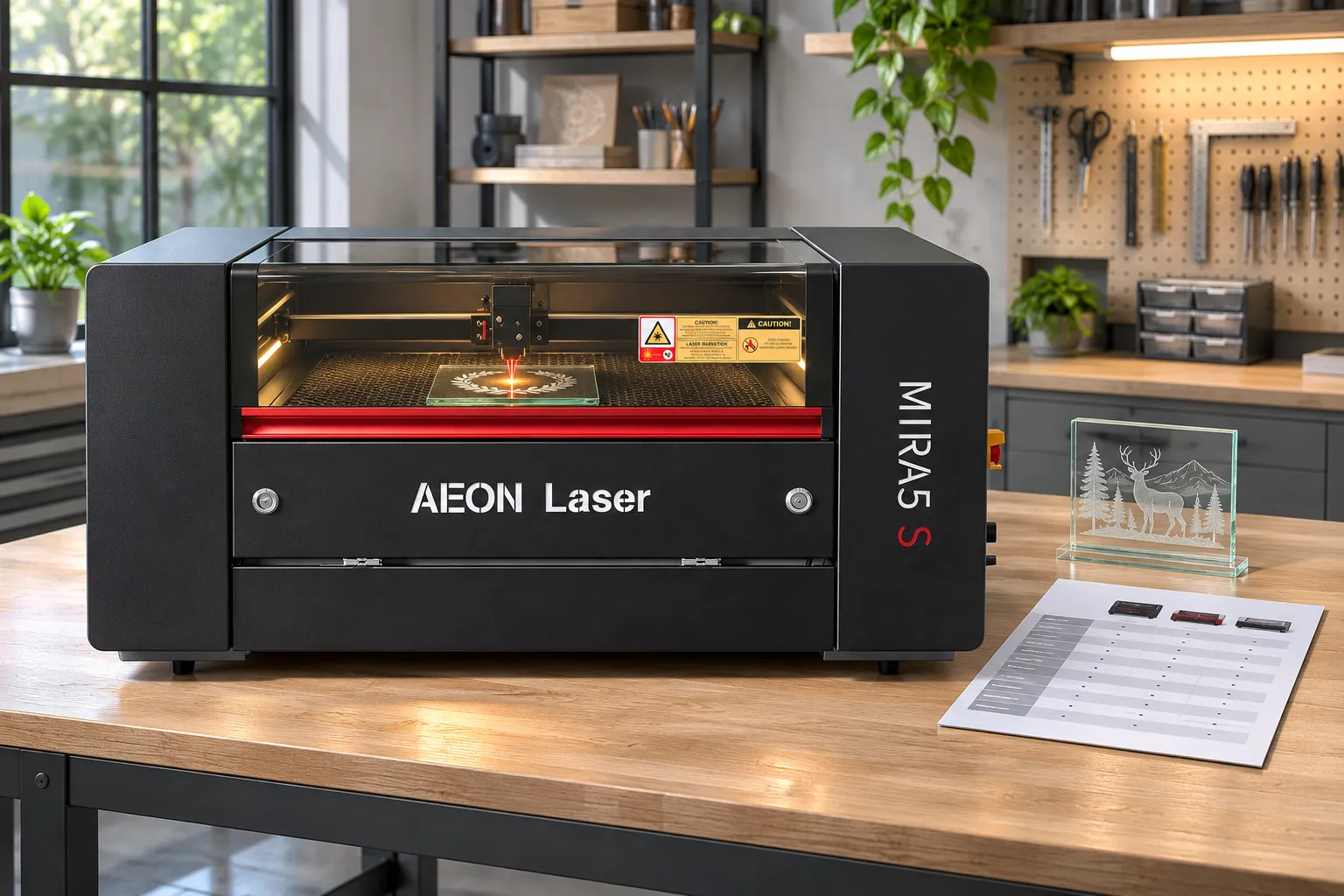
For personalization and prototyping outside large runs, Thermoflan offers in particular the Mira 5 and the compact Redline Mira 5 S in CO₂. The choice between a flatbed and a rotary cylinder is checked against the actual dimensions and shapes of the parts. For fine marking, the UV Basic, open station with galvanometric head is available in 3, 5, 10, 15 or 20 W.
Conversely, the UV Pro, standalone station controlled by an industrial PC is offered in 3, 5, 10, 15, 20 or 30 W. This laser marking machine accepts parts up to 530 × 400 mm, with a pass-through table possible beyond that. The cost of the station is not just the catalog price: source, optics, axes, clamping, enclosure, extraction and cooling all count. Software, installation, training, maintenance and the capital tied up complete this total cost.
The last option is the UV Pro or UV Basic laser with the 3D option, which lets the operator draw the 3D profile of the part. The galvanometric head then automatically refocuses the beam during engraving for optimal results at the different drawn heights.
What protections and obligations apply to the workstation?
A glass engraving station combines laser radiation, possible emissions and employer obligations. Each of these aspects should be checked before commissioning and throughout operation.
Laser classification and protections
The class of the source and that of the complete station are different. A powerful source may be enclosed in a class 1 device for radiation accessible during normal operation. However, opening or maintenance changes the risk. For the safety of the delivered station, request the following items.
- Classification: that of the whole delivered system, not just the source.
- Documentation: instructions in French and declaration of conformity.
- Stops and interlocks: devices that cut off emission when the enclosure is opened.
- Intervention procedures: the actions to take during adjustments and maintenance.
On an open machine, the goggles must match the wavelength, and no one should look at the laser beam. In addition, NF EN 60825-1 governs the classification of laser equipment, and NF EN ISO 11553-1 governs the safety of laser machines, according to an AFNOR fact sheet from April 2020. Compliance with these standards alone does not guarantee the quality of the result on the workpiece.
Extraction and ventilation monitoring
If the process emits pollutants, INRS recommends extraction as close as possible to the emission point, with appropriate treatment or discharge and regular filter maintenance. The requirement is determined from the emissions actually measured, particularly when the glass has a coating.
Once the ventilation or air-treatment system is in place, the order of 8 October 1987 requires a reference values file no later than one month after the first commissioning. In a room with specific pollution, this text requires ventilation inspection at least once a year. Certain recirculation checks must be carried out at least every six months, but these do not replace an annual inspection of the engraver itself.
Employer responsibilities and compliance
In France, Article R. 4452-7 of the Labour Code, in force since 5 July 2010, requires the employer to assess exposure to optical radiation. If the documentation does not allow the risk to be ruled out, the employer calculates it and, if necessary, measures it. Articles L. 4121-1 and L. 4122-2 place prevention, information, training and appropriate means under the employer’s responsibility, at no cost to workers.
On the machinery side, the European Machinery Regulation (EU) 2023/1230 mainly applies from 20 January 2027. The regime to examine for a proposed device therefore depends on the date it is placed on the market.
CO₂ and UV Lasers for Glass Engraving
Frosted engraving or fine marking: compare Thermoflan’s CO₂ and UV lasers and get expert advice on your glass parts.

Frequently asked questions
Can you engrave glass with a diode laser?
On transparent glass, a dark layer that absorbs the beam must be applied before engraving and then removed. Washable paint comes off with water, and marking tape peels off after five minutes of soaking. This coating is still required with a rotary device. On a mirror, the reflective surface can send the beam back toward the module and damage it. This is therefore not the ideal solution: it is time-consuming and involves extra handling.
How do you laser engrave a mirror?
Marking is done from the back: the reflective layer is removed, and the design is mirrored in the software. A fiber laser can remove this layer, even though it does not engrave bare glass directly.
Can you get a colored engraving on glass?
Yes, after engraving. A glass paint or filling paste can be applied to the engraved area to create a colored effect.