







Table of Contents
Choosing a laser cutting machine for wood means comparing the source, power, format, the panels to be processed, and the full budget. CO₂ cutters are compared on verifiable criteria: thicknesses, material compatibility, useful precision, workshop equipment, regulatory obligations, and prices in euros.
Which CO₂ technology should you choose based on wood thickness?
The target thickness first determines the choice of source. It then determines the tube power and the type of machine. Once these three parameters are set, comparing models becomes objective.
How does a CO₂ laser work?
According to INRS, a CO2 laser emits infrared radiation at 10.6 µm. Mirrors then direct the laser beam to the head, where a lens focuses it onto the wood. The energy causes localized heating, while the X and Y axes follow the path of the digital file.
- Découpe : le faisceau traverse toute l’épaisseur du bois pour reproduire les contours du fichier.
- Gravure : elle enlève une couche de matière et crée un motif en creux, dont la profondeur dépend des réglages.
- Marquage : il modifie l’aspect de la surface sans creuser profondément, avec un brunissement qui fait ressortir l’inscription.
In laser cutting and engraving, this distinction has a direct consequence: a machine capable of engraving does not necessarily cut the thickness you are targeting. Therefore, check the cutting capacity on your panel, not just the engraving quality.
The type of laser matters as much as the stated wattage. Unlike a CO₂ laser, a diode offers neither the same cutting capacity, nor the same format, nor the same enclosure. Comparing these two technologies based solely on nominal power therefore leads to the wrong choice.
What power for what thickness?
Below are indicative guidelines for wood and plastics, summarized in the table. These values do not guarantee the cut of a given panel. There is in fact no universal maximum thickness: the wood’s composition, focus, speed, and number of passes all determine the cut actually achieved with a wood laser cutter.
A power of 25 to 80 W is generally recommended for engraving, and more than 80 W for cutting or for higher speed. Keep in mind that doubling the power does not guarantee doubling the throughput: the gain depends on the material, its thickness, and the geometry.
Puissance du tube Épaisseur indicative (bois et plastiques) 30 W 3 à 4 mm 40 W 5 à 6 mm 50 à 60 W 10 mm 75 à 120 W 13 mmWhich tubes and which architectures should you compare?
Glass CO₂ laser tubes are generally water-cooled, and replacing one usually costs less than replacing a metal RF source. The RF source responds faster to power variations and lends itself to detailed engraving. The choice therefore depends on the main use: panel cutting or fine engraving. For panel cutters, flatbed machines follow the contours of large parts, while galvo stations favor marking speed over a defined area.
Thermoflan offers tubes from 30 to 150 W, as well as Nova Super Elite machines that combine a glass tube and an RF tube, described in its range of professional CO₂ laser machines. However, cutting through a given thickness occasionally does not establish a consistent production capacity. Aeon lasers distributed by Thermoflan come standard with pass-through beds, allowing the front and back of the machine to be opened to engrave or cut materials of “infinite” length.
Tip
Choose your CO₂ laser based on the thickness of the wood
Start with the thickness of the panels to be cut: it determines the laser source, then the tube power and the machine type. Then verify these choices with tests on your own parts.
Which woods and panels can be cut?
A wood’s compatibility with laser cutting depends on its nature, its glues, and its coatings. Solid wood, plywood, and MDF each react differently. Each family therefore requires its own checks.
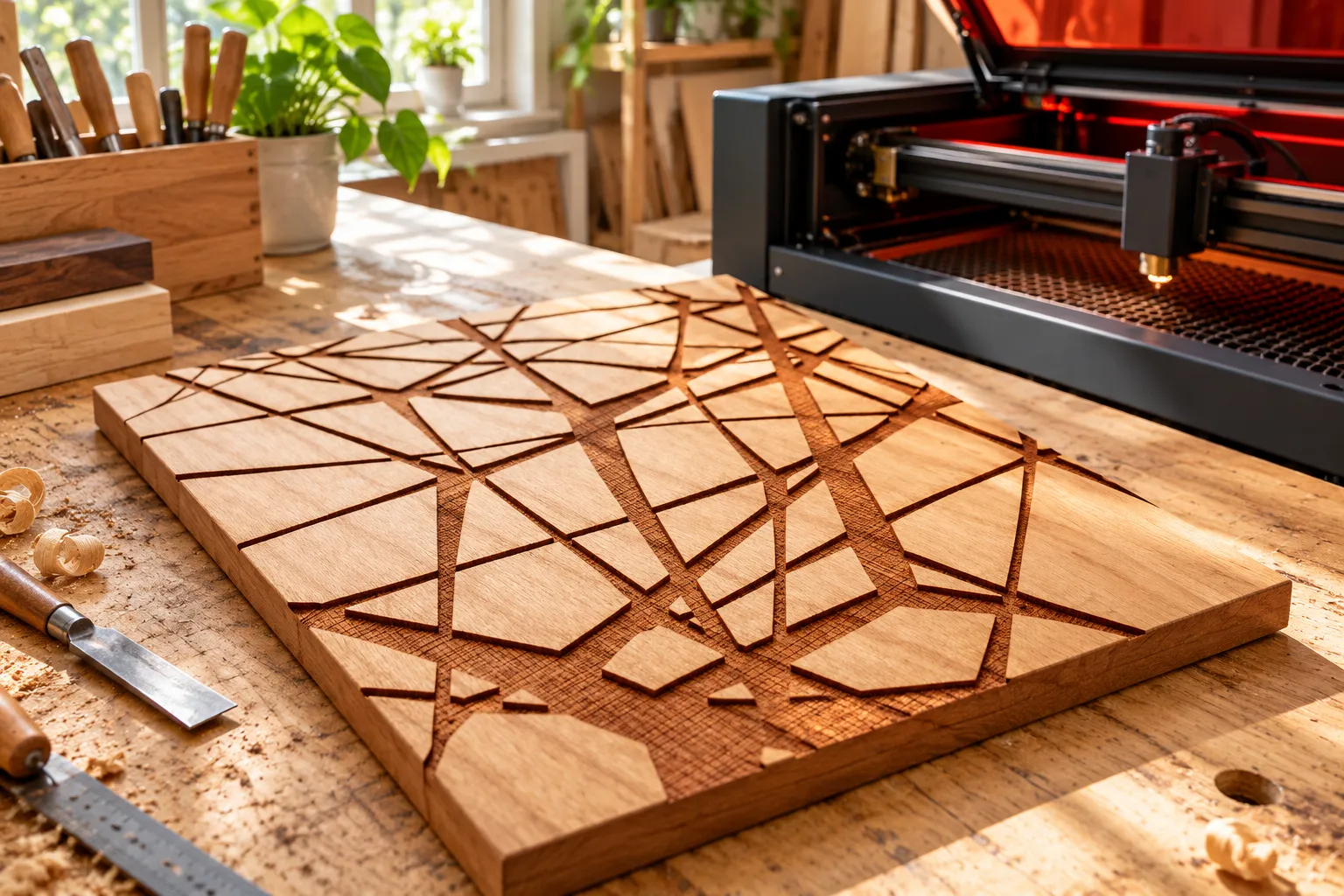
Solid wood and veneered wood
Thin, untreated natural wood generally cuts well on a laser machine designed for wood. However, the result varies with several characteristics of the board: species, density, moisture content, grain direction, knots, and resin. Certain species are preferable, such as lime (linden), balsa, and poplar.
- Textes et logos : la gravure laser sur bois reproduit des inscriptions et des motifs détaillés.
- Contraste : il dépend notamment de l’essence, du fil, de la finition et de l’humidité.
- Bois plaqué : sa composition doit être vérifiée avant toute découpe.
For veneered or coated materials, Thermoflan recommends checking the composition of the glues and coatings. A visible reaction under the beam does not prove that the fumes produced are compatible with the installed filtration.
Plywood and ply uniformity
Cutting plywood depends on its plies, its glues, and any internal defects. Two panels of the same nominal thickness may therefore require different settings. Always record the reference and batch of each panel tested.
On thin plywood, check cut continuity, delamination, charring, and the condition of the edge. As thickness increases, other criteria come into play: depth of focus, fume extraction, number of passes, and edge taper.
MDF, glues, and coatings
MDF, or medium-density fiberboard, may be suitable for certain cuts if the specific grade is approved for the machine. Its binders, however, produce fumes and residues that can foul the optics.
Thermoflan advises against cutting MDF thicker than 6 mm: the result becomes very burnt and the process produces a lot of smoke. In practice, reserve laser cutting for thin panels of this material.
Thermoflan also advises against cutting mass-dyed MDF, a restriction noted among its wood cutting and engraving solutions. More broadly, refuse any panel of unknown composition that is judged on its appearance alone.
Which criteria should you compare before buying?
Once the source and materials are identified, the comparison focuses on three points: format, actual cut quality, and control. These criteria should be checked on the technical datasheet, then on your own parts.
Work area and configuration
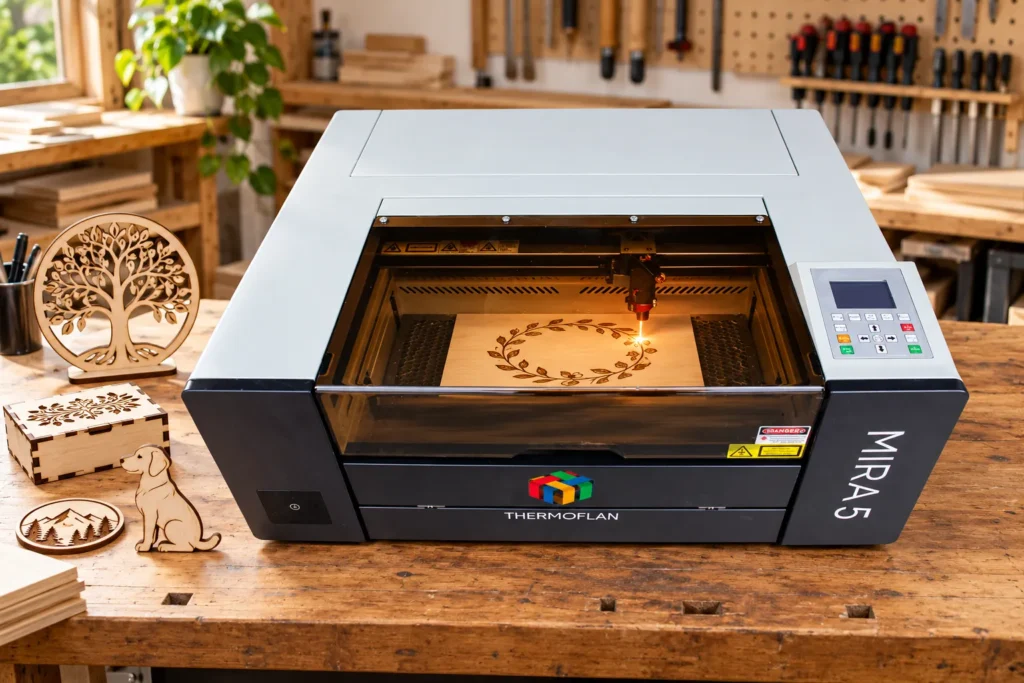
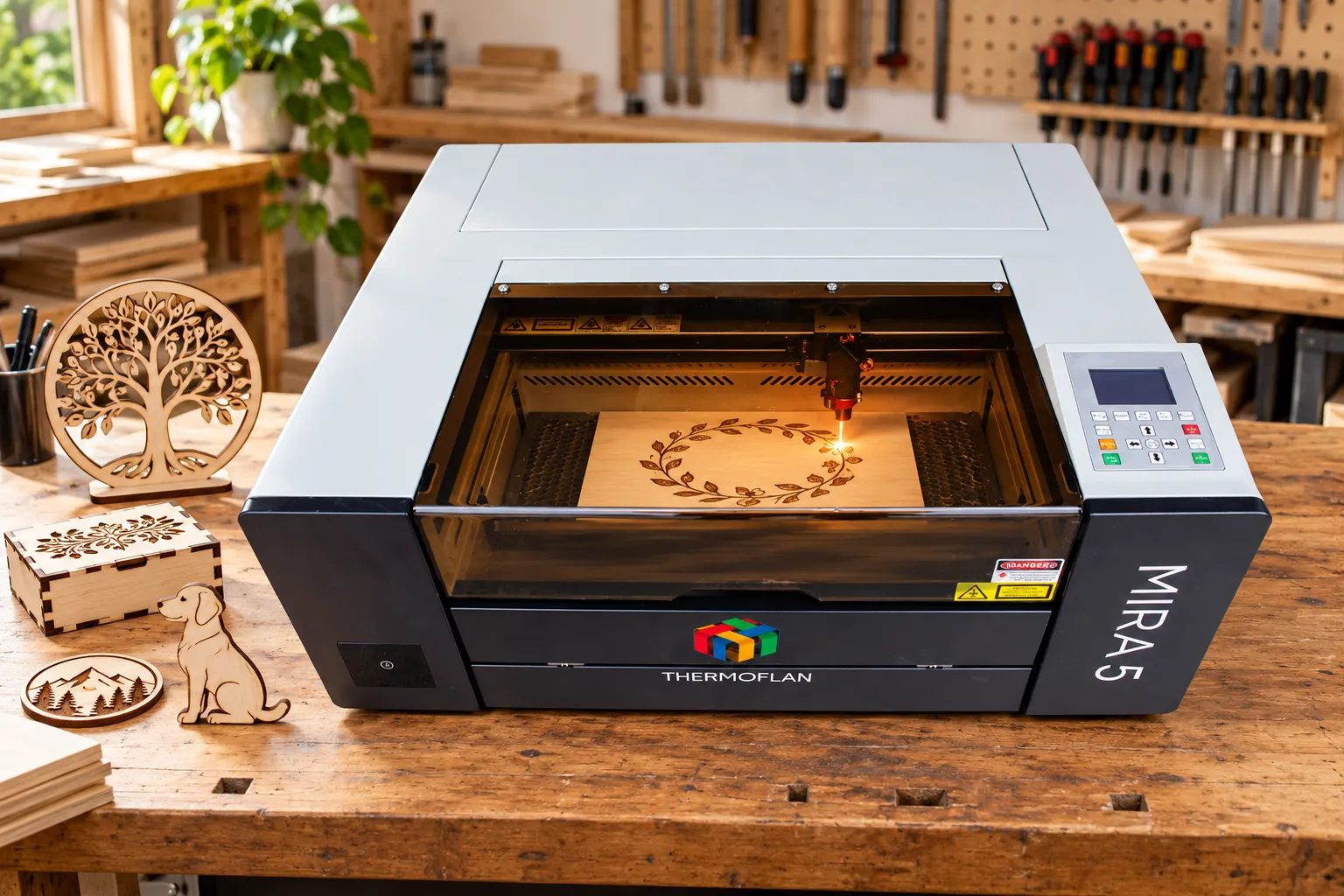
The usable work area should be chosen based on the dimensions of the parts and how they are laid out on the bed, not the machine’s external footprint. Thermoflan offers formats ranging from 450 × 300 mm to 1,600 × 1,000 mm. Its Mira 5, a compact laser cutter and CO₂ laser engraver, has a work area of 500 × 300 mm. Its usable height ranges from 0 to 120 mm.
Depending on its configuration, a laser engraving machine can accept several accessories: an adjustable table, a camera, a rotary axis, or pass-through doors. Check their compatibility with the planned parts before approving the quote.
Cut quality and useful precision
A high advertised positioning precision does not guarantee the tolerance of a finished part. Mechanical play, calibration, focus, kerf width, and wood distortion also play a role. To assess a cut, measure the kerf width and check its consistency, the squareness of the edge, the taper, and the burn marks on the faces.
Similarly, the maximum engraving speed of a laser engraver does not represent the time for a production run. Preparation, acceleration, adjustments, loading and unloading all add to the head’s travel time.
Software and tests on your parts
Drawing software alone is not enough to control a laser CNC. File formats, the controller and the cutting parameters must be compatible, particularly with a DSP controller, meaning a dedicated control board.
The purchase test must use the exact reference and batch of the intended panel. Then record several items: measured thickness, power, speed, focus, air assist and total machine time.
In addition, a file supplied by the buyer makes it possible to qualify a laser CNC for wood on the precision of its joints and its repeatability over several cycles. Timing then separates preparation, cutting, rework and unloading.
What equipment and obligations apply in the workshop?
A CO₂ cutter requires its fume extraction, cooling and safety instructions. This equipment determines cut quality as much as workshop compliance.
Fume extraction and air assist
Air assist removes combustion products at the cutting point. It reduces the risk of ignition without eliminating it. Fume extraction, meanwhile, must be sized for the machine, the ducts and the filters. Aeon laser machines come standard with air assist and fume extraction (blower).
Check the airflow at the connection, the pressure losses, clogging and the exhaust method. Contrary to a common belief, a saw dust extractor is not necessarily suitable for laser fumes. Particulate filtration alone also does not ensure control of gaseous compounds.
Cooling, monitoring and maintenance
Cooling keeps the source within its prescribed operating conditions. For a water-cooled CO₂ tube, check the circuit’s capacity, its temperatures, its alarms and its protection against loss of flow. On an enclosed machine, the interlocks must remain operational, but the cover does not eliminate the fire risk or emissions.
Wood cutting must therefore never be left unattended. Before each use, check safety devices, extraction and cleanliness. A dirty lens, a misaligned beam or insufficient extraction degrades the cut and can increase risks.
Compliance and occupational exposure
Before commissioning, request the EC declaration of conformity for the exact model, its laser class, its guards and its manual in French. The standard NF EN 60825-1 covers the classification of laser equipment, and the Order of 1 March 2016 on artificial optical radiation refers to it for assessing optical risks. Articles R. 4452-1 to R. 4452-31 of the Labour Code require this assessment. Regulation (EU) 2023/1230 on machinery applies from 20 January 2027.
According to Article R. 4412-149 of the Labour Code, the occupational exposure limit value for wood dust is 1 mg/m³ over 8 hours. INRS indicates that an accredited body must measure it at least once a year. A new measurement is required after any change likely to affect health.
How much does a laser wood cutting machine cost?
The budget for a laser wood cutting machine breaks down into three levels: the advertised purchase price, the equipment and services in the quote, then the operating cost. Each should be compared separately.
Purchase price and scope of the displayed prices
CO₂ machines generally range from €5,000 to €30,000 and more, an indicative range that does not replace a quote. Some professional models of 130 to 150 W start around €10,000 to €16,000 depending on configuration. More fully equipped systems can exceed €25,000. Thermoflan also lists the compact Mira 5 laser cutter from €5,840, without specifying the corresponding configuration.
Equipment and services to be quoted
There is no single national price for a complete CO₂ workshop. The price varies with optical power, working area, mechanics, optics, safety, software and automation. Therefore, request an itemized quote for each item.
- Machine et accessoires nécessaires : source, table, options indispensables à vos pièces.
- Extraction et refroidissement : captage dimensionné et circuit adapté à la source.
- Transport, installation, mise en service et maintenance : prestations souvent chiffrées à part.
In metropolitan France, the standard VAT rate is 20% for the operations concerned. For a VAT-registered company entitled to deduction, this recoverable VAT is not necessarily a final cost.
Operating cost and cost per part
The operating cost of a laser cutting machine covers filters, lenses, mirrors, source, energy and pneumatic assist. Operator time, scrap, rework and production stoppages must be added.
These items come down to the cost per compliant part, which includes actual cycle time and scrap. An isolated hourly machine rate can mask productivity differences between two models.
For an SME, the comparison may cover 3 to 5 years, based on dated quotes and an explicit usage scenario. However, the announced service life of a tube or filter is not a guarantee under real workshop conditions.
CO₂ lasers for wood cutting
Formats from 450 × 300 mm to 1,600 × 1,000 mm for cutting solid wood, plywood and MDF. Ask the Thermoflan experts for advice.

Frequently asked questions
Is there financial aid available to fund wood dust extraction?
Yes, subject to conditions. The French Health Insurance Occupational Risks body (Assurance Maladie : Risques professionnels) indicates that for certain wood dust extraction aids, 70% of eligible expenses excluding VAT are covered. The grant ranges from a minimum of €500 to a maximum of €25,000. Check your eligibility, as well as the preliminary audit required for certain applications.
How do you validate a new batch of panels before cutting them in production?
Keep the batch technical data sheet and measure the thickness at several points. Then check the adhesives and coatings, and test a sample. Finally, record the validated parameters for each material and each machine.