






View all news
Pre-inked stamps
From: 7090 €
Pre-inked stamps represent one of the most technically demanding marking processes, requiring great precision at every stage of curing and production.
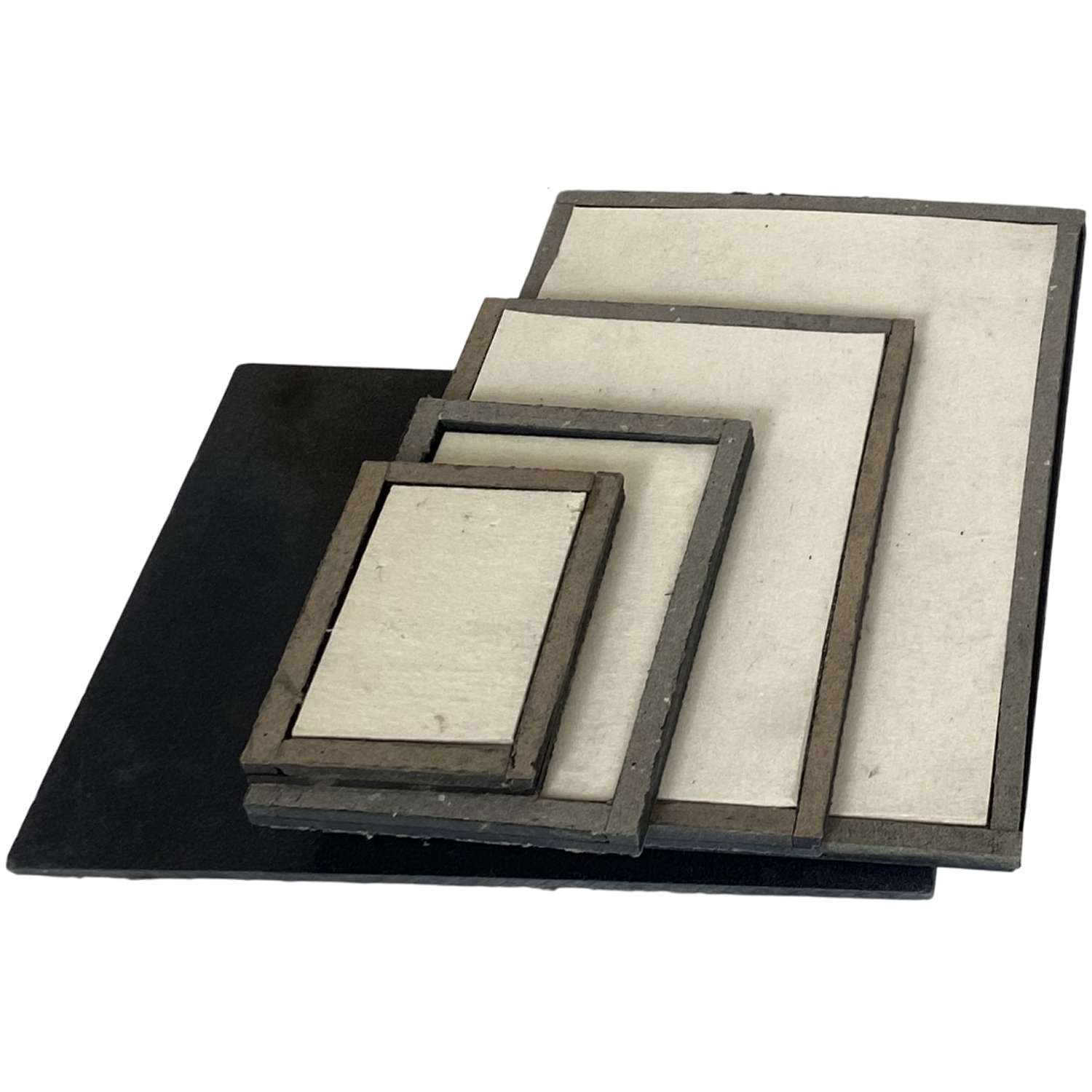
To make this easier, Thermoflan has developed the “framed matrix board” — an innovative solution that streamlines production while delivering exceptional quality and consistency.
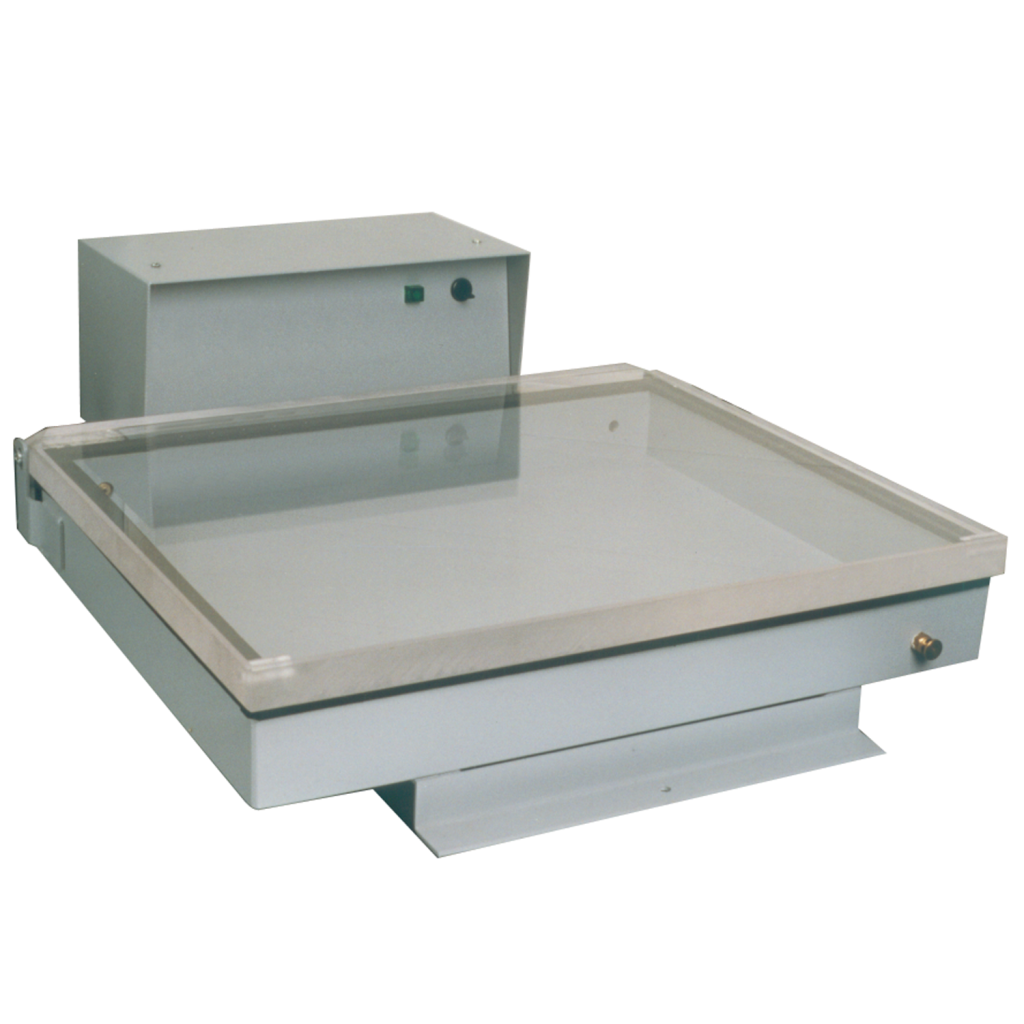
Paired with our high-precision manufacturing equipment, designed and assembled in-house, it enables you to create sharp, long-lasting, and exclusive stamps.
Explore our full range of products for pre-inked stamp making : positive and negative films, developers, fixers, hard photopolymers, Framed matrix board, matrix boards for preinked stamp production, premix gel, and release agent.
Number of colours:
Single color
Shape:
Relatively flat shape
Quantity:
Single
Materials:
Technical sheet
Production step — Products available from us :
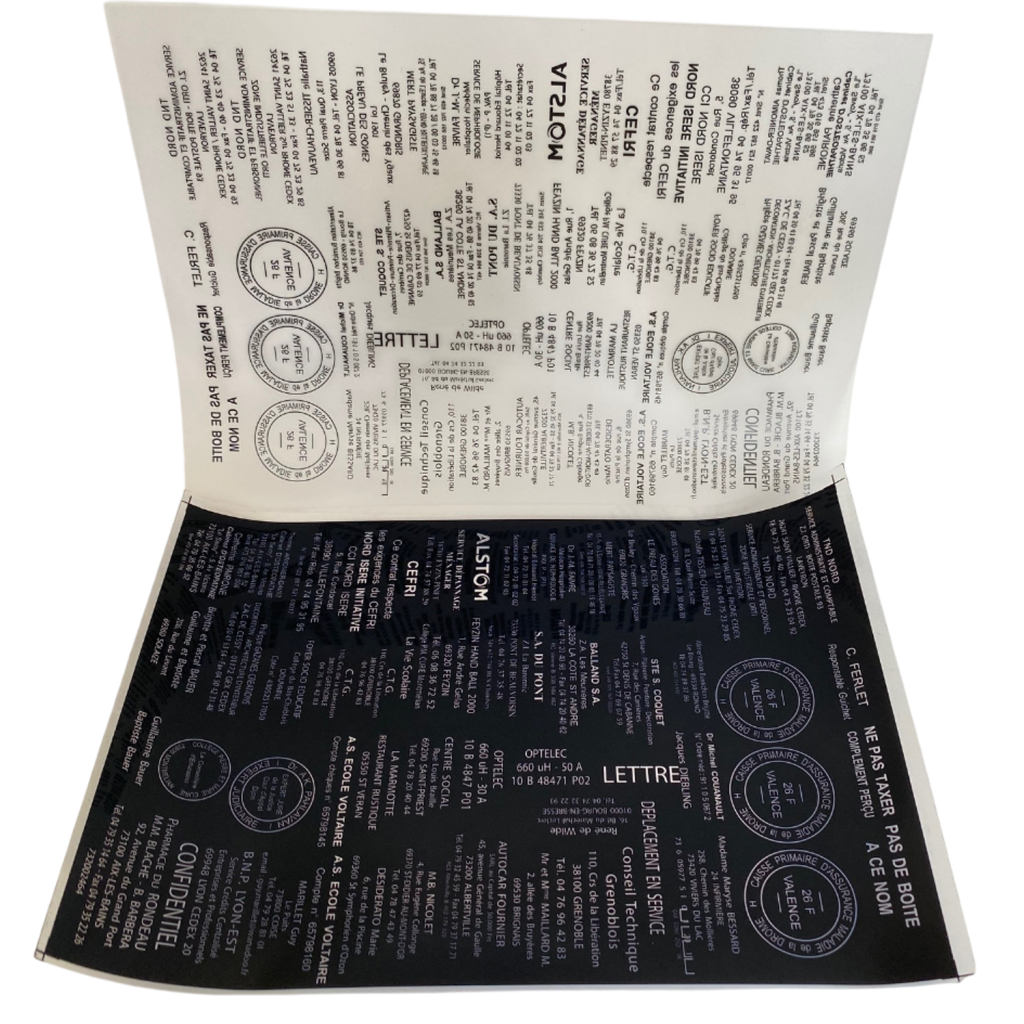
• Positive film
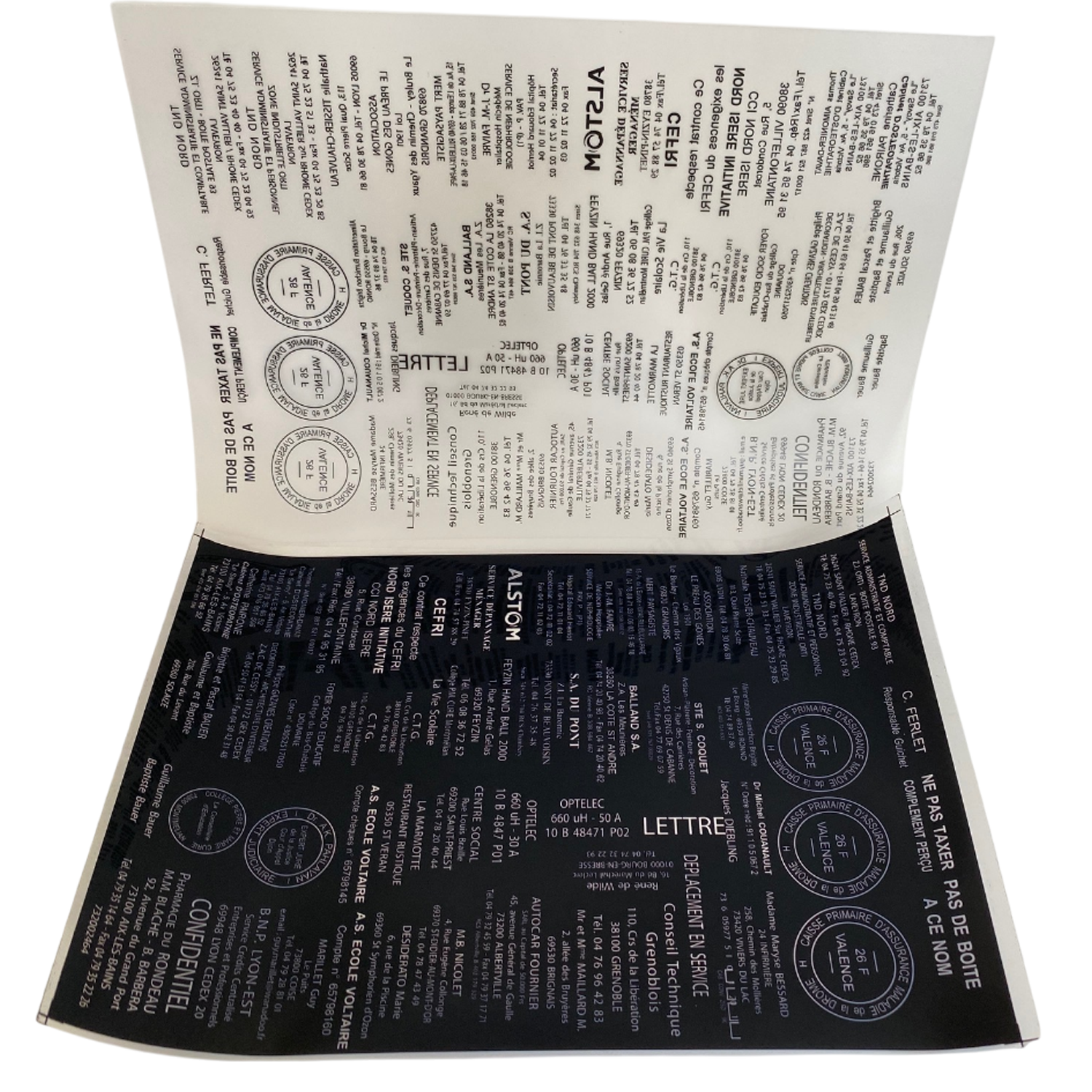
Medium used to create the positive image. It can be printed with either a laser or inkjet printer.
• Negative film
A “daylight” film is exposed through the positive in the Thermogravor’s exposure area.
After exposure, it is processed in a developer bath, then fixed in a fixer bath to produce the final negative film.
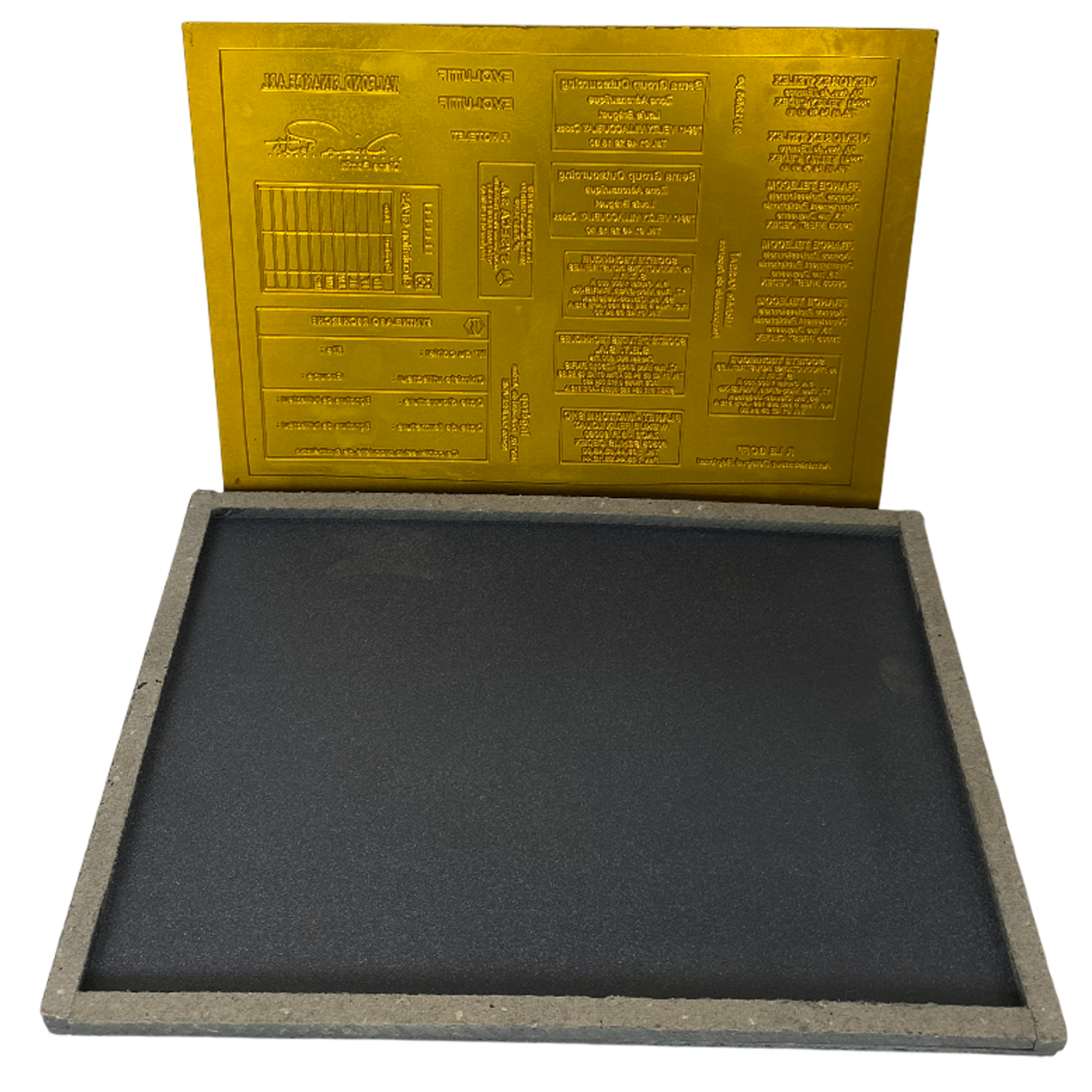
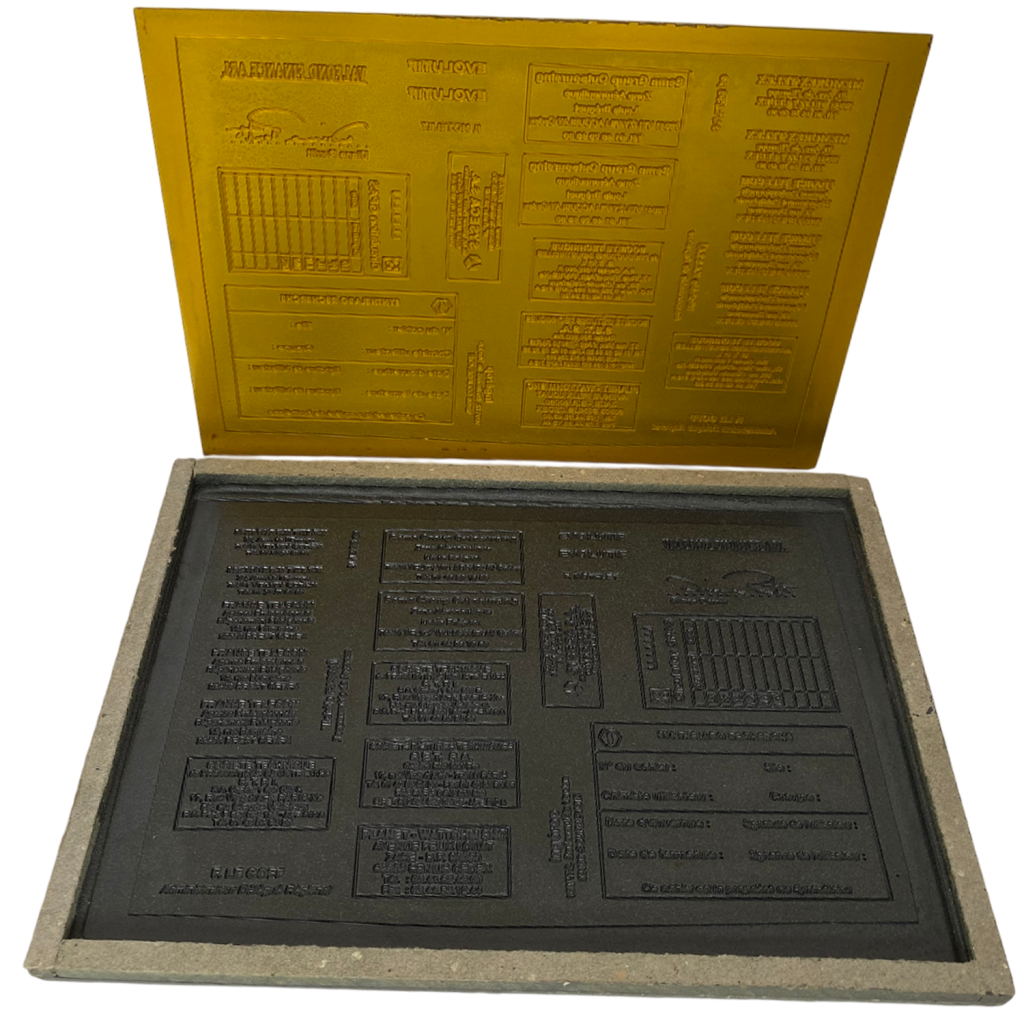
• Hard photopolymer
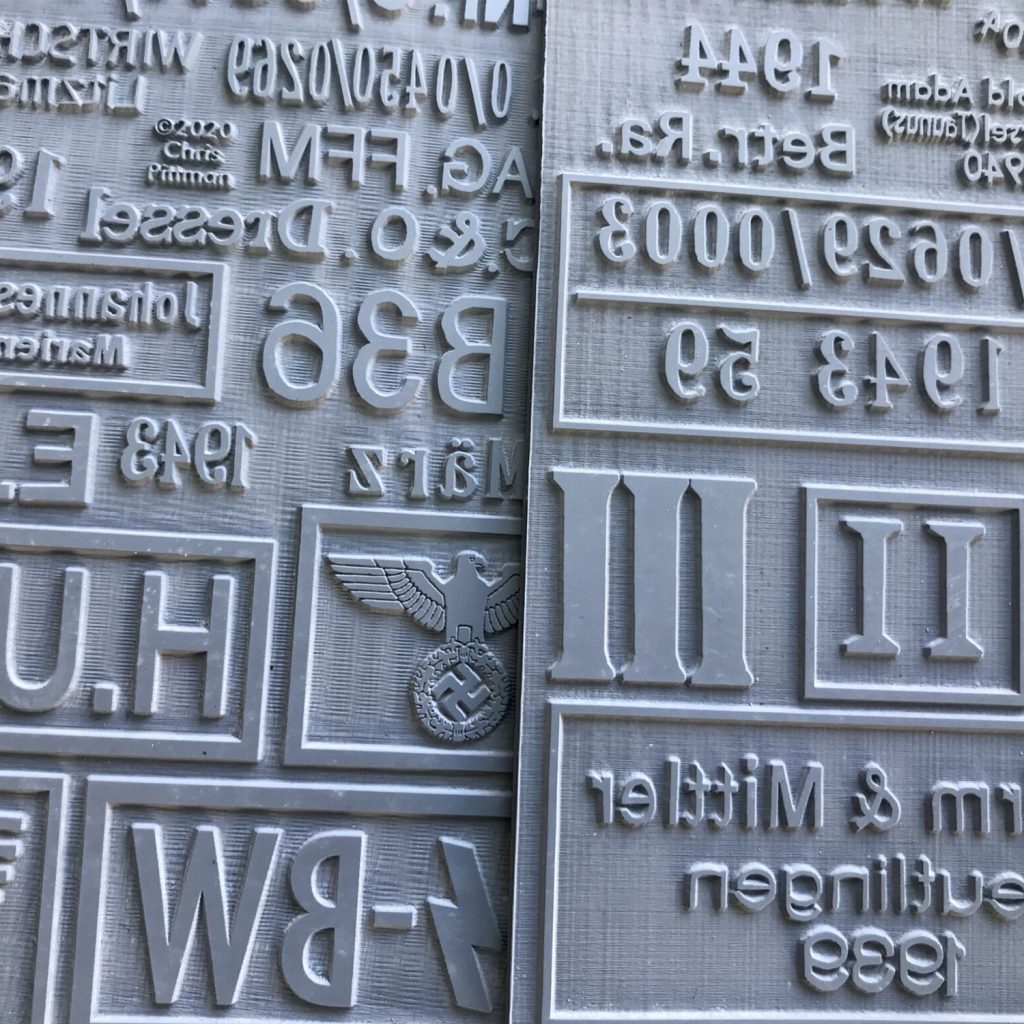
It is a photosensitive relief plate pressed into the matrix board to produce a die (depth).
The plate is UV-exposed through the negative film in the upper section of the Thermogravor machine : exposed areas harden and become etch-resistant , while unexposed areas are brushed away.
The plate is then dried and post-exposed again for increased hardness.
The thickness of the resulting relief defines the character height of the finished stamp.
• Release agent
Product sprayed onto the photopolymer plate to facilitate its separation from the matrix board after molding.
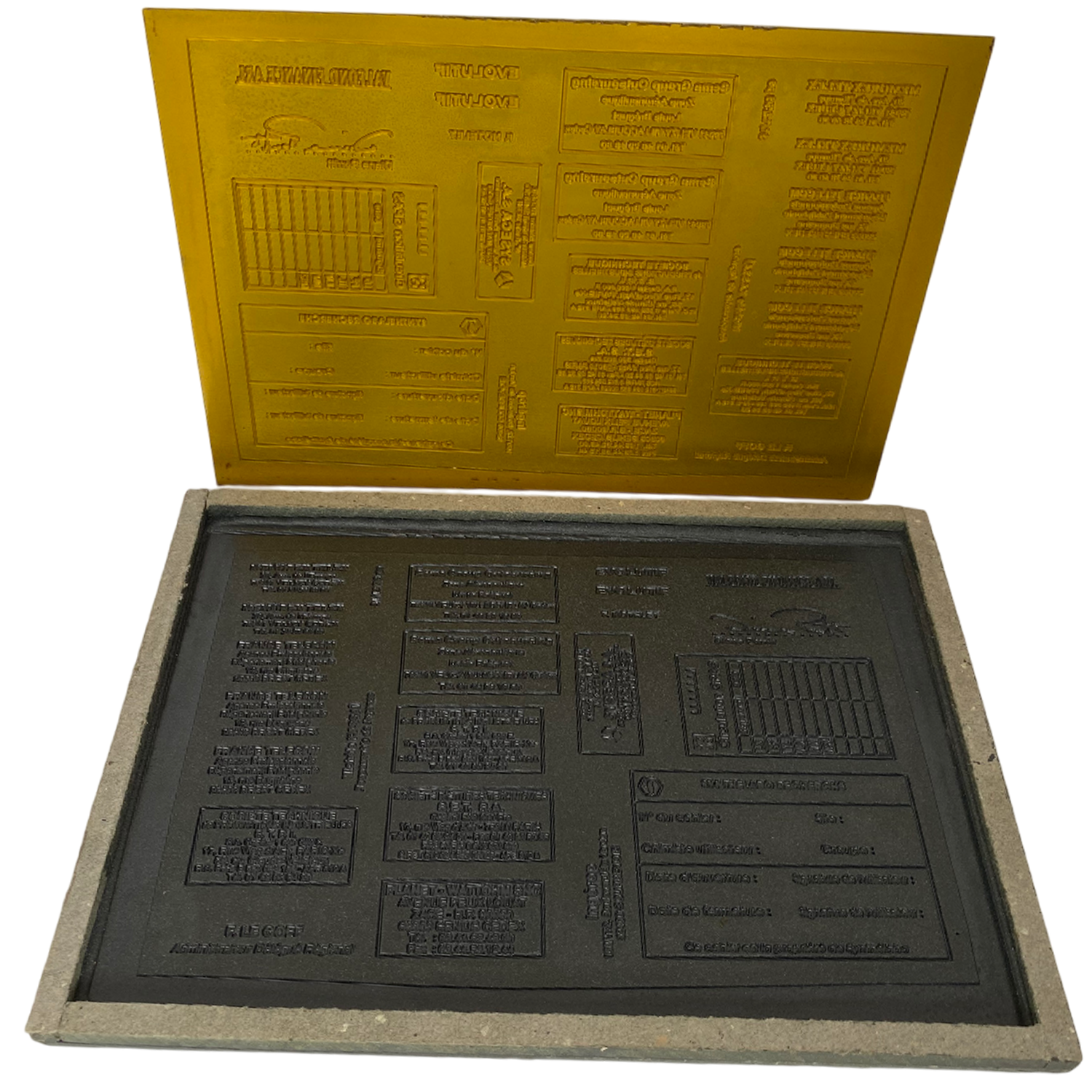
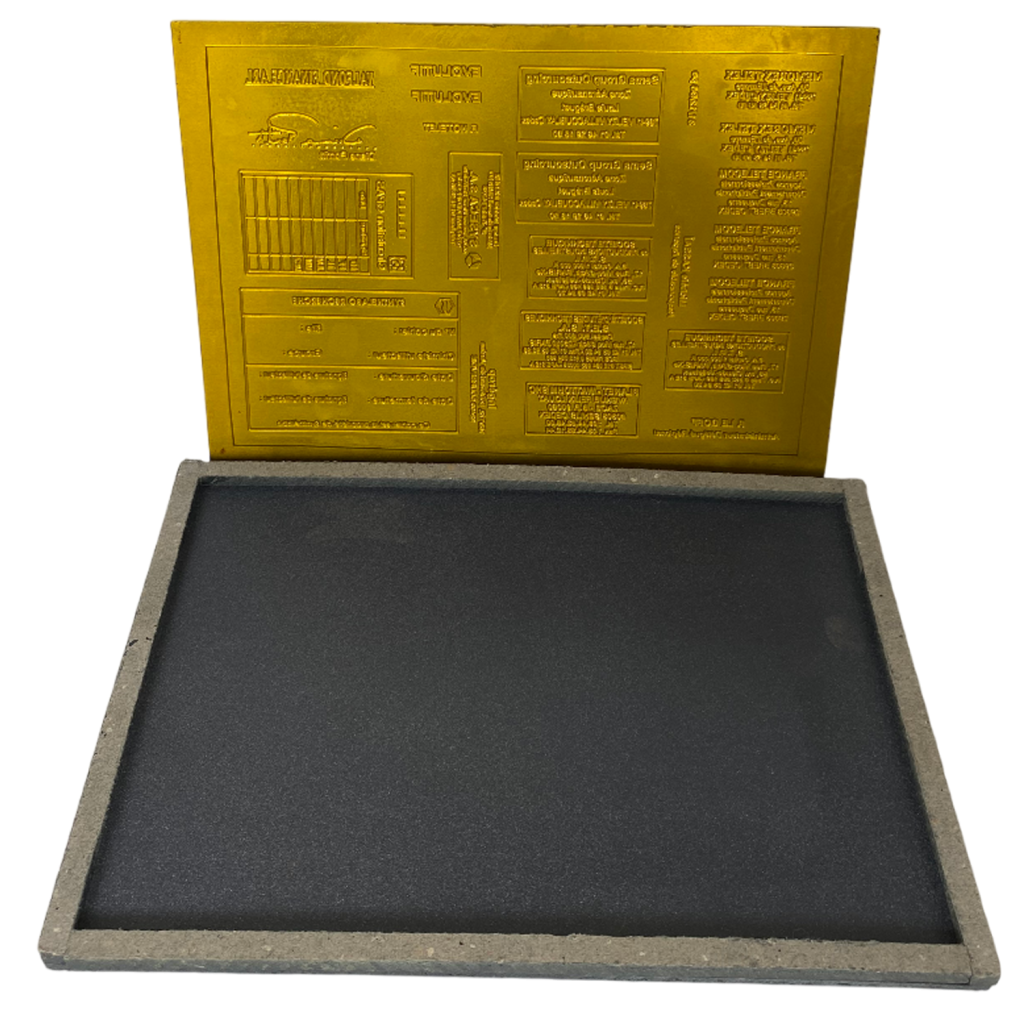
• Framed matrix board
Consists of a pre-inked type matrix board surrounded by a frame in which the photopolymer is pressed to produce a die.
The matrix board is softened at high temperature, then the photopolymer is pressed into it using a moulding press.
The framed matrix board features a border to hold the premix when it is poured into the matrix.
After curing , you obtain the hollow matrix used for premix gelation.
• Premix
The premix gel is poured into the framed matrix board , filling the recesses of the matrix.
It consists of ink micro-capsules that break open under pressure from the user, releasing ink onto the paper surface.
The felt placed behind ink acts as a reservoir, continuously refilling the capsules.
Features:
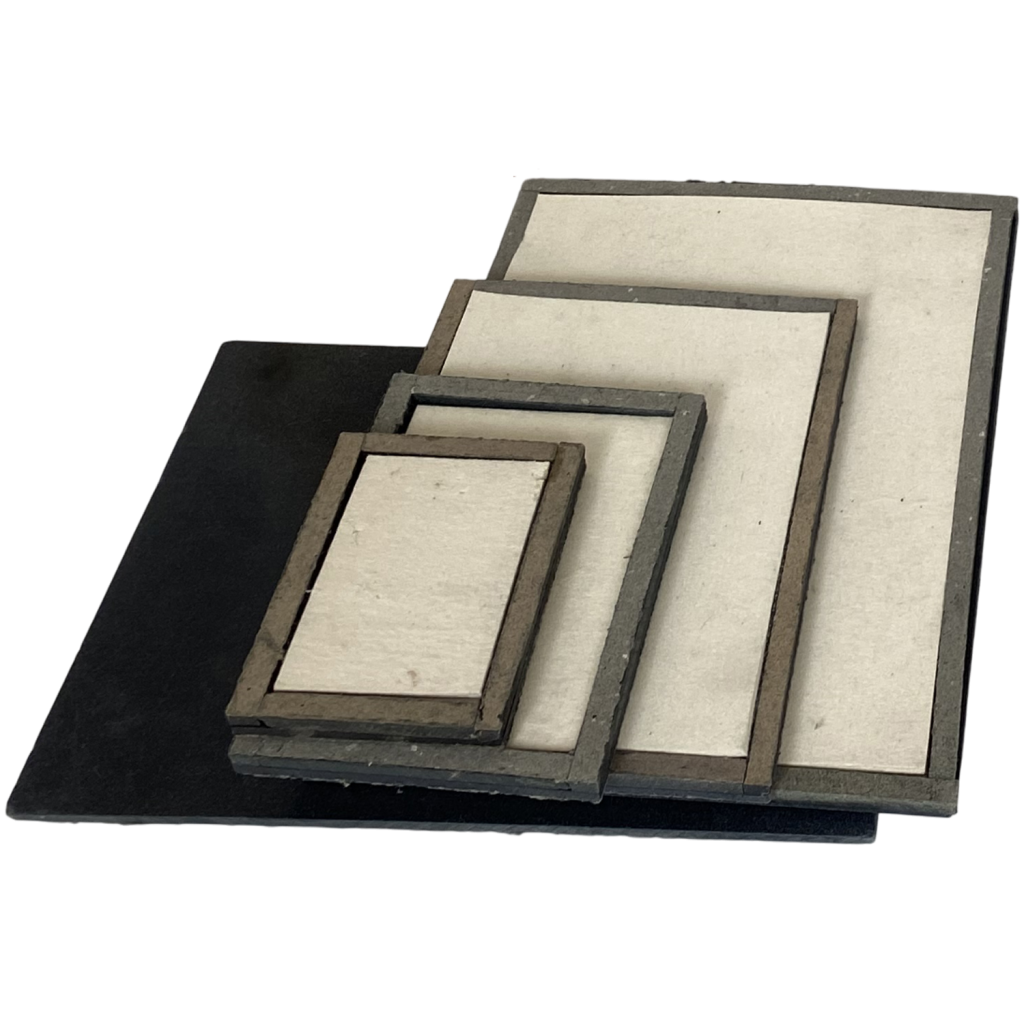
Framed matrix board
Developed and patented by our company, the framed matrix board consists of:
– A thermosetting plate designed to receive, after proper preheating, the photopolymer pattern without damaging the characters.
– A frame, polycondensed with the matrix board, ensuring perfect ink calibration during molding.
Key advantages include:
– No need for costly aluminum or steel moulding frames
– No cooling plate required
– Lower initial investment
– No need for frame cleaning — the frame matrix board is simply disposed of after use
– A flexible process with a range of available formats: A4, A5, A6, A7, and A8
Felt
The gel (premix) is applied into the characters of the matrix, then covered by the felt.
The felt serves as ink reservoir: when pressure is applied, it becomes saturated with ink and fills the gel capsules embedded in the characters.
Available in A4, A5, A6, A7, and A8 formats.
Positive film and daylight film
Daylight film is a photosensitive film that reacts to UV light, allowing the production of a negative film through a positive film (tracing paper) printed on an inkjet or laser printer.
The negative is exposed in the Thermogravor photopolymer machine and then developed (developer) and fixed (fixer) in trays.
Positive and daylight films are available in A4 format in packs of 100.
Hard photopolymer
Hard photopolymer is a photosensitive relief plate that, when pressed into a matrix board, creates hollow characters.
It is UV processed through a negative film. The areas exposed to UV light resist water development and form the plate’s relief, while unexposed areas are brushed away.
The thickness of this relief determines the final character height of your stamp.
Thickness : 1.52 – water processed.
Size : A4 — 20 plates per pack.
Accessories available with this product


FAQ on Pre-inked stamps
What is a Marking Stamp?
A marking stamp, also known as a seal or rubber stamp, is a manual or automatic instrument used to mark and print a pattern on various types of media.
Its flexibility of use allows it to effectively meet two major areas of application:
Administrative and professional context
- Authentication of official documents (company seal).
- Dating documents (date stamps).
- Repetitive notations in accounting, secretarial, or logistics work.
- Cancellation and document tracking.
Creative and hobby context
- Used in stationery and scrapbooking.
- Decoration of invitations and greeting cards.
- Packaging and label customization.
- Creation of unique and decorative materials.
A traditional stamp consists of three essential elements that ensure its operation:
- The ink pad: a felt pad or cartridge soaked in ink.
- The die (or impression): the engraved relief part containing the text or logo, made of rubber or polymer resin.
- The mount (or handle): an ergonomic support ensuring grip and marking pressure.
Choosing the right ink depends primarily on the material to be marked and the conditions of use:
- Standard inks for paper.
- Fast-drying or alcohol-based inks for non-porous surfaces (plastic, metal, glass).
- Specific inks for textiles, resistant to washing.
- Technical inks for industrial applications or demanding outdoor conditions.
How does a Marking Stamp work?
A marking stamp allows ink to be transferred onto a substrate to reproduce text, a logo, a number, or any other visual quickly and repeatably.
Regardless of the system used, the principle remains the same: a pattern is loaded with ink and then applied by pressure onto the surface to be marked.
A stamp marking system generally relies on three essential elements:
- The pattern carrier
This is the element that contains the visual to be reproduced (text, logo, numbering, symbol, etc.). - The inking system
It provides ink to the pattern before each impression. Depending on the technology used, the ink can be integrated directly into the stamp or applied via a separate ink pad. - The application mechanism
It ensures contact between the stamp and the substrate to obtain a clean and consistent marking.
Depending on production needs and the substrates to be marked, there are several marker stamp technologies available :
- Rubber
- Photopolymer resin
- Pre-inked version
Operation of the different types of stamps:
Rubber or photopolymer resin stamps
- The stamp is impregnated with the ink contained in the ink pad
- It is then applied to the substrate to be marked to transfer the ink
- A new ink application is required for each impression
Pre-inked stamps
- The ink is integrated directly into the material
- It is stored in a microporous structure composed of ink microcapsules
- Marking is performed without prior external inking
How is a stamp manufactured?
Manufacturing a rubber stamp involves creating a surface capable of reproducing a visual (text, logo, number, or symbol) and then integrating it into an inking system.
The manufacturing process takes place in 4 steps and applies equally to resin stamps, traditional rubber stamps, and pre-inked models.
- Graphic design
Texts, logos, and layouts are created or adjusted on a computer using DTP software to prepare the final visual. - Negative exposure
The visual is printed on a high-density transparent film to create a perfect negative.
The areas intended for marking remain transparent while the background becomes completely black and opaque. - Creating the relief (the cliché)
The negative film is exposed to UV rays in an exposure machine.
The light passes through the transparent areas and hardens the photosensitive material.
This results in:
– either the final stamp directly (in the case of resin stamps);
– or a relief cliché (hard photopolymer) serving as a master template. - Final molding (for rubber and pre-inked)
The relief cliché is hot-pressed into a matrix to create a reusable recessed mold.
This matrix then allows for:
– pressing and vulcanizing traditional rubber;
– or gelling the specific ink used to manufacture pre-inked stamps.
What equipment is required for the manufacturing of pre-inked stamps?
The manufacturing of a pre-inked stamp is one of the most technical processes on the market. It requires high-precision equipment as well as rigorous control of temperatures and cycle times. The process takes place in three main stages.
Creation of the matrix (photopolymer phase)
This first step consists of preparing the design to be reproduced. It uses a process similar to that of traditional rubber stamps.
- Film production: creation of the negative film in daylight
- Photopolymer machine (Thermogravor range): exposure allowing the creation of the hard photopolymer imprint
Molding of the recessed imprint
Once the photopolymer has hardened, it is molded to create the matrix intended to receive the pre-inked gel.
- Use of specific blanks: classic pre-inked blanks or the frame blank innovation
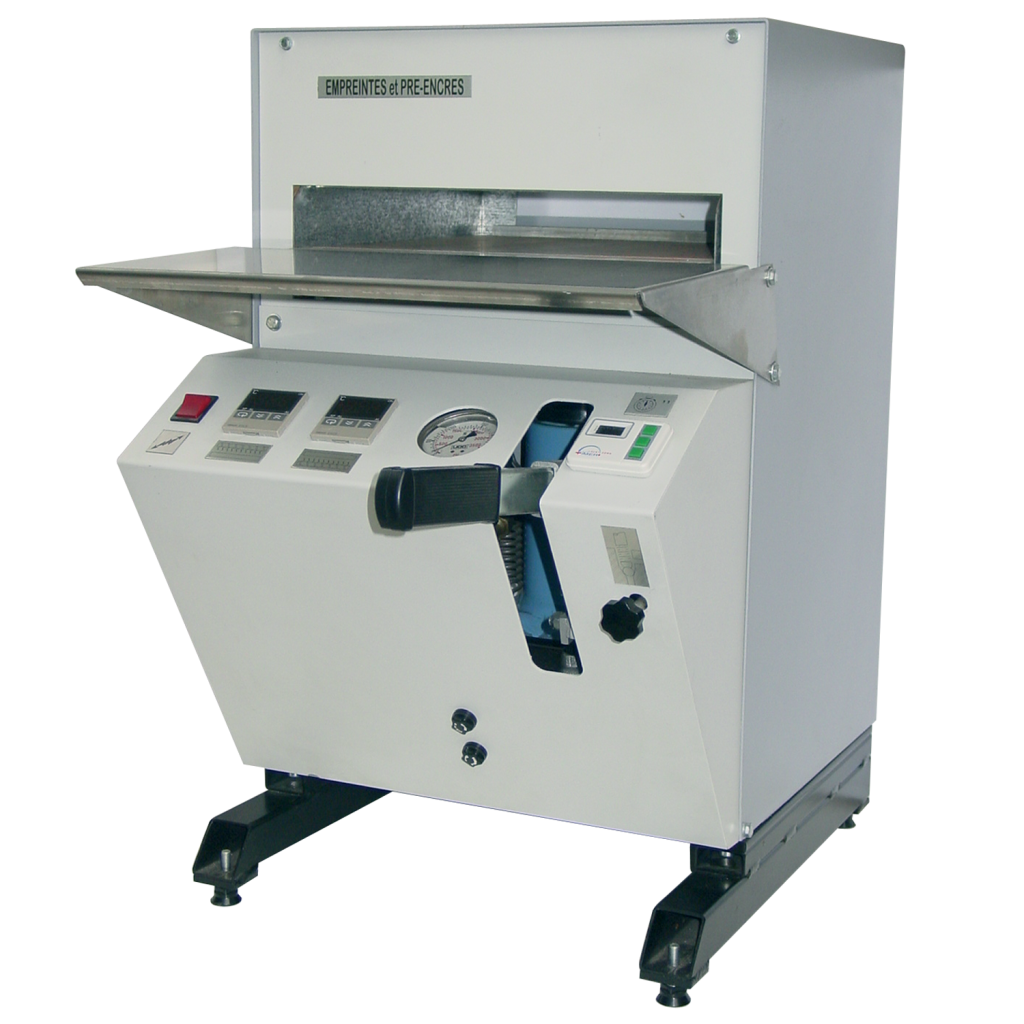
- Impression press: operation performed under pressure using an automatic press or a model such as the PEVP A4
Curing and gelation (critical step)
This final phase consists of curing the pre-inked gel to set the ink into the heart of the stamp.
- High thermal regulation curing press
- Precise temperature control (to the exact degree)
- Homogeneous distribution of heat across all plates
The expertise of Thermoflan presses guarantees this thermal homogeneity. This mastery is essential to ensure optimal curing of the gel and to obtain durable, premium-quality stamps.
What is a pre-inked stamp?
What is the difference between a self-inking stamp and a pre-inked stamp?
Although both systems are automated, they rely on entirely different printing technologies and mechanisms.
The self-inking stamp (The classic system)
The self-inking stamp uses a mechanical system visible with every mark:
- Rotation operation: The die rests against an ink pad initially. When pressed, the mechanism rotates the die to mark the document. The stamp is thus re-inked with every use.
- Maintenance: When the ink runs out or the pad is worn, it is necessary to replace the removable ink cartridge.
The pre-inked stamp (Premium technology)
The pre-inked stamp eliminates any rotation mechanism and integrates the ink directly into its structure:
- Gel-based ink operation: It does not have a conventional cartridge. The text or logo is formed in a gelled ink that releases the marking with simple direct pressure, without noise or mechanical friction.
- Successive impressions: This technology allows you to perform 4 to 5 markings in a row quickly. After a short resting period, the internal reservoir automatically recharges the gel with ink.
- Quality and precision: The process offers superior marking finesse and ideal sharpness for complex logos or small characters.
- Intensity adjustment: The mount is equipped with a pressure adjustment system that allows the print density to be customized (to obtain a lighter or darker rendering depending on the substrate).
- Record durability: A properly manufactured model can ensure up to approximately 50,000 impressions before depletion, which is a significantly longer lifespan than traditional systems.
How is the frame blank innovative in the manufacturing of pre-inked stamps?
Patented at the time of its market launch, the frame blank simplified the manufacturing of pre-inked stamps by eliminating several intermediate operations and reducing production times. Its principle is based on the direct integration of functions previously performed with multiple separate components.
Innovations of the frame blank
- Direct frame integration The frame is integrated directly into the blank. This design eliminates the use of aluminum chassis, which reduces handling, simplifies workshop organization, and limits accessory storage.
- Elimination of cleaning operations The absence of chassis to recover eliminates the need for solvent cleaning steps. The process becomes simpler, faster, and more comfortable on a daily basis.
- Shorter curing cycles The frame blank technology allows for faster gel curing. Manufacturing time is reduced and overall productivity is improved.
- Great format flexibility To adapt to various production needs, the frame blank is available in several standard dimensions: A8 • A7 • A6 • A5 • A4
Pre-inked stamp: what are the advantages and disadvantages compared to other stamps?
The pre-inked stamp stands out from traditional systems due to its unique technology. Here are its main benefits and manufacturing requirements:
The Advantages
- Exceptional longevity (Up to 50,000 impressions): Thanks to its integrated ink system within the material itself, it allows for approximately 50,000 perfect impressions, without any refills or cassette changes. It is the choice for durability.
- Flawless and adjustable print quality: It offers superior sharpness compared to classic stamps. Furthermore, its mount includes a pressure adjustment system that allows for precise control of ink intensity (lighter or darker) based on user preference.
- A high-end, differentiating product: Being more technical and less common on the market than the standard self-inking stamp, the pre-inked stamp represents a high-value offering. It allows you to stand out from the competition by providing a premium product.
The main disadvantage (Manufacturing side)
Rigorous production technicality: Its manufacturing does not tolerate improvisation. The process requires an extremely precise curing time and production equipment equipped with perfect thermal regulation to ensure optimal results.
What is an ink stamp used for?
The 4 main areas of application for ink stamps:
Corporate and administrative field
- A daily tool for companies and administrations for authenticating official documents
- Used on commercial documents: quotes, contracts, delivery slips
- Complements dates and signatures on documents
- Also includes daters and numberers
Scrapbooking and creative stationery
- Used for personalizing handmade creations: albums, announcements, invitations
- Allows for the creation of numerous visual and decorative effects
- Compatible with various accessories: metallic inks, multicolor inks, embossing powders for relief effects
Textile marking
- Used for marking clothing and textiles
- Specific inks resistant to repeated washing
- Good durability over time without degradation of the mark
Industrial and technical solutions
- Meets demanding technical specifications
- UV inks for outdoor resistance and environmental constraints
- Acid inks for etching and traceability (e.g., marking on glass, light bulbs, technical parts)
THERMOFLAN advantages
Over 60 years of experience
Permanent stock
Best quality/price ratio
Technical availability
Ask our experts for advice
How can we help you?